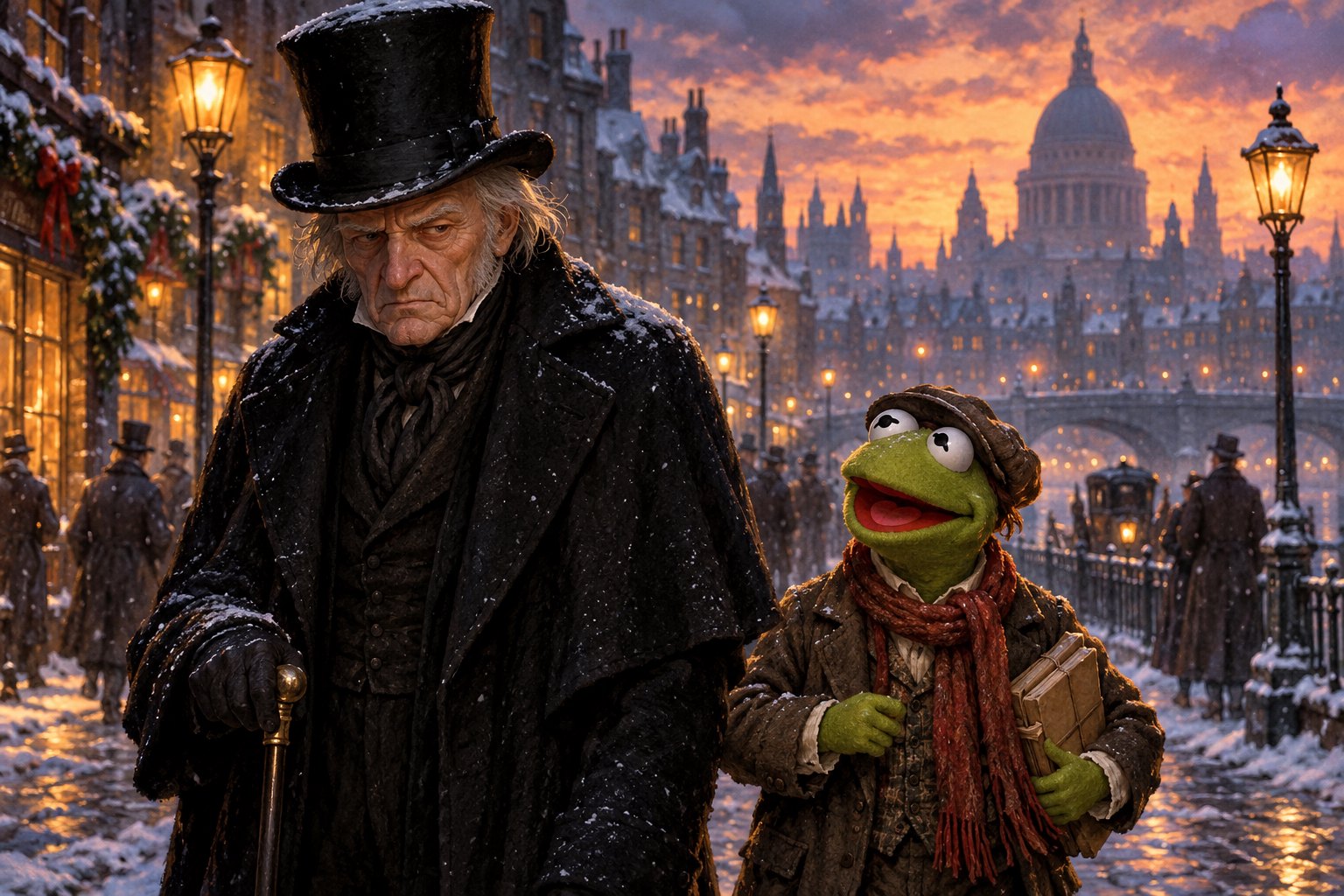
The Muppet Christmas Carol is returning in a different form, without Michael Caine as Ebenezer Scrooge. For anyone attached to the original, that absence raises a question more interesting than whether familiar characters can bring back familiar feelings: how much of the film’s magic depends on the human being standing among them? The reported return makes that distinction newly relevant. [Coverage of the Muppets’ Christmas return](https://www.cinemablend.com/television/walton-goggins-walmart-christmas-ad-muppet-christmas-carol-revival).
My answer is: a great deal. Caine gives the comedy something solid to push against, then makes the story’s grief feel equally substantial. This is a retrospective review of the original film, rather than a verdict on the new incarnation.
Spoilers follow for the original film, including its ending.
Caine makes Scrooge’s authority feel real
Brian Henson’s 1992 film, written by Jerry Juhl, places Caine’s Scrooge inside a London populated by humans and Muppets. Kermit plays Bob Cratchit, Miss Piggy plays Emily Cratchit, and Gonzo takes the role of Charles Dickens. Those central credits are documented in the [American Film Institute’s film entry](https://catalog.afi.com/Catalog/moviedetails/59335).
The casting could have made Scrooge merely the grumpy adult supervising a puppet comedy. Instead, Caine gives him the confidence of someone who assumes his priorities are universal. His upright bearing and clipped delivery suggest a man accustomed to ending conversations rather than participating in them.
“Bah, humbug!” functions as a verbal door slam. Scrooge does not simply dislike celebration; he wants the authority to declare other people’s pleasure worthless. Caine makes that impulse recognizable without making it attractive. The jokes happen around a person whose cruelty has consequences.
That commitment also protects the Muppets. When Scrooge addresses Bob, the scene registers as an employer speaking to an employee. The difference in their physical construction becomes irrelevant to the power imbalance. Caine’s seriousness lets Kermit be a person with something to lose.
Bob and Emily reveal the cost of Scrooge’s worldview
Bob’s warmth can initially look like uncomplicated goodness. Seen from inside his household, however, it becomes a form of work. He must keep family life generous while living with financial pressure and uncertainty. Kermit’s gentleness gives that effort an understated dignity.
Emily supplies a necessary counterweight. Her resistance to Bob’s toast to Scrooge prevents gratitude from becoming an obligation imposed on the people he mistreats. Miss Piggy’s forcefulness is funny, but the anger beneath it is justified. A family need not approve of an employer simply because his wages help put food on the table.
The scene works because both spouses have a defensible position. Bob wants to preserve the holiday’s spirit; Emily refuses to let that spirit erase their circumstances. Their disagreement makes the household more convincing than an arrangement of smiling victims would be.
This is also why character matters more than recognition in family entertainment, a question explored in our look at the character opportunities for PAW Patrol 4. Familiar faces create an invitation. Conflicting needs give viewers a reason to stay.
Belle makes regret more complicated than loneliness
The Ghost of Christmas Past returns Scrooge to his youth, including his relationship with Belle. She leaves when his attachment to money has displaced their shared future. The sequence gives his isolation a history, but it does not make that history an excuse.
From Belle’s perspective, the tragedy is waiting for someone who keeps postponing the life he claims to want. Financial security can sound like a sensible condition for happiness. Scrooge turns it into a condition that can never be satisfied.
Watching his younger self, the older Scrooge encounters a particularly painful kind of helplessness: he now understands an argument he once believed he had won. Caine’s vulnerability matters because the film has already established how carefully this man controls himself.
My reservation is that Belle receives less room to exist beyond the relationship than Scrooge receives to mourn it. Yet her departure remains essential. The film allows her to recognize a broken promise and act on that recognition. His eventual redemption cannot retroactively require her to have waited longer.
Gonzo and Rizzo make room for fear
Gonzo’s literary confidence and Rizzo’s practical anxieties establish two ways of experiencing the story. One wants to tell it properly. The other wants to survive the telling with something left to eat.
“Light the lamp, not the rat!” captures their partnership in miniature. Elevated storytelling collides with a small creature’s immediate physical problem. The line’s place in the film’s comic business is also reflected in this [interactive screening guide](https://static.libnet.info/frontend-images/pdfs/provolibrary/PDFs/Muppet_Christmas_Carol_script.pdf).
These interruptions do more than provide relief. They let viewers move between sympathy and nervous laughter without abandoning either response. Rizzo gives fear a comic vocabulary; Gonzo provides enough narrative confidence to keep the journey moving.
For me, the comedy succeeds because it rarely asks us to despise the story for being earnest. The film can acknowledge its theatrical machinery while remaining committed to what happens inside it. Knowing that someone is telling a story does not make the people in that story disposable.
Tiny Tim turns an abstraction into an absence
The Ghost of Christmas Yet to Come confronts Scrooge with two deaths: his own, largely unmourned, and Tiny Tim’s, which devastates the Cratchits. The contrast exposes the difference between possessing resources and becoming indispensable to someone’s life.
Tim’s vulnerability changes the meaning of the family’s earlier happiness. Their affection was never evidence that they needed nothing. It was evidence of what they were protecting.
That distinction keeps the film’s sentiment from collapsing into the comforting idea that poverty is harmless when people love one another. Love gives the Cratchits a reason to endure. It cannot guarantee their child’s survival.
The dark passage also helps explain why this adaptation belongs in a conversation about ghost stories. As our guide to literary companions for classic horror films explores, changing a story’s form can change how its fear reaches us. Here, familiar comic performers make the possibility of loss more intimate.
The ending asks for more than a better mood
Scrooge’s transformation becomes meaningful when it changes his conduct toward other people. His generosity includes improving Bob’s circumstances, and Tiny Tim survives. The ending connects feeling to action rather than treating tears as sufficient proof of reform.
“God bless us, every one!” offers the film’s broadest invitation. Its generosity is moving because Scrooge has spent so much of the story deciding who deserves consideration. He finally joins a community whose value existed before he recognized it.
That is the deeper achievement of Caine’s performance. He begins as someone who believes he can judge the world from outside it and ends as someone relieved to belong. A return without him can have its own pleasures, but this original establishes a demanding standard: Scrooge must learn to see other people as fully real. Caine makes that discovery feel like the beginning of a life.
Original content by this site's editorial team. Published: October 28, 2026 at 16:07:51 PDT (Los Angeles time)