Thomas Mann returns to Germany in Fatherland with the authority of a celebrated writer and the unresolved obligations of a parent. Paweł Pawlikowski’s drama places those identities beside each other, then asks how comfortably they can coexist. Its most compelling question is personal: what does a daughter need from a father whom everyone else approaches as a cultural institution?
Hanns Zischler plays Mann opposite Sandra Hüller as Erika, with August Diehl as her brother Klaus. The 82-minute film follows a fictionalized journey through postwar Germany in 1949. For viewers drawn to intimate historical drama, its central attraction is that collision between an internationally important visit and a family relationship that public recognition cannot repair. The premise, cast, and running time are confirmed by [Film at Lincoln Center’s program](https://www.filmlinc.org/nyff2026/films/fatherland/).
Spoilers follow for the family tragedy and the film’s closing movement.
A homecoming that cannot restore home
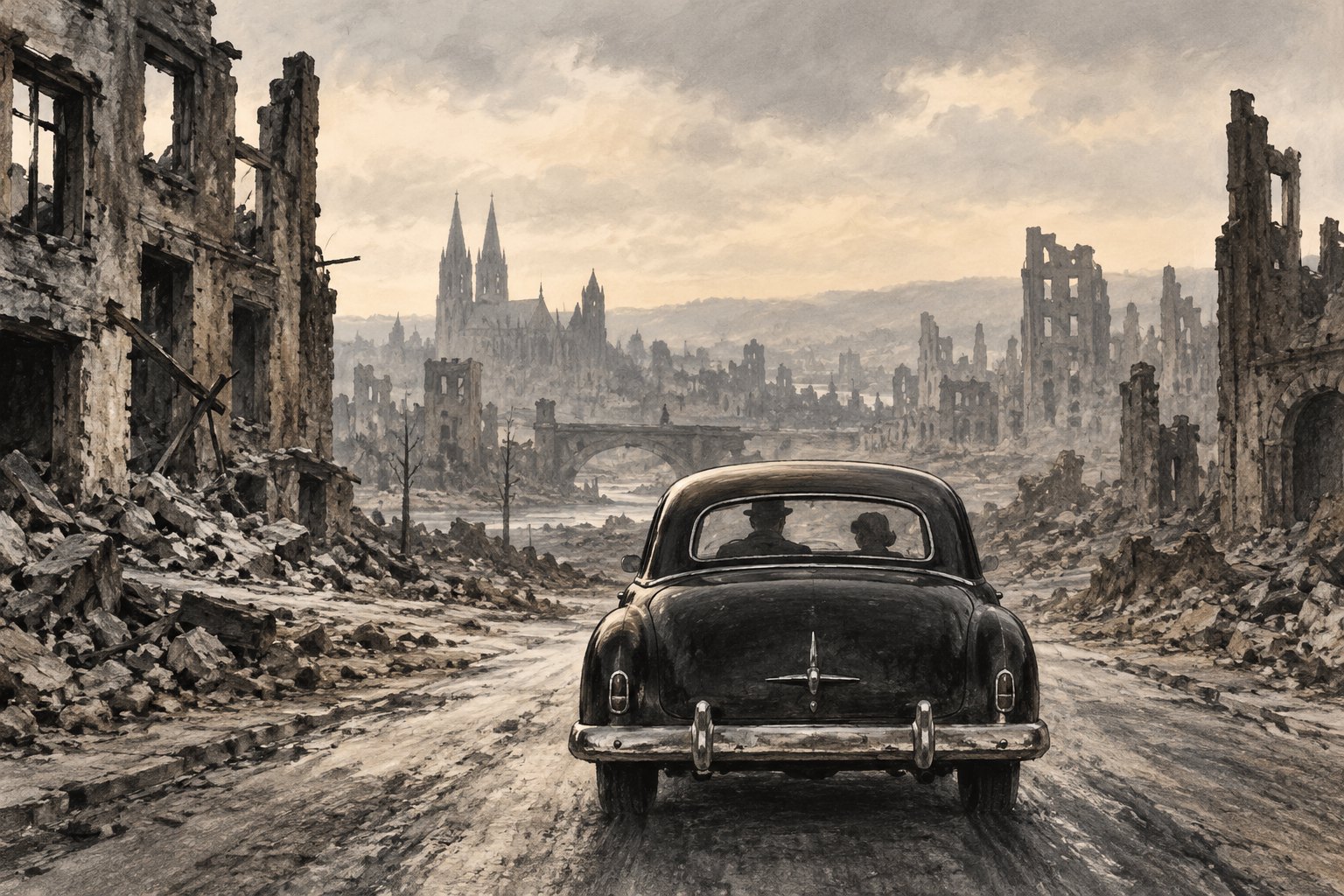
The journey takes Thomas and Erika from Frankfurt to Weimar in a black Buick. The geography matters: traveling between American and Soviet spheres makes every appearance potentially useful to a political narrative. A distinguished visitor can intend to speak about literature while his hosts hear an endorsement.
That gives the road-movie structure an unusually restrictive quality. Movement ordinarily promises freedom; here, arriving somewhere new means encountering another set of expectations. Mann’s reputation travels ahead of him. He can cross a boundary more readily than he can control what his presence signifies.
There is also an essential historical qualification. Pawlikowski explicitly describes taking liberties with events and chronology. In an interview, he explains that Mann was actually in Stockholm when Klaus died; the film brings separate circumstances together. Fatherland should therefore be understood as an interpretation of historical people, rather than a record of their itinerary. [Pawlikowski discusses that distinction in this interview](https://theartsdesk.com/film/theartsdesk-qa-pawel-pawlikowski-personal-and-political-fatherland).
The choice sharpens the dramatic question. A broader biography could explain how Mann became important. This compressed journey asks what importance permits him to overlook. That distinction also informs our discussion of how biographical films turn public figures into dramatic characters: reputation supplies context, but decisions create the story.
Erika’s care makes authority possible
Erika’s position is more complicated than that of a dutiful traveling companion. She manages access to her father, works on his speeches, and even shaves him. These details, described in John Powers’s NPR review, make his apparent independence look considerably less self-sufficient. [Powers’s account of the film](https://www.kasu.org/education-and-community-culture/2026-10-28/thomas-mann-returns-to-his-fatherland-in-this-practically-flawless-film) also establishes the emotional importance of her relationship with Klaus.
My reading is that these acts of care carry the film’s strongest criticism of greatness. A celebrated person’s composure can depend on someone else absorbing inconvenience, anticipating needs, and keeping distress out of view. From Erika’s perspective, affection and employment become difficult to separate. She is close enough to sustain the public figure, yet that proximity does not guarantee emotional reciprocity.
It would be reductive to treat her loyalty as simple weakness. Caring for a difficult parent can involve admiration, habit, shared history, and a genuine investment in what that parent represents. The more interesting question is when loyalty stops allowing disagreement. Erika’s importance lies in her capacity to challenge the man she continues to help.
Klaus exposes the limits of cultural confidence
The opening telephone conversation between Erika and Klaus establishes a family connection outside their father’s ceremonial world. Klaus’s bitter shorthand for the political alternatives, “Stalin or Mickey Mouse,” makes the division sound both enormous and absurd. The line is documented in the [Associated Press interview about the film](https://apnews.com/article/229ea502a5d41e87897e2cefdacdfb0f).
Its sting comes from reducing supposedly comprehensive visions of society to two recognizable figures. For someone already alienated, being asked to choose a side may offer little comfort. Political belonging and personal belonging are different needs, even when public arguments insist on treating them as interchangeable.
When Klaus dies and Thomas continues the tour, Erika’s grief brings the cost of that separation into focus. The ethical problem is not whether a bereaved person displays the expected emotion. Grief has no single convincing performance. It is whether maintaining the schedule leaves room for another person’s pain.
That is where the father-daughter relationship becomes more revealing than an abstract accusation of coldness. Mann’s commitments may feel necessary to him. Erika experiences their consequences. The same decision can appear disciplined from inside his sense of duty and intolerable from inside hers.
A German writer without an easy answer about belonging
At a press conference, Mann identifies himself as an American citizen and a German writer before acknowledging uncertainty about where he belongs. The brief phrase “I am also a German writer” separates artistic identity from citizenship without resolving the tension between them. The exchange is reproduced in [this account of the film’s press-conference scene](https://jewishpostandnews.ca/uncategorized/in-fatherland-thomas-mann-finds-a-germany-divided/).
That uncertainty is more useful than an uncomplicated declaration of national pride. Language, memory, residence, and political allegiance need not point toward the same place. Returning to a country cannot automatically reconcile them. Nor does being welcomed establish that the welcome is innocent.
From Mann’s perspective, defending culture offers a way to resist having identity reduced to political affiliation. From Erika’s perspective, however, eloquence remains subject to a more immediate test: how does it affect the person beside you? I find that tension more persuasive than either a celebration of artistic greatness or a wholesale dismissal of it.
What the restrained form asks of viewers
Łukasz Żal’s black-and-white cinematography and the short running time place considerable weight on what remains unspoken. The potential strength of that approach is concentration: an unresolved relationship can occupy the viewer’s attention without a succession of explanatory speeches. Its potential limitation is distance. Some viewers will want more access to these people than the film’s compressed structure provides.
The useful viewing habit is to watch for changes in obligation: who arranges the encounter, who speaks publicly, who must continue functioning afterward. Those questions make restraint legible without assuming every silence contains the same emotion. They also complement our examination of how revisiting films changes our attention to character and history.
The ending: feeling is a beginning, not a repair
The closing movement brings Bach and a moment of emotional release into Mann’s tightly controlled world. My interpretation is that this permits vulnerability without settling the family’s grievances. Being moved is meaningful, but it cannot retroactively supply care that someone needed earlier.
That distinction gives Fatherland its most productive ambiguity. Art can enlarge a person’s emotional life while also providing a refuge from difficult relationships. A defense of culture may be sincere and still leave urgent private obligations unanswered.
Read through Erika’s experience, the title becomes a question about the terms of belonging. How much must a daughter accommodate to remain close to her father? How much must an exile accept to recognize a homeland again? The film’s richest possibility lies in refusing to make attachment synonymous with obedience. Love can survive criticism; indeed, criticism may be the moment when love finally asks to be returned.
Original content by this site's editorial team. Published: October 28, 2026 at 13:43:50 PDT (Los Angeles time)