The MTV Video Music Awards continue outside the television frame. That is the appeal of The Hollywood Reporter’s coverage of seven things viewers did not see on TV: the promise of a second perspective on a ceremony otherwise defined by performances, acceptance speeches, and carefully selected close-ups. But unseen activity needs context. A moment omitted from the broadcast does not automatically explain the people involved more accurately than a moment shown onstage.
Coverage of the 2026 ceremony has emphasized Madonna’s opening performance and Artist of the Year recognition, alongside Taylor Swift’s reported new record. Those headlines establish the night’s dominant public stories. The more interesting critical question here is how television creates that sense of dominance—and what reporting from inside the room can add.
This is television commentary about the VMAs and the interpretation of off-camera coverage, rather than a reconstruction of the seven reported incidents.
The broadcast gives viewers a point of view
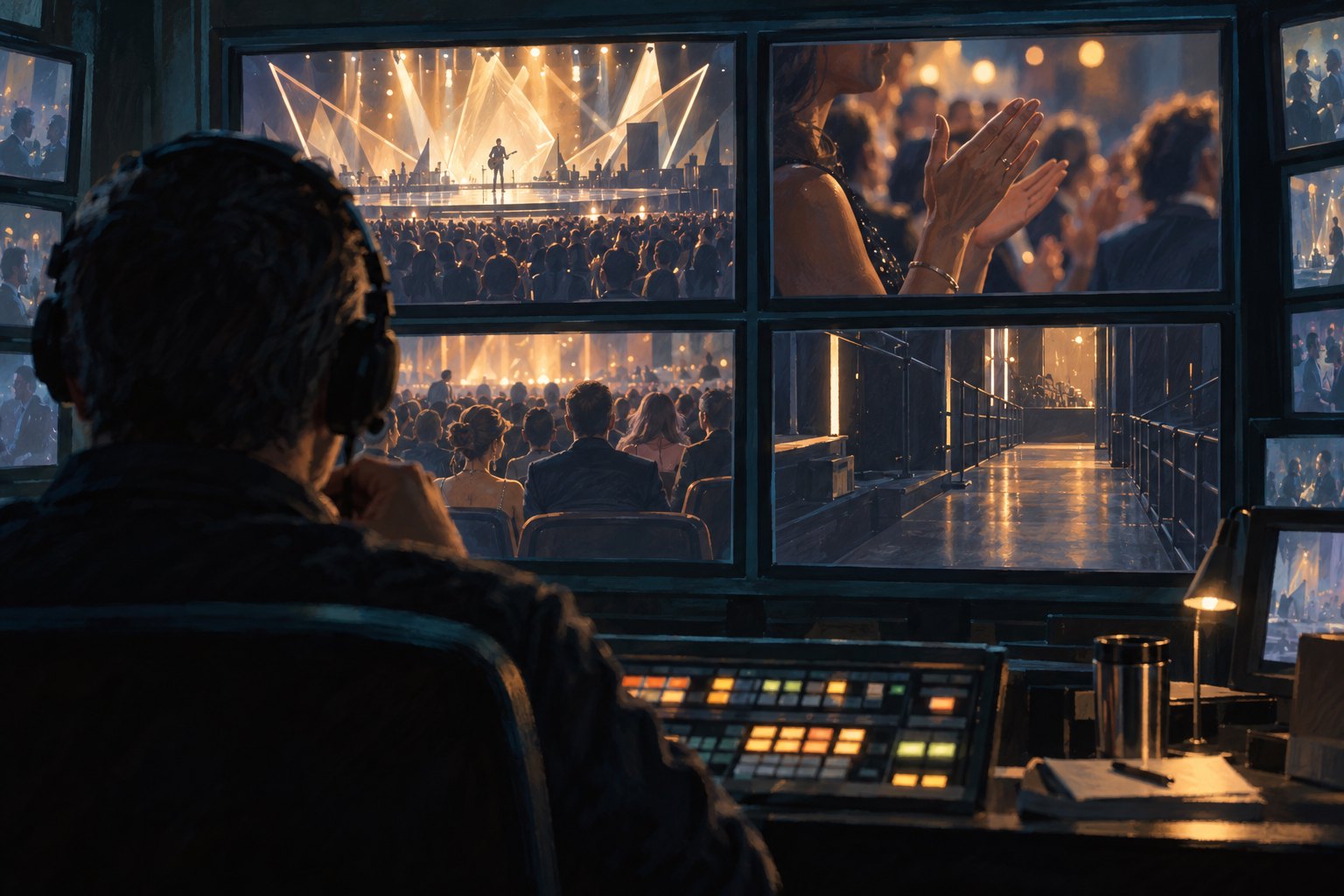
A televised awards ceremony offers an unusually persuasive illusion: because events unfold live, we feel we are seeing them directly. Yet a director still decides which image reaches us. A wide shot establishes scale. A close-up makes a face feel consequential. A cut to another artist can suggest that their response belongs to the meaning of the performance.
These are familiar tools of screen storytelling. In a film, the relationship between two shots can establish attraction, suspicion, or conflict without dialogue. At an awards show, the same visual grammar operates around people whose private thoughts remain unavailable. The images invite interpretation even when the evidence cannot support a definite conclusion.
My view is that this makes camera selection one of the most useful subjects for VMAs criticism. Instead of asking only who commanded attention, ask how that attention was organized. Did the frame let us study the performance, or repeatedly tell us how other famous people appeared to receive it?
Madonna’s prominence is a starting point, not an explanation of every moment
The reported combination of Madonna’s opening performance and Artist of the Year win gives coverage an obvious center. An opening appearance introduces a performer before the evening has accumulated competing highlights; an award supplies a clear result that can anchor the recap. Together, those elements make a strong public narrative.
They do not explain every interaction elsewhere in the venue. Once an artist becomes the central figure in coverage, there is a temptation to interpret everything around that person as further evidence of triumph: each glance becomes admiration, each conversation an endorsement. That is where criticism can turn into storytelling unsupported by observation.
Our discussion of Madonna and the appeal of the comeback narrative considers that larger framework. The distinction here is between a documented public achievement and the meanings attached to incidental behavior. The first can be reported directly. The second requires a much lighter touch.
A reaction shot cannot supply a person’s thoughts
Taylor Swift’s place in the night’s record-focused coverage creates a similar interpretive pressure. When viewers already expect an artist to be central, even a brief audience appearance can seem loaded with significance. A smile, a neutral expression, or a glance away can become a miniature story before anyone establishes what prompted it.
Consider a hypothetical cut from an award announcement to a seated artist. The sequence encourages us to connect the expression with the result. But the image alone may not establish what the artist heard, where they were looking, or whether the expression changed a second later. A close-up gives us visual access, not psychological access.
This is where character-focused film criticism needs an adjustment. A fictional character’s motives can be tested against dialogue, actions, and later revelations within a completed work. A real attendee has no obligation to provide a satisfying narrative explanation. Good commentary describes visible behavior precisely and leaves room for uncertainty.
What off-camera reporting can actually add
The strongest reason to seek a report about what television missed is to recover context. A broadcast must keep moving. An observer in the room can potentially describe what happened around a televised moment, how long an interaction lasted, or whether activity continued after the program cut away.
That additional perspective is useful when it makes the event more specific. Who was present? Was an exchange audible? Did the observer see its beginning and end? An account of people speaking is different from an account that establishes what they said. Likewise, witnessing applause does not establish the private opinion of every person applauding.
None of this makes small celebrity encounters uninteresting. Their charm often lies in their modest scale: people sharing a room rather than occupying separate, monumental images. The pleasure disappears when an ordinary gesture has to prove a rivalry, alliance, or career transformation.
The room and the screen can produce different experiences
A home viewer and an attendee can reasonably experience the same ceremony differently. Television can bring a facial expression close enough to study. A person in the room may have a better sense of spatial scale, competing activity, and the time between major moments. Neither perspective contains everything.
That distinction also matters when evaluating a musical performance as screen work. A camera move can reveal choreography or obscure it. A close-up can intensify a vocal moment while removing the surrounding physical action. These are criteria for judging the presentation; they are not claims about particular choices made during this ceremony.
The relationship resembles the difference between individual viewing and the collective atmosphere discussed in our commentary on what watching together adds to a screening. Audience energy is part of an experience, but it should not substitute for a clear account of the work itself.
How to read the next unseen-moments recap
A useful reading habit is to separate three layers: the observable action, the circumstances around it, and the interpretation. An artist approaching another artist is an action. When and where it happened provide circumstances. Calling it a reconciliation adds an interpretation that needs further evidence.
Apply the same care to absence. Someone missing from a shot may simply be outside its boundaries. A broadcast that does not show a response has not demonstrated that no response occurred. What television omits can invite further reporting, but omission alone cannot settle a claim.
The deeper appeal of the VMAs beyond the broadcast is the possibility of seeing a large public spectacle at a more human scale. My judgment is that the best backstage coverage expands our understanding without pretending to unlock anyone’s inner life. It lets Madonna, Swift, and their fellow attendees remain people participating in an event, even as television turns selected seconds into the story everyone remembers.
Original content by this site's editorial team. Published: September 28, 2026 at 04:15:18 PDT (Los Angeles time)