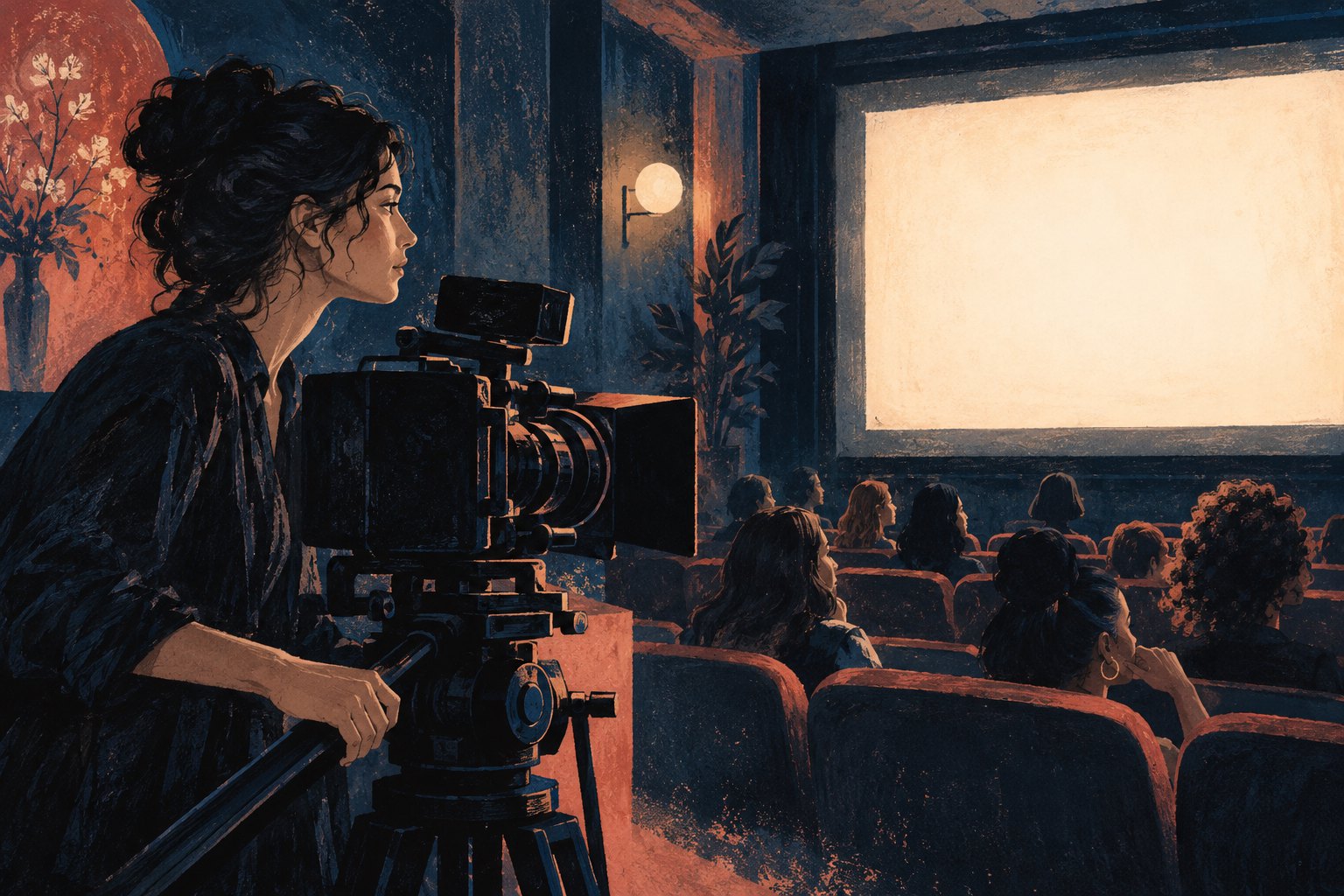
The M.V. Film Society’s Women in Film Festival raises a question worth carrying into the theater: when a woman appears at the center of a movie, does the story actually belong to her? Billing, screen time, and a memorable performance can help establish a protagonist. But ownership emerges through something more specific: whose desires organize the action, whose uncertainty shapes our experience, and whose decisions the film allows us to understand.
That is the critical opportunity suggested by the festival’s focus. For viewers, it offers a reason to look beyond whether a character is admirable or a story is uplifting. The more revealing question is whether the filmmaking gives a woman a complicated inner life—and trusts the audience to stay with it.
This is spoiler-free festival commentary about perspective and film criticism, rather than a review of individual selections or a screening guide.
Start with what the character wants
A useful approach to any film encountered through the festival is to identify its central character’s desire before assigning her a symbolic role. What does she want at the beginning? What would getting it cost? Does that desire change because she learns something, because circumstances narrow her options, or because the screenplay abruptly needs a different ending?
Those distinctions matter. A character can occupy almost every scene while functioning mainly as the recipient of other people’s decisions. Conversely, someone with little practical power can remain the dramatic center if the film makes her calculations, compromises, and refusals legible.
Agency does not require physical triumph or an inspirational speech. It might emerge through withholding an answer, maintaining an inconvenient friendship, or choosing an imperfect opportunity. The test is whether a decision grows from the person the film has established and meaningfully affects what follows.
Our discussion of desire and agency in Wicker approaches a related question. As a separate reading companion, it offers another way to think about the difference between being desired by others and having desires of one’s own.
The camera can complicate what the screenplay says
A screenplay may insist that a woman matters while the images quietly organize themselves around somebody else. Watch where the camera goes after she speaks. Does it remain with her, allowing a thought to settle, or immediately seek another character’s approval? When she enters a room, do we discover the space through her attention, or primarily observe the effect of her arrival on everyone else?
No single shot answers those questions conclusively. A reaction shot can reveal a relationship, and a distant composition can express isolation. Patterns provide the stronger evidence. Over several scenes, the film teaches us whose perceptions are reliable, whose feelings require explanation, and whose discomfort can be treated as background.
Sound deserves equal attention. Music can acknowledge a character’s fear, soften her anger, or tell us to distrust her before her behavior warrants it. Silence can create room for thought, but it can also withhold access. The valuable critical move is to connect a formal choice to its effect rather than assume that one technique is inherently more respectful.

A complicated woman does not need to become a role model
One limiting way to approach a women-focused festival is to expect every protagonist to provide an encouraging example. That expectation can make criticism oddly punitive: a selfish decision becomes a failure of representation, while an admirable character receives praise regardless of how thinly she is written.
My view is that dramatic freedom includes the freedom to be wrong. Jealousy, vanity, resentment, ambition, and bad judgment can produce rich characterization when the film gives them context and consequences. Understanding a person’s motives does not require endorsing her behavior.
The opposite shortcut is equally unhelpful. Cruelty does not automatically make a character complex, and suffering does not establish depth. Look for contradictions that the performance and writing sustain: affection that survives resentment, confidence that collapses in a particular relationship, or generosity complicated by a wish to be needed.
Our spoiler-filled analysis of perfection and desire in Black Swan provides a separate exploration of difficult identification. Readers who have not seen that film should save it for afterward.
Listen for the line that changes meaning
Memorable dialogue can clarify a film’s emotional architecture, but the most quotable sentence is not necessarily its most revealing one. A casual assurance early in a story may become painful after a betrayal. A repeated question may shift from affection to surveillance. A refusal may matter because the character previously could not express one.
When discussing a festival screening, connect a line to the moment that gives it force. Who speaks? Who listens? What happens immediately afterward? Performance can transform ordinary language through timing, hesitation, or the effort required to sound calm.
This also makes for better conversation than extracting an apparent message. A line can be sincere, defensive, mistaken, or deliberately manipulative. Treating it as the filmmaker’s position can erase the very ambiguity that makes the scene interesting.
Make comparisons without flattening the films
The festival’s framing offers a useful starting point for comparison, but it should not become a verdict. Women filmmakers and women characters do not imply a single temperament, visual style, or political conclusion. Criticism becomes more interesting when it notices differences in how films handle similar pressures.
After watching, consider these questions:
- Whose knowledge guides the story? Notice whether viewers discover important information alongside the central character or repeatedly ahead of her.
- What does the film allow to remain unresolved? An open ending may preserve a difficult truth, though it still needs dramatic preparation.
- Which supporting character has an independent life? Relationships become richer when other people have purposes beyond helping or obstructing the protagonist.
- What specific choice earned your response? Identify a cut, gesture, exchange, or sound cue rather than relying only on broad praise.
These questions leave room for disagreement. Two viewers can recognize the same technique and respond differently to it. Naming the evidence makes that disagreement productive.
The deeper question is whose experience counts
The strongest reason to approach the M.V. Film Society’s Women in Film Festival critically is the possibility of expanding what we notice. A film can change our understanding of a character without making her more likable. It can expose a familiar situation as unfamiliar when experienced by the person usually kept at its edges.
For me, that is the most useful standard to bring into the theater: does the film make another person’s experience specific enough that it resists an easy summary? When the answer is yes, representation becomes something viewers can feel in the construction of a scene—in what we wait for, what we fear, and whose next choice matters.
Original content by this site's editorial team. Published: October 14, 2026 at 18:14:52 PDT (Los Angeles time)