Ken Russell’s The Devils still feels frighteningly current because its public madness has a practical use. Behind the accusations, ecstatic performances, and declarations of righteousness, someone wants control of a town. Someone needs an opponent removed. The horror lies in watching those ordinary ambitions acquire the authority of a holy mission.
Released in 1971, the film reaches its 55th anniversary with its capacity to unsettle intact. My judgment is that its enduring force comes from the relationship between spectacle and calculation: people lose themselves in the frenzy, while others know exactly what they stand to gain. Russell makes that relationship grotesque, exhausting, and painfully legible.
Full spoilers follow, including the ending. The film contains sexual imagery, coercive religious rituals, torture, and execution. This review discusses Russell’s dramatization, rather than treating every scene as a literal record of seventeenth-century history.
Grandier’s flaws make his persecution more revealing
Oliver Reed plays Father Urbain Grandier, a priest whose personal conduct hardly prepares him for sainthood. His treatment of the pregnant Philippe exposes a brutal imbalance: he enjoys the freedom of desire while expecting her to carry its consequences. His religious authority gives him language with which to evade responsibility.
That ugliness matters. Russell refuses to make opposition to persecution depend on liking its victim. Grandier can be sexually irresponsible, arrogant, and capable of defending something valuable. His resistance to the destruction of Loudun’s fortifications places him against a political project larger than his private failings.
Reed makes the connection between charisma and entitlement uncomfortable. Grandier’s confidence attracts people, but it also encourages him to assume that intelligence and presence can master any encounter. His bearing suggests a man accustomed to entering a room and finding its center already reserved for him.
As his predicament worsens, that confidence becomes inadequate. The authorities are constructing a case whose outcome does not depend on the quality of his answers. His tragedy exposes a frightening distinction: having committed wrongs does not make every accusation true. A society that forgets that distinction makes almost anyone available for destruction.
Sister Jeanne wants recognition—and becomes useful
Vanessa Redgrave’s Sister Jeanne is both implicated in the catastrophe and vulnerable to the people directing it. Her fixation on Grandier grows inside a life of confinement, frustrated desire, and shame. She imagines an intimacy that does not exist, then finds that her fantasies can acquire consequences outside her own mind.
“If only he’d seen me first.” The short line gives her longing a devastating shape. She imagines recognition as a missed appointment: another woman has occupied the place that might have transformed her life. Her imagined Grandier offers more than sexual fulfillment. He promises an escape from the self she has learned to despise.
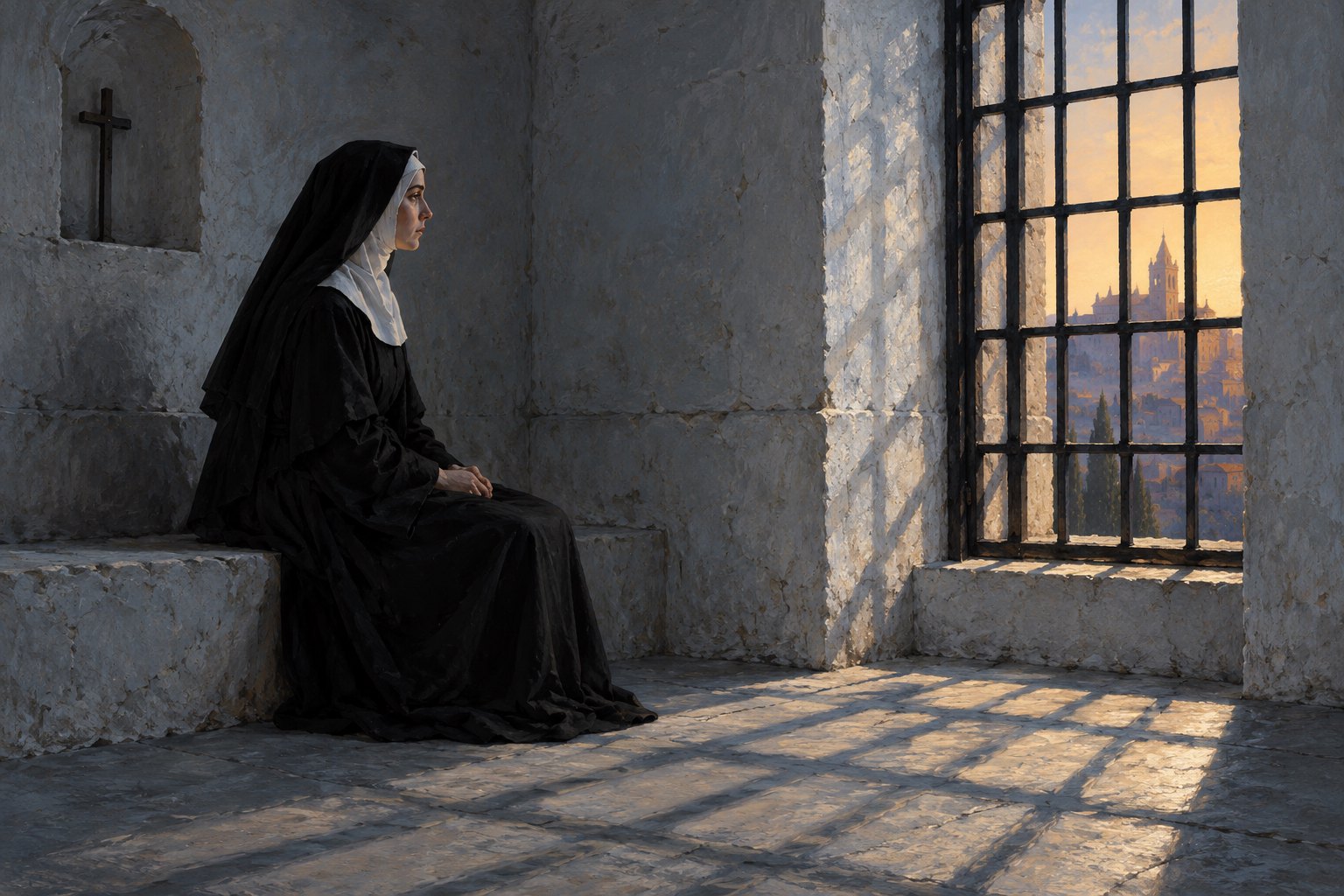
Redgrave gives that longing a dangerous instability. Jeanne can wound other people while remaining desperately exposed herself. Reducing her to a jealous accuser would miss how the machinery around her works: her distress becomes valuable once it can be shaped into evidence against a politically inconvenient man.
There is also something troubling in Russell’s own treatment of her. His extravagant imagery sometimes risks turning bodily difference and psychological anguish into another attraction. Yet Redgrave repeatedly restores the person inside the spectacle. The performance asks us to recognize suffering even when sympathy cannot erase responsibility.
That tension connects with the question explored in our commentary on who controls another person’s story. Jeanne gains an audience, but she does not gain lasting authority over what her words mean.
Father Barre makes doubt impossible
The exorcist Father Barre turns investigation into performance. His procedures assume the explanation they supposedly exist to test. Once possession becomes the authorized account, resistance can confirm it, suffering can demonstrate it, and spectacle can advertise it.
The scene involving a supposedly sacred relic exposes the system with vicious economy. The women respond to its alleged power; the king then reveals that its container is empty. The demonstration should destroy confidence in the proceedings. Instead, exposure fails to dismantle the persecution.
That failure is among the film’s most contemporary observations. Revealing a deception does not automatically defeat an arrangement that benefits powerful participants. Evidence requires people willing and able to act on it. Without that commitment, a revelation can become another entertaining episode.
Barre’s certainty also changes the moral function of care. People presented as spiritually endangered become bodies on which he can display authority. His conviction supplies permission for cruelty. Russell’s historical horror becomes especially disturbing when the language of rescue makes intervention harder to challenge.
Loudun’s walls explain what the frenzy accomplishes
The fortifications give the narrative a concrete political object. Cardinal Richelieu’s ambitions and Laubardemont’s intervention concern the weakening of local independence. Grandier’s defense of Loudun obstructs that objective. The witchcraft case makes removing him appear necessary for an entirely different reason.
This is why the film deserves closer attention than a description centered on outrageous nuns would suggest. Its dramatic structure keeps asking who benefits. The crowd experiences crisis; the officials obtain an opportunity. The two experiences occur together without being identical.
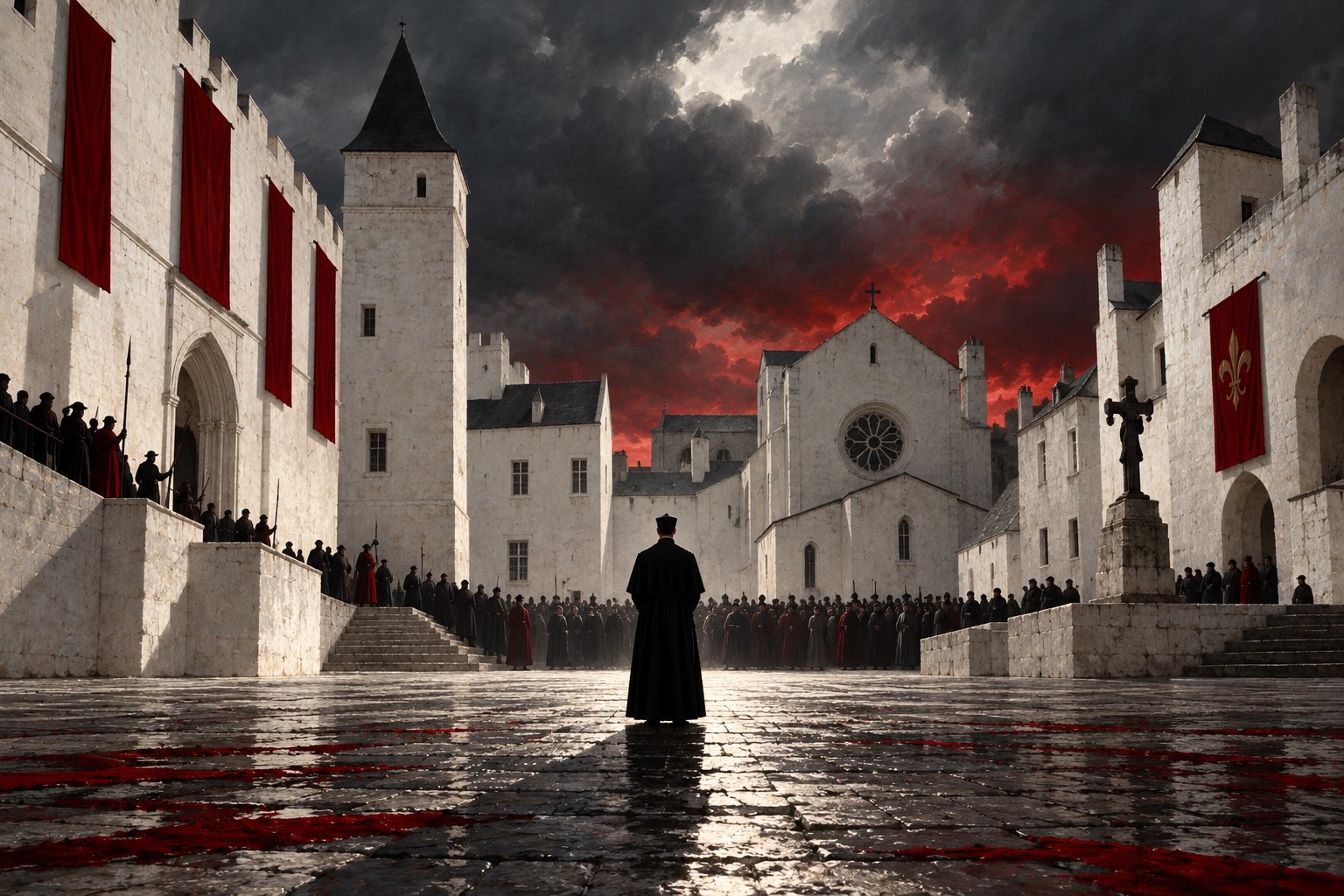
Derek Jarman’s striking white architectural designs sharpen that reading. To my eye, their severity creates a world that already resembles an apparatus for watching and judging. Figures appear exposed against hard surfaces, with little visual refuge. The setting makes public visibility feel dangerous.
Russell’s excess has a cost. The relentless grotesquerie can flatten distinctions between spectators, opportunists, and believers. At moments, the film seems so determined to overwhelm us that individual reactions disappear into the commotion. But its strongest passages recover the essential distinction between those suffering inside the event and those arranging it.
Madeleine gives faith a quieter meaning
Madeleine, played by Gemma Jones, offers Grandier a relationship that asks for more than admiration. Their marriage makes commitment tangible, even as it exposes the contradictions in his position. Her presence allows the film to imagine intimacy as a responsibility rather than another proof of masculine power.
Grandier’s declaration, “I want to serve the people of Loudun,” identifies the moral possibility beneath his vanity. Service requires him to look beyond the gratification of being desired or obeyed. Whether he fully achieves that transformation is open to interpretation; the aspiration gives his eventual suffering emotional weight.
This is also why dismissing The Devils as merely hostile to religion seems inadequate. The film distinguishes between belief practiced through attachment and belief enforced through humiliation. Our analysis of compassion in The Exorcist considers a related question: what does spiritual conviction require someone to do for another person?
The ending reveals the order beneath the chaos
Grandier is executed, and Loudun’s walls are destroyed. Madeleine’s departure through the ruined defenses leaves a survivor moving through the material result of the persecution. The political objective outlasts the religious excitement that enabled it.
The ending gives the film’s madness a chilling coherence. Public frenzy has helped produce an orderly transfer of power. An accusation has removed an obstacle; suffering has become an instrument; the community has lost something it cannot recover by simply calming down.
My strongest reading of The Devils is therefore about the ownership of reality. Once an institution can determine what counts as a symptom, whose testimony matters, and which response proves guilt, innocence has nowhere secure to stand. Fifty-five years later, Russell’s film remains formidable because it makes us watch that enclosure being built—and recognize how eagerly people can participate.
Original content by this site's editorial team. Published: October 31, 2026 at 11:12:06 PDT (Los Angeles time)