The Cat in the Hat raises a question that matters more than the size of its magical world: can a spectacular adventure still pay attention to two unhappy children? Variety’s comparison of the film to an overloaded superhero movie identifies a concern about scale. The more useful critical question is what that scale does to the characters. Does the adventure help us understand them, or simply keep them occupied?
This is a critical analysis of the confirmed premise and attributed reporting, rather than a firsthand screening review. Story spoilers follow; the ending is not discussed.
The Cat has an assignment. The children have a problem.
Warner Bros. describes Bill Hader’s Cat as an employee of the Institute for the Institution of Imagination and Inspiration, LLC. His assignment is to cheer up Gabby and Sebastian, siblings struggling after moving to a new town. Failure could cost him his magical hat. Erica Rivinoja and Alessandro Carloni direct from their own screenplay. These details establish an adaptation built around competing needs: the children want relief, while their visitor needs success. [Warner Bros.’ official synopsis](https://www.catinthehatfilm.com/)
That distinction provides a promising foundation. Helping someone and needing to be recognized as helpful are different motivations. An entertainer can become so invested in producing a reaction that the person being entertained disappears from view. The Cat’s professional predicament invites precisely that reading, although the premise alone cannot establish how successfully the finished film develops it.
From the children’s perspective, an unfamiliar home is already a substantial disruption. Their surroundings have changed before the Cat arrives. A stranger bringing further unpredictability therefore carries two possible meanings: welcome liberation or one more demand to accept circumstances they did not choose.
Gabby and Sebastian deserve more than a cheering-up mission
The phrase “cheer up” sounds kindly, but it can also flatten an emotional experience. Sadness after a move is not necessarily a misunderstanding waiting for a funny visitor to correct it. Missing familiar places can coexist with enjoying new ones. A child can have a wonderful afternoon and still want the old bedroom back.
For that reason, the strongest character-centered reading begins by resisting the idea that happiness is the only acceptable destination. A satisfying adventure might give its young protagonists more confidence, greater trust, or a stronger sense of participation. Laughter can accompany those changes without serving as proof that every difficulty has disappeared.
Sibling stories also need room for unequal reactions. Two children sharing an address do not necessarily share a temperament. One may seek reassurance through routine; another may welcome distraction. Those are interpretive possibilities, not claims about unverified scenes. They illustrate what character development would need to make visible: individual responses rather than a single, convenient category of unhappy children.

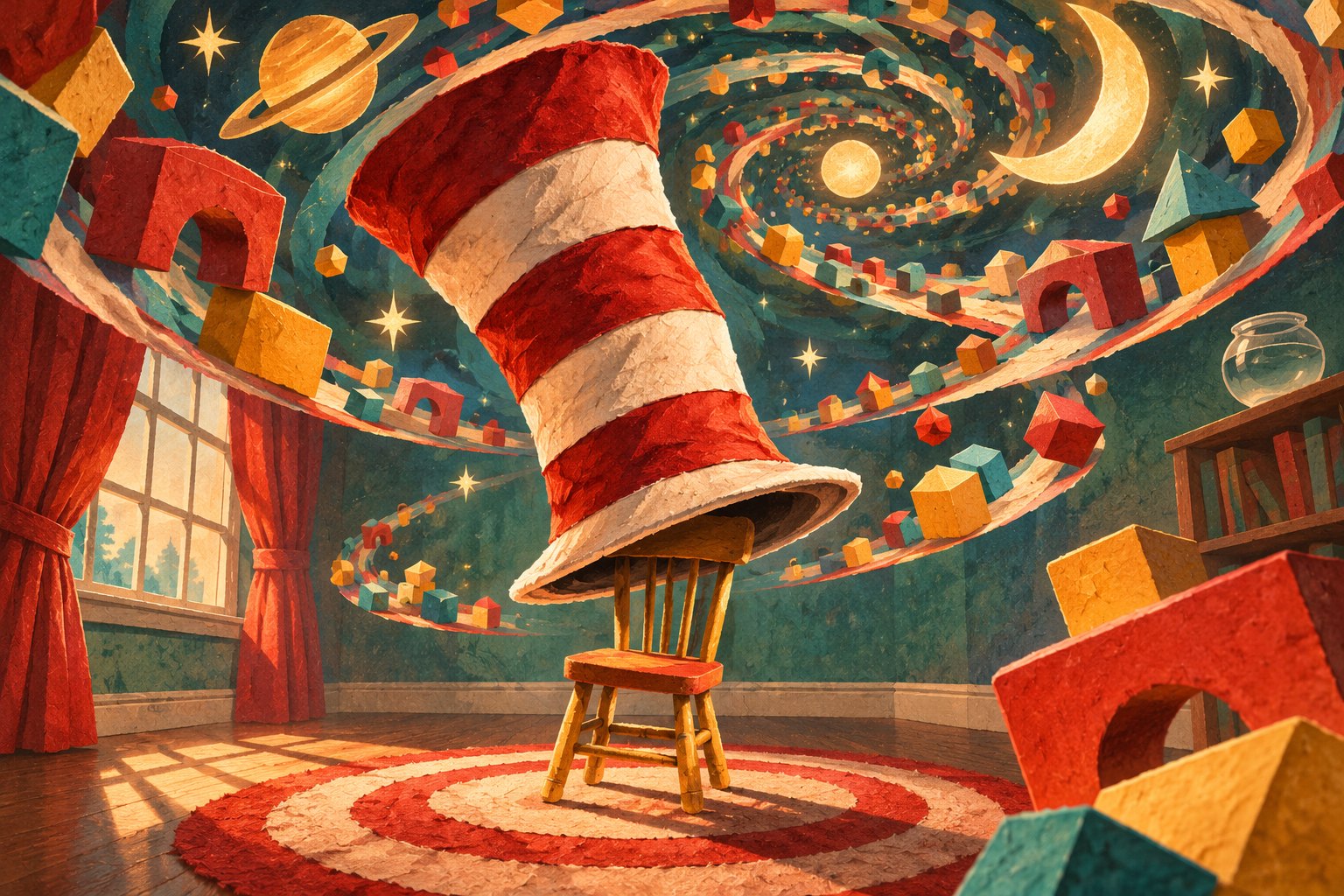
The illustration above represents that emotional terrain rather than a scene from the movie. Its modest scale points toward an important dramatic principle: a room can contain enormous stakes when the audience understands what belonging there would mean.
What the blockbuster comparison actually tells us
The Associated Press reports that the adventure involves a lost device capable of undoing the past and a threat to the universe. It also quotes the Cat’s incredulous line, “I can’t believe this and I’m a talking cat,” and a credits gag: “Let’s go sequel!” Those reported details help explain the superhero comparison: expanding danger and an explicit joke about continuing the property. They do not, by themselves, establish a universal audience verdict. [Associated Press review](https://apnews.com/article/cb9697f40a8b02a7732a2bbeb262d711)
Large stakes are not automatically empty stakes. An extravagant chase can reveal trust. A fantastical obstacle can make an ordinary fear visible. The problem arises when the audience must keep processing new information without learning anything new about the people experiencing it.
A useful distinction is between escalation and development. Escalation makes a problem bigger. Development changes what a character understands or chooses. The two can happen together, but adding danger does not guarantee that they will.
Imagine the difference between watching a child survive an elaborate obstacle and watching that child decide to ask someone for help. The first supplies suspense; the second can transform a relationship. The most effective family adventures make the physical action carry that emotional decision.
This is also why familiar characters need more than renewed visibility. Our discussion of what another Jack Sparrow story would need considers a related challenge: recognition draws attention, while competing motives sustain it.
Mischief needs someone who can answer back
The Cat’s essential dramatic attraction is permission: the possibility that ordinary restrictions might suddenly become negotiable. Yet permission becomes interesting only when another character can hesitate, refuse, bargain, or change the terms.
A child who merely follows a magical guide through successive attractions has limited influence over the story. A child whose judgment changes the adventure becomes a participant. That difference matters especially in a film aimed at young viewers, who spend much of everyday life following plans made by adults.
Comedy benefits from resistance, too. A dazzling trick becomes funnier when someone is unimpressed for a specific reason. A grand promise becomes revealing when another character asks a practical question. These exchanges allow personality to interrupt spectacle.
The Cat need not become sensible to become emotionally convincing. He needs relationships that expose the limits of his approach. Mischief can remain mischievous while acquiring consequences; indeed, consequences give the audience a reason to care whether he learns anything.
A deeper reading: who gets to define a good day?
The most productive interpretation of this adaptation’s setup concerns control. Someone arrives with an assignment to improve other people’s feelings. That is a generous intention carrying an uncomfortable possibility: the helper may decide what improvement should look like before listening.
Seen through that lens, the central question becomes whether the children can help define their own adventure. Enjoyment offered as an invitation differs from enjoyment imposed as a solution. The distinction is small enough for an intimate comedy and substantial enough to support a feature film.
Readers interested in how companionship acquires emotional weight can find a complementary discussion in our character-focused look at Planes, Trains and Automobiles. Different audiences and comic styles can share the same underlying concern: learning to see beyond another person’s disruptive behavior.
My judgment about the storytelling principle is straightforward: the Cat’s imagination matters most when it creates space for someone else’s. Bigger worlds can support that purpose, but they cannot substitute for it. The meaningful measure of this adventure is whether Gabby and Sebastian become more than the recipients of a spectacular visit—whether their wishes, objections, and decisions help determine what the visit means.
Original content by this site's editorial team. Published: November 3, 2026 at 09:50:21 PST (Los Angeles time)