
The Graduate makes escaping other people’s expectations look exhilarating, then asks what happens when the escape succeeds. Mike Nichols’ 1967 film remains a remarkably funny study of someone who desperately wants his life to change but cannot describe the life he wants. Its romance gathers speed while its emotional certainty quietly falls away.
Dustin Hoffman’s essay Surviving “The Graduate”, published in The New Yorker, recalls the insecurity he experienced while making the film. That recollection offers a useful entry into his performance: Benjamin Braddock’s discomfort is so persuasive that even his silences seem to require effort. The actor’s experience and the character’s predicament are distinct, but both invite us to look past the apparent confidence of a celebrated movie.
Spoiler warning: This review discusses the affair, Elaine’s wedding, and the ending.
Benjamin knows how to succeed, but not what success is for
Benjamin returns from college to a comfortable California home and a celebration arranged by his parents. His accomplishments make him easy to praise. His uncertainty makes him difficult to hear. The adults surrounding him treat his future as something that needs an efficient business plan, preferably one they already understand.
“Plastics.” The famous recommendation is funny because it reduces an enormous personal question to a single marketable answer. Benjamin needs a reason to enter adulthood; the advice offers an industry. Nobody delivering this guidance seems troubled by the mismatch.
Hoffman makes Benjamin’s politeness feel physically restrictive. His hesitant replies suggest someone searching for the approved response even when he resents the question. This is crucial to the comedy. He has learned how to satisfy authority, and that training continues operating after his faith in authority has weakened.
The pool sequence turns that contradiction into a visual joke. Displayed in diving equipment at his father’s urging, Benjamin becomes another achievement for the guests to inspect. Underwater, he gains distance from them, but the equipment that permits his withdrawal is itself part of the parental performance. Even his refuge arrives through somebody else’s arrangement.
My reading is that his privilege makes the paralysis sharper rather than less real. He has room to drift because other people provide the room. The film recognizes his unhappiness without establishing that unhappiness as a sufficient moral achievement.
Mrs. Robinson understands the rules and their cost
Anne Bancroft gives Mrs. Robinson a composure that Benjamin initially lacks. When she initiates their sexual relationship, she controls the situation with an assurance that makes his nervousness painfully visible. Their scenes are funny, but the imbalance matters: she is an older family acquaintance who recognizes his uncertainty and presses forward.
The affair gives Benjamin a secret without giving him an independent life. He can conceal something from his parents while remaining inside their social circle. His apparent rebellion depends on a relationship with someone who belongs to the world he wants to escape.
Bancroft’s performance becomes most affecting when conversation threatens that arrangement. Mrs. Robinson’s abandoned art studies and the pregnancy that preceded her marriage suggest a history of possibilities narrowing. Her reluctance to discuss herself makes the information feel costly. The woman who appears to have every answer has organized her life around avoiding certain questions.
That history does not excuse her manipulation. It changes its emotional meaning. Her determination to keep Benjamin away from Elaine can be read as jealousy, protectiveness, fear of exposure, or several impulses operating together. Bancroft allows those possibilities to coexist without turning Mrs. Robinson into a puzzle that one confession solves.
The screenplay becomes less generous to her as the romance with Elaine takes over. She increasingly functions as an obstacle. Yet the earlier performance leaves a residue that the plot cannot easily dismiss: this woman has already lived through the kind of irreversible decision the younger characters are approaching.
That shift in attention is also central to our examination of Shelley Duvall’s performance in The Shining: watching the woman’s experience closely can change the emotional center of a familiar film.
Elaine deserves more than Benjamin’s need for direction
Benjamin’s treatment of Elaine makes it difficult to accept him as an uncomplicated romantic hero. On their first date, he takes her to a strip club and humiliates her, attempting to sabotage the outing. Her distress interrupts his strategy. Only then does he begin relating to her with something approaching openness.
Katharine Ross makes that hurt important. Elaine’s tears are a consequence of Benjamin’s conduct, not decorative evidence of her innocence. His subsequent tenderness matters, but it cannot make the cruelty disappear. The scene establishes that his discomfort can become someone else’s suffering.
When Elaine learns that his older lover was her mother, the romantic fantasy encounters a problem that enthusiasm cannot repair. Benjamin follows her to Berkeley and pursues a future together with growing determination. From his perspective, he has finally found purpose. From hers, the situation includes betrayal, competing accounts, and a man who has already decided what their relationship should become.
This is where the film feels both compelling and limited. Elaine has choices and moments of resistance, yet Benjamin receives far more space to define the story. We understand his urgency better than we understand her developing judgment. The romance asks us to invest in a couple while giving us unequal access to its members.
A useful comparison is our discussion of Jack’s ambition and Sally’s judgment in The Nightmare Before Christmas. In both films, attending to the woman’s perspective helps separate a protagonist’s consuming desire from the wisdom of acting on it.
The wedding escape gives Elaine one decisive answer
At the church, Benjamin’s urgency becomes spectacular. He calls to Elaine from behind glass, making himself impossible to ignore. The image brings his earlier isolation into a public confrontation: a young man who could barely answer questions now interrupts an entire ceremony.
But Elaine’s response is essential. When Mrs. Robinson tells her, “It’s too late,” Elaine answers, “Not for me!” For that moment, her decision exceeds Benjamin’s plan. She refuses her mother’s claim that the future has already closed.
The line also creates a painful connection between mother and daughter. Mrs. Robinson speaks with the authority of someone who knows what a binding decision can cost. Elaine insists that her own decision remains available. Neither position requires us to believe the younger woman knows what will happen next.
What the final bus ride leaves unresolved
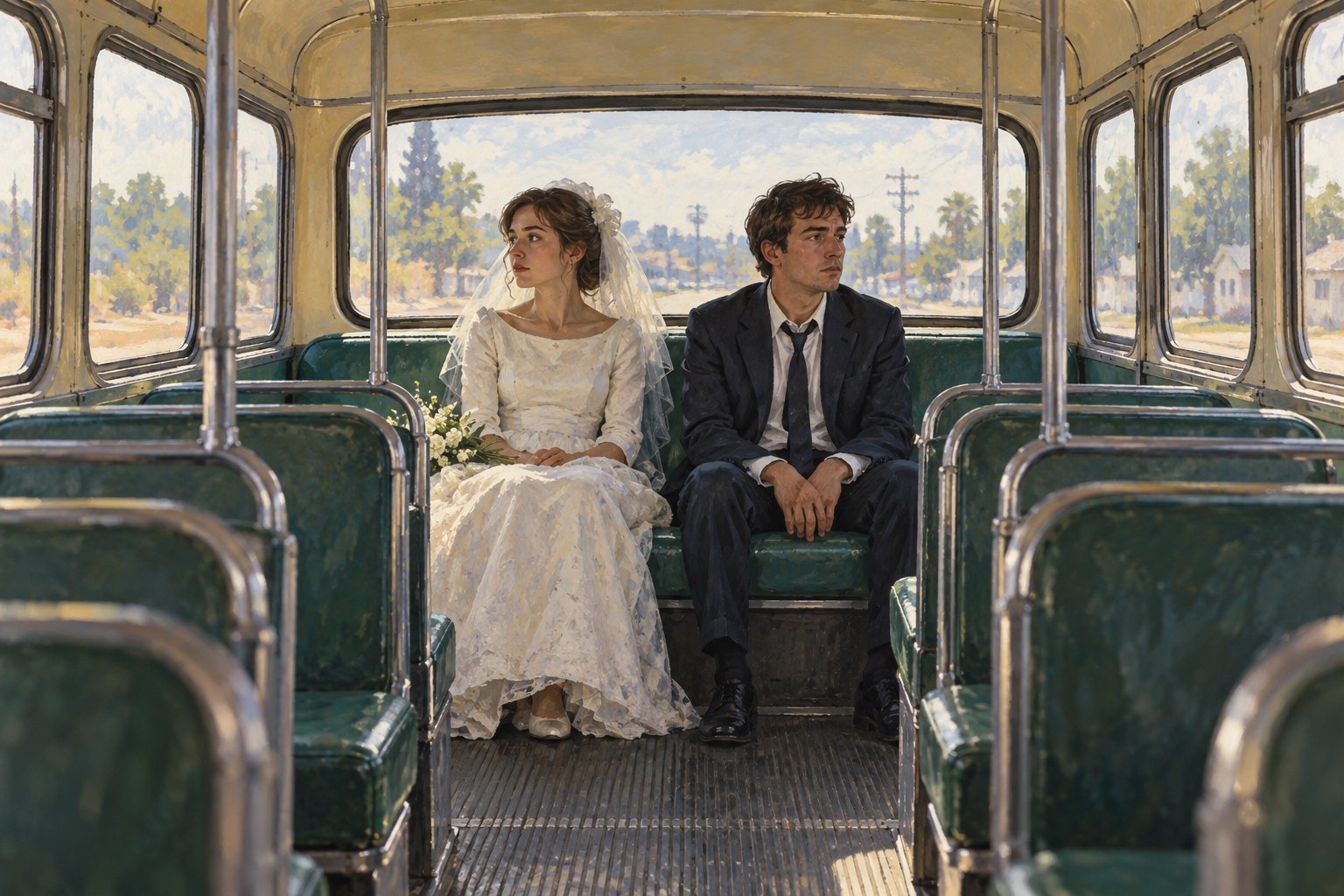
Benjamin and Elaine escape onto a bus, and the film lets their exhilaration continue long enough to change. Their smiles subside. The return of Simon & Garfunkel’s “The Sound of Silence” unsettles the release of the chase. The immediate problem has ended; the larger questions have become visible again.
I do not read their expressions as proof that the relationship will fail. The film gives us no such certainty. What the shot removes is the comforting assumption that a dramatic act of refusal supplies everything a shared life requires. They have chosen to leave. They have barely begun deciding where to go.
This is the deeper force of The Graduate: Benjamin rejects a future imposed by others, yet repeatedly treats other people as solutions to his own uncertainty. Mrs. Robinson offers distraction; Elaine offers direction. Maturity would require him to recognize both women beyond those functions.
My verdict is that the film’s greatest strength lies in the friction between its romantic momentum and its unresolved human consequences. Hoffman makes confusion funny, Bancroft gives disappointment a formidable presence, and Ross makes Elaine’s refusal count despite the limits of her role. The ending leaves them with a difficult freedom: the opportunity to make choices after the audience’s applause would ordinarily let them stop.
Original content by this site's editorial team. Published: October 31, 2026 at 21:21:52 PDT (Los Angeles time)