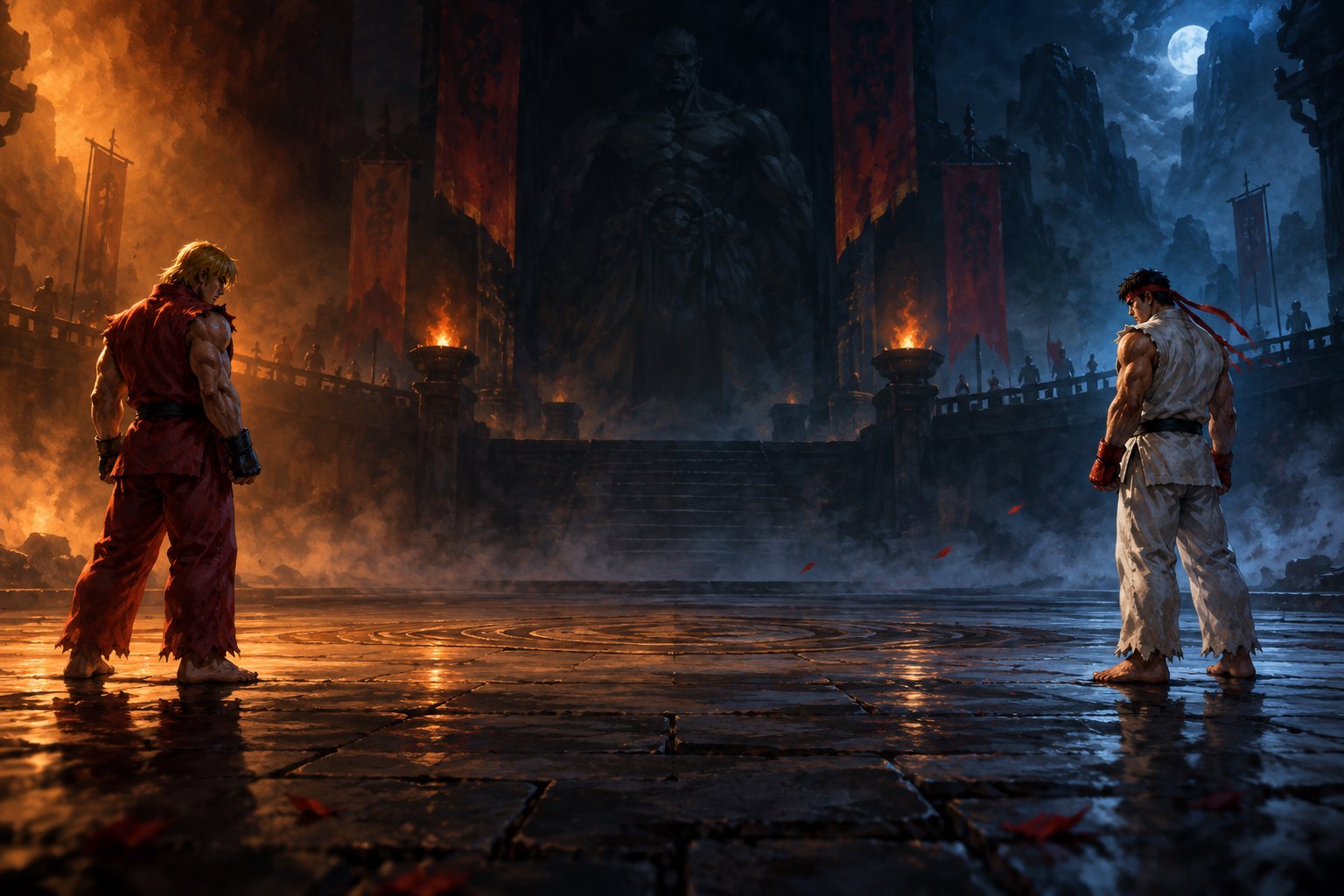
Street Fighter gives Noah Centineo and Andrew Koji a potentially stronger dramatic hook than simply deciding which fighter wins. Their characters, Ken Masters and Ryu, enter the reboot with a relationship already damaged. Bringing them back together means making every confrontation carry two questions: who has become the better fighter, and what remains of the bond between them?
That is the most interesting angle on this new adaptation. Familiar characters can attract an audience, but a fractured friendship gives that audience something to follow beyond the next entrance. This is an analysis of the confirmed story setup, not a firsthand review of the completed film. Setup spoilers follow; the ending, individual performances, and execution of the action are not assessed here.
What the reboot’s story actually establishes
Paramount’s official synopsis places the story in 1993. Ryu, played by Koji, and Ken Masters, played by Centineo, are estranged when Chun-Li, played by Callina Liang, recruits them for the World Warrior Tournament. A conspiracy behind the competition forces the pair to confront each other and their past. Kitao Sakurai directs.
Those details establish a useful distinction: the tournament is the mechanism that reunites the characters, while their damaged relationship supplies a personal conflict. The competition can move the plot forward without automatically resolving what has happened between them.
The synopsis does not establish how responsibility for their estrangement is divided, what either man privately wants from the reunion, or whether reconciliation is possible. Those are crucial gaps for a character reading. Assigning blame or describing an emotional breakthrough without seeing the relevant scenes would turn interpretation into invention.
Ken Masters: being seen is different from being understood
For Centineo’s Ken, the central dramatic opportunity lies in the difference between performing for an opponent and facing someone who already knows him. A stranger can respond to skill, confidence, or intimidation. An estranged friend brings an older understanding that may be harder to control.
One possible reading of this setup is that a tournament offers Ken an appealingly measurable answer to an emotionally complicated situation. Victory produces a result. It cannot necessarily produce forgiveness, respect, or agreement about the past. That tension would give competitive behavior a meaning beyond ambition.
But the distinction needs to remain conditional. The confirmed premise does not establish that Ken enters to seek approval or hide insecurity. Those would be interpretations to test against his actual decisions, especially when an easy competitive advantage clashes with an opportunity to repair the relationship.
That is also where performance becomes more revealing than a character description. As our discussion of how performances reveal the motives beneath confidence explores, the interesting material often sits between what someone projects and what their behavior exposes. For Ken, the decisive evidence would be how he responds when Ryu refuses to accept that projection.
Ryu: estrangement needs a point of view
Koji’s Ryu presents the other half of the same problem. A story about two estranged people becomes thinner if one exists mainly to explain, forgive, or correct the other. Ryu needs a relationship to the past that has its own emotional logic.
Distance alone does not establish wisdom. Nor does a reluctance to reconnect automatically indicate cruelty. Depending on the scenes, either could reflect self-protection, resentment, uncertainty, or a boundary that deserves respect. A useful character analysis must distinguish among those possibilities instead of treating reserve as proof of moral superiority.
The strongest question to bring to Ryu’s side of the story is therefore specific: what would reconnecting with Ken require him to risk? If the answer is merely losing a match, the friendship and tournament remain loosely connected. If it involves revising a judgment or acknowledging responsibility, the external contest can become an expression of a deeper conflict.
That does not require an elaborate speech. A decision to approach, withdraw, cooperate, or refuse can establish a point of view. What matters is whether the choice belongs to Ryu as a person, rather than serving only to advance Ken’s story.
Chun-Li’s recruitment changes the relationship
Chun-Li’s confirmed role in bringing the two men into the tournament makes her the catalyst for their renewed contact. That position raises an immediate character question: how does her purpose intersect with theirs?
Recruitment is an act of persuasion. It creates a difference between the reason someone offers an invitation and the reason another person accepts it. The synopsis leaves those individual motives unresolved, so it would be premature to describe Chun-Li as either a trustworthy guide or a manipulator.
From a storytelling perspective, the opportunity is to let all three characters understand the same arrangement differently. Ken and Ryu might agree to participate without agreeing about each other. Chun-Li can initiate their involvement without necessarily controlling what follows. The resulting friction could make exposition function as drama, provided each person retains meaningful choices.
What fighting can communicate that exposition cannot
A combat scene can reveal a relationship through attention. Does someone anticipate an opponent’s habits? Recognize a hesitation? Take a risk because an old assumption still feels reliable? Those are general possibilities of action filmmaking, not descriptions of verified sequences in this reboot.
They matter especially to a story about estrangement. Two people may no longer understand each other emotionally while still knowing how the other moves. That mismatch offers a cinematic way to express intimacy that has outlasted trust.

Moving from a game to a movie also changes the audience’s relationship to action. A player makes choices; a viewer interprets choices made by characters. Recognizable movement can provide pleasure, but dramatic movement also changes what someone knows, wants, or is willing to do.
This is related to the problem examined in our analysis of translating spectacle into a cinematic experience: preserving an attraction and shaping an audience’s attention are distinct creative tasks. Here, the camera’s emphasis can determine whether a clash feels like a demonstration or a consequential encounter.
The deeper question: can winning repair anything?
The most promising interpretation of Street Fighter’s premise concerns the limits of competition. A tournament can establish who prevailed under particular conditions. A damaged relationship involves different questions: whose account of the past gets heard, what responsibility is accepted, and whether either person can tolerate an answer that does not flatter them.
For Ken and Ryu, that creates the possibility of two outcomes that do not align. Competitive success might leave the personal conflict untouched. An apparent setback might create the first opening for understanding. Neither outcome should be assumed before the film earns it.
That is the standard this reboot’s central pairing invites. Centineo and Koji’s characters need more than a shared arena; they need choices that make their shared history matter. The richest version of this story would leave viewers thinking about what each man can finally recognize in the other—and what no victory could ever settle.
Original content by this site's editorial team. Published: October 15, 2026 at 11:17:25 PDT (Los Angeles time)