Street Fighter has a stronger emotional premise than its crowded battlefield initially suggests: being an exceptional fighter does not necessarily make someone a dependable brother. My reading of the 2026 adaptation is that Ken and Ryu’s damaged relationship gives its extravagant martial arts fantasy a worthwhile center. The trouble is how frequently competing characters, jokes, and spectacle pull attention away from that relationship.
Directed by Kitao Sakurai, this is an uneven proposition for viewers seeking a tightly organized tournament movie. Its appeal lies in the collision between enormous personalities and surprisingly vulnerable motivations. The most useful question is whether a fight changes what someone wants, fears, or owes another person.
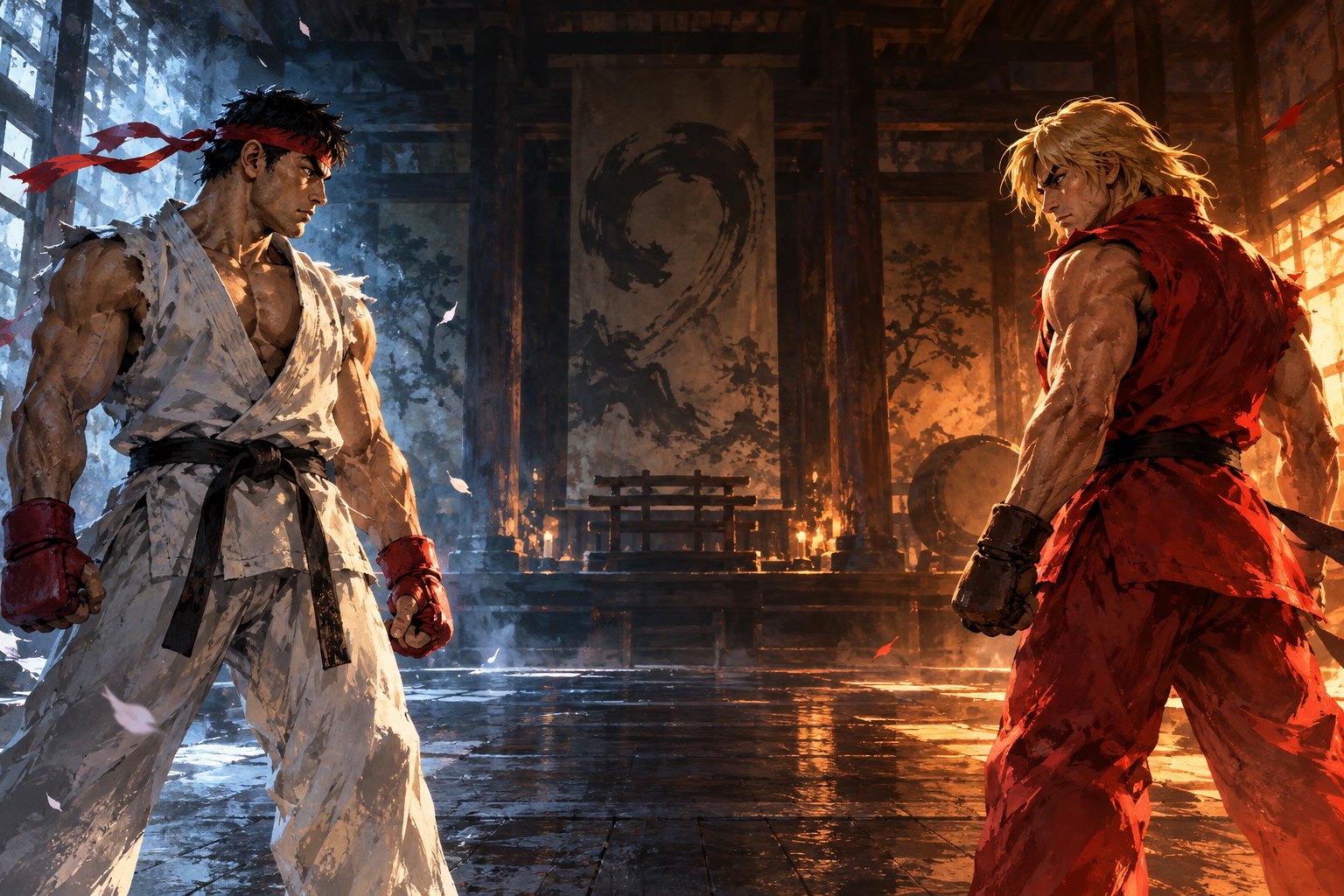
Spoilers follow for character arcs, confrontations, and selected dialogue. The illustrations are interpretive artwork rather than film stills.
Ken’s real opponent is the need to prove himself
Noah Centineo’s Ken and Andrew Koji’s Ryu provide the central relationship. They share a history of training and brotherhood, but their connection has become entangled with resentment. Ken’s movement toward helping Ryu gives the story a direction beyond collecting victories.
From Ken’s perspective, comparison can become a trap. When another person supplies the measure of your worth, even success leaves you dependent on that person. A championship might establish superiority for an evening; it cannot explain why superiority matters so much in the first place.
That distinction makes the rescue impulse dramatically valuable. Helping Ryu requires Ken to act for someone whose existence complicates his self-image. He has to recognize a person where he might otherwise see a rival, a reminder of failure, or an unpaid emotional debt.
The character therefore offers a useful test of the film’s comedy. A joke that exposes Ken’s insecurity can deepen him. A joke that merely interrupts his distress spends emotional momentum without replacing it. The difference matters because this story asks us to take brotherhood seriously inside a world built for flamboyant exaggeration.
Ryu complicates the fantasy of the perfect champion
The animated opening establishes Ryu’s victory over Sagat in the earlier World Warrior tournament. It gives him the stature of a champion before the central relationship has been repaired. That ordering is meaningful: the story can begin with sporting achievement already secured and still leave its hero profoundly unfinished.
Seen through Ryu’s position, mastery brings an uncomfortable obligation. Being powerful means other people have reasons to fear you, exploit you, or expect protection from you. Skill cannot answer every demand placed on it.
My interpretation is that Ryu and Ken make the strongest pairing when each exposes the weakness in the other’s definition of strength. Ken’s competitive hunger needs a purpose beyond comparison. Ryu’s exceptional ability needs a human connection that achievement alone cannot supply. Their relationship makes vulnerability part of the action premise.
This is also why rivalry needs consequences outside the contest itself. Our analysis of the human cost of rivalry in The Prestige explores a darker version of that problem: the opponent can become so central to a character’s identity that winning stops resembling freedom.
Chun-Li gives revenge a personal perspective
Callina Liang’s Chun-Li pursues Bison because he murdered her father. Her motivation gives the larger conflict an intimate scale. For her, the villain’s power is inseparable from a specific absence in her life.
Bison’s callback, “For me, it’s Tuesday,” exposes the cruelty of that imbalance. What defines the victim’s world barely registers in the perpetrator’s memory. The line works as more than recognition bait when considered from Chun-Li’s perspective: it refuses her the acknowledgment that revenge often seeks.
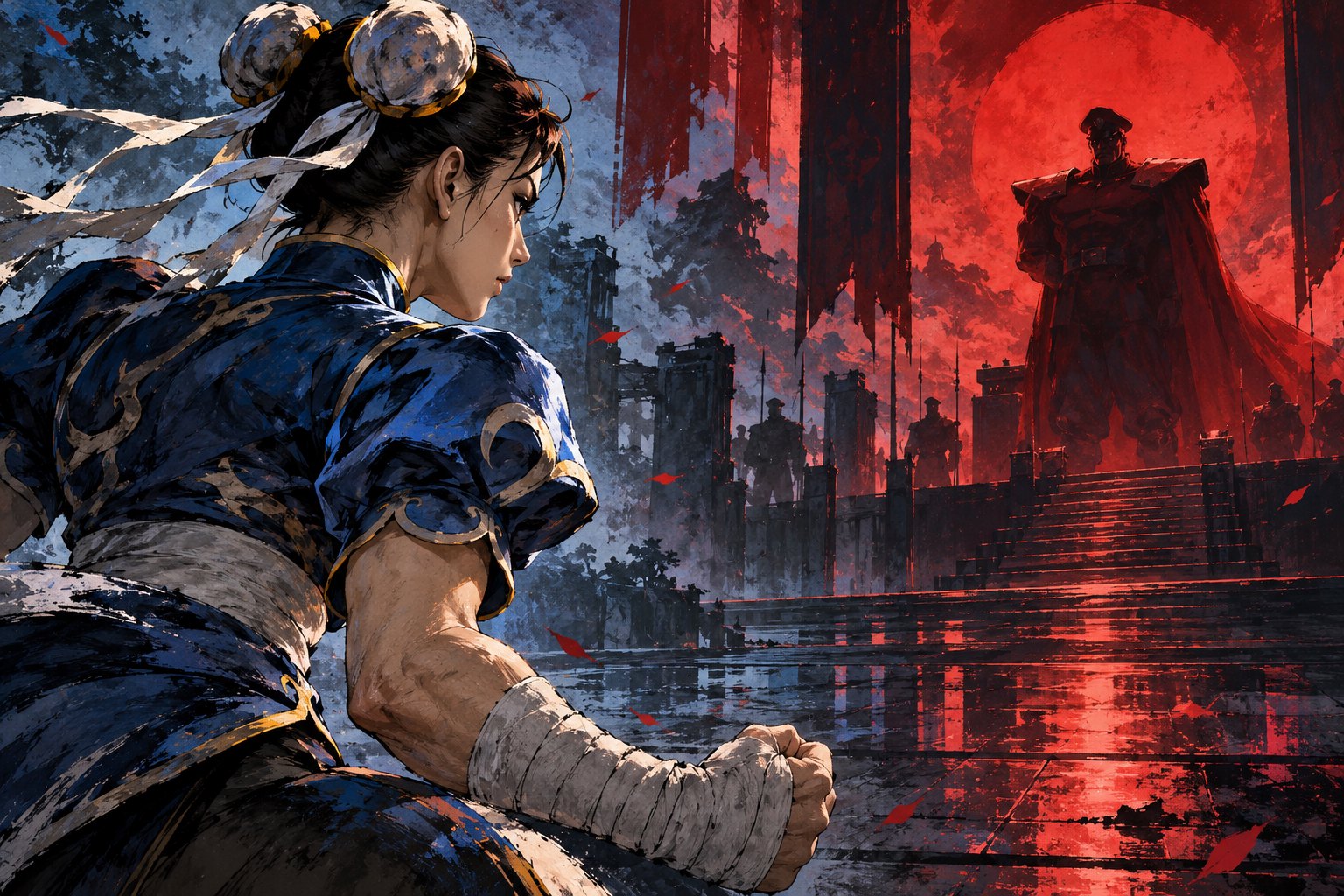
Her anger consequently carries a different dramatic weight from Ken’s insecurity. Ken wants to escape a comparison; Chun-Li wants to confront responsibility. Treating both simply as reasons to enter a fight would flatten what makes them distinct.
The film’s sexualized humor around Chun-Li complicates that agency. My objection is structural: when a character’s grief establishes a serious point of view, jokes that reposition her as an object of someone else’s attention interrupt that perspective. The question is whose experience the scene asks us to inhabit.
That concern connects with our examination of how personal loss can shape a superhero conflict. A painful backstory becomes dramatically useful through the choices it produces, rather than through the severity of the loss alone.
Bison turns strength into something to possess
David Dastmalchian’s Bison wants to extract Ryu’s fighting power for himself. This supplies a revealing contrast with the brothers. Their abilities emerge from a shared history that remains emotionally difficult; Bison treats power as a resource he can acquire.
Read this way, the villain represents an impatient fantasy of mastery without responsibility. He wants the result without the relationship, the discipline, or the obligations attached to it. That makes his threat relevant to the protagonists even when his presentation is deliberately extravagant.
The ensemble creates a separate problem of dramatic proportion. Cammy’s antagonism toward Chun-Li, for example, does not culminate in a fight between them. An implied confrontation creates an expectation; leaving it unfulfilled can make a character feel like a reservation for another story.
What the Easter eggs add—and where recognition stops helping
The film openly borrows the games’ language. “Round 1: fight!” accompanies the title card, while Bison’s “You lose” invokes the announcer’s blunt judgment. Those phrases offer wonderfully simple rules in a story whose personal conflicts resist simple outcomes.
Ken dismantling a car recalls the bonus stage. Ryu’s encounter with E. Honda in a sauna evokes Honda’s bathhouse setting. These references are most effective when they also provide a physical situation with its own comic or dramatic possibilities. Recognition is an introduction; the scene still needs somewhere to go.
The recreated Street Fighter II opening fight includes Danny and Michael Philippou. That is a cameo to spot rather than an explanation of the plot. Similarly, familiar moves reward returning players, but naming an attack cannot substitute for making its setup, impact, and consequence readable.
The deeper conflict is over what strength is for
The most persuasive interpretation of Street Fighter places three desires beside one another: Ken’s need for worth, Chun-Li’s demand for accountability, and Bison’s appetite for possession. Ryu’s power sits at the intersection of those competing pressures.
For me, the brotherhood gives the movie its strongest answer. Strength becomes meaningful when it enables a character to accept responsibility for someone else. That idea can survive outrageous costumes and supernatural combat; it requires enough attention to make the choice matter.
The result is a qualified recommendation for viewers drawn to heightened martial arts melodrama and recognizable arcade personalities. The film has a compelling emotional contest inside its crowded spectacle. Its limitations become clearest whenever the spectacle makes that contest harder to follow.
Original content by this site's editorial team. Published: October 21, 2026 at 03:05:21 PDT (Los Angeles time)