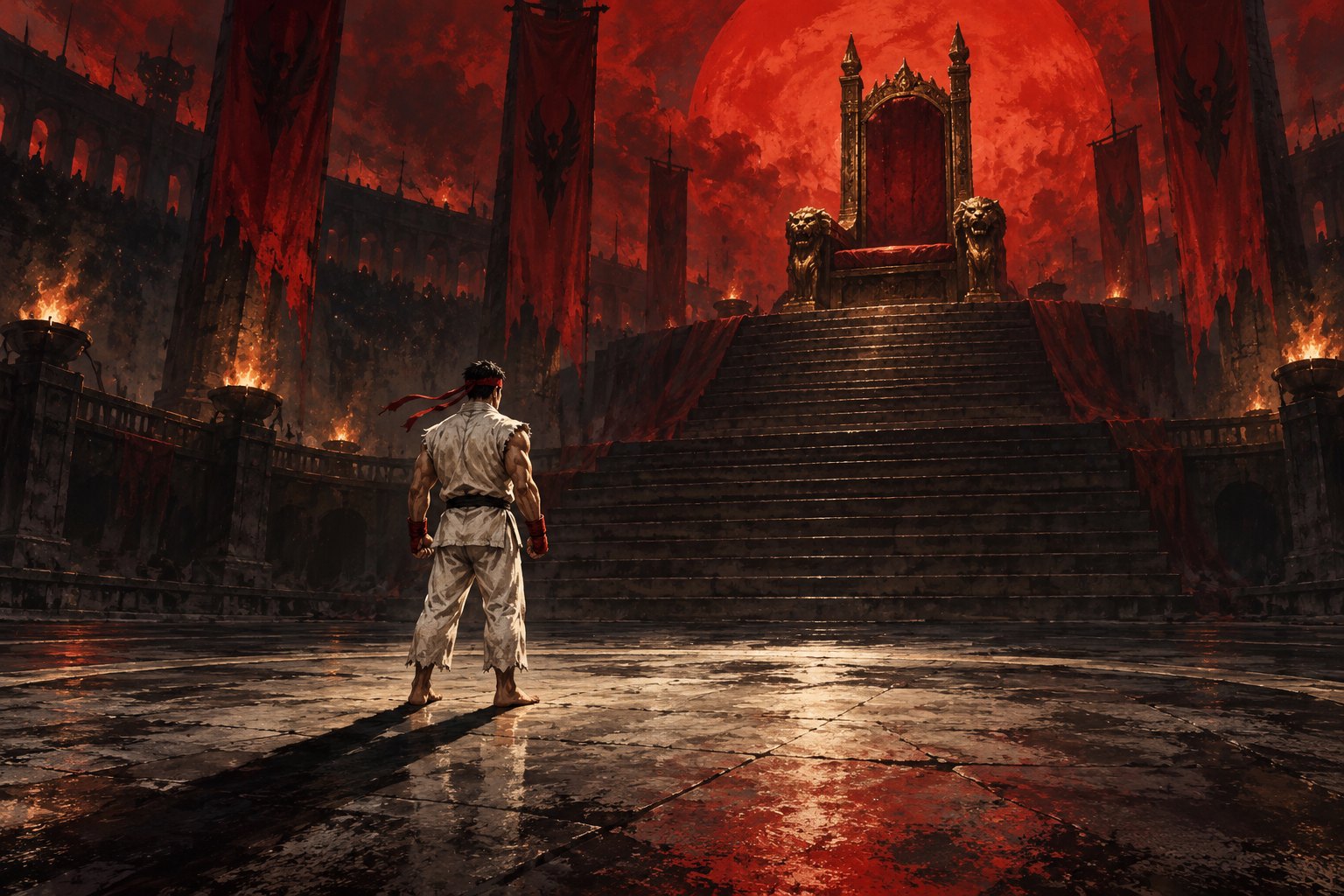
Street Fighter being compared to the live-action Super Mario Bros. sounds like a warning until you consider the pleasure that comparison promises: a movie with enough personality to make its questionable decisions interesting. Mashable’s enthusiastic response places the new adaptation in that territory. The useful question is whether its absurdity gives the characters room to breathe or simply fills every available inch of the screen.
Spoilers follow for the premise and character conflicts. This is a critical analysis of reported story details and published reviews, rather than a firsthand screening verdict.
Why the Super Mario Bros. comparison matters
Mashable’s review describes director Kitao Sakurai’s Street Fighter as an exuberant adaptation whose appeal survives reservations about its storytelling. Its comparison with live-action Super Mario Bros. is an expression of affection for unruly entertainment, not a claim that the two films share a plot. [Mashable’s review, reproduced by CNCB News](https://cncbnews.com/article/2026/10/street-fighter-review-what-if-its-giving-super-mario-bros-live-action-but-i-love-that)
That distinction matters. Calling a film enjoyable despite its faults can become a way of avoiding criticism. But enjoyment is also evidence worth examining. A strange costume, an extravagant performance, or an implausible emotional turn can create an experience that a smoother production never achieves. The critic’s responsibility is to explain what makes those choices rewarding.
My view is that a video game adaptation earns its extravagance when it translates the pleasure of playing into the pleasure of watching. Recognition helps, but cinema needs relationships, timing, and consequences. A familiar fighter becomes dramatically interesting when a victory costs something that cannot be restored by starting another round.
That distinction between attachment and achievement also underlies our discussion of what an extraordinary declaration of movie love actually tells us. Enthusiasm deserves an explanation, not an apology.
Ken and Ryu give the spectacle a personal conflict
Published accounts identify the estrangement between Ryu, played by Andrew Koji, and Ken Masters, played by Noah Centineo, as the central relationship. Chun-Li recruits them into a tournament connected to M. Bison, whose ambitions involve taking power from other fighters. Kakuchopurei’s review emphasizes the friendship as the film’s organizing thread while criticizing the surrounding plotting. [Kakuchopurei’s Street Fighter review](https://www.kakuchopurei.com/2026/10/street-fighter-2026-review-kkp/)
Read through that relationship, a tournament becomes more than a ladder of increasingly difficult opponents. Fighting offers estranged friends a language they still share. They can recognize each other’s habits even when they no longer understand each other’s choices. Physical familiarity can survive emotional intimacy, which makes a confrontation between former companions more revealing than a contest between strangers.
The dramatic opportunity is especially strong for Ken. Wanting to distinguish yourself from someone you love creates a contradiction: you need their recognition while resenting their authority to grant it. A victory can therefore feel incomplete if the person whose opinion matters most remains unreachable.
Ryu’s side of that relationship poses a different question. Discipline can be admirable, but emotional restraint can also look like indifference to someone already convinced he has been overlooked. Neither friend needs to be entirely wrong for the distance between them to become destructive.

Chun-Li and Bison complicate the meaning of strength
TheWrap’s account identifies Chun-Li’s motive as revenge against Bison for killing her father. It also describes Bison’s desire to extract Ryu’s fighting power. Those reported motivations establish a useful contrast between seeking strength to answer a loss and seeking strength to possess other people. [TheWrap’s Street Fighter review](https://www.thewrap.com/creative-content/movies/street-fighter-review-capcom-noah-centineo-andrew-koji/)
Chun-Li’s perspective makes the tournament morally different from a sporting event. Someone competing for recognition can imagine a satisfying result within its rules. Someone pursuing the organizer for a personal atrocity has little reason to respect the spectacle’s legitimacy. Her presence makes the distinction between winning the competition and confronting its purpose especially important.
Bison’s ambition, meanwhile, invites a reading of power as ownership. Training requires time, vulnerability, and dependence on teachers. Taking another fighter’s abilities promises to bypass those obligations. The villainous fantasy is not merely becoming stronger; it is acquiring the rewards of another person’s life without accepting its responsibilities.
That is where character analysis becomes more useful than counting familiar faces. Our examination of how victory changes the meaning of power in Dune approaches a related question: what does someone believe strength entitles them to do?
Comedy can reveal vulnerability—or interrupt it
The strongest argument for a ridiculous Street Fighter is that embarrassment belongs in a story about pride. A character who wants to seem invulnerable becomes more recognizable when his body, temper, or vanity betrays him. Humor can expose the need underneath a boast without requiring a speech explaining it.
But a joke also directs attention. If every moment of hurt immediately becomes a gag, the audience learns that emotional investment will be interrupted. The issue is not whether a fighting movie should be serious. It is whether its comic rhythm allows a feeling to register before moving on.
Action has a similar obligation. Spectacle becomes expressive when viewers understand what a fighter is trying to accomplish, what changes during the exchange, and why a particular choice matters. Familiar moves can contribute to that progression. Their recognizability alone cannot supply it.
The deeper appeal: being ridiculous without becoming disposable
The most promising interpretation of Street Fighter’s central conflict is that people cannot be reduced to their most marketable ability. A fighter may be admired for strength while needing forgiveness, friendship, or freedom from someone else’s judgment. That difference gives an oversized adventure a human scale.
The Super Mario Bros. comparison is valuable because it leaves room for an imperfect film to matter. Yet affection becomes more persuasive when it stays specific. Does the absurdity reveal wounded pride? Does the spectacle make rivalry legible? Does a joke bring two people closer, or merely delay their conversation?
Those are the standards I would bring to Street Fighter. Its excess is an invitation, not a defense. The lasting pleasure would come from finding people worth caring about inside the extravagant costumes—and discovering that their ridiculousness makes them easier to understand.
Original content by this site's editorial team. Published: October 16, 2026 at 00:37:11 PDT (Los Angeles time)