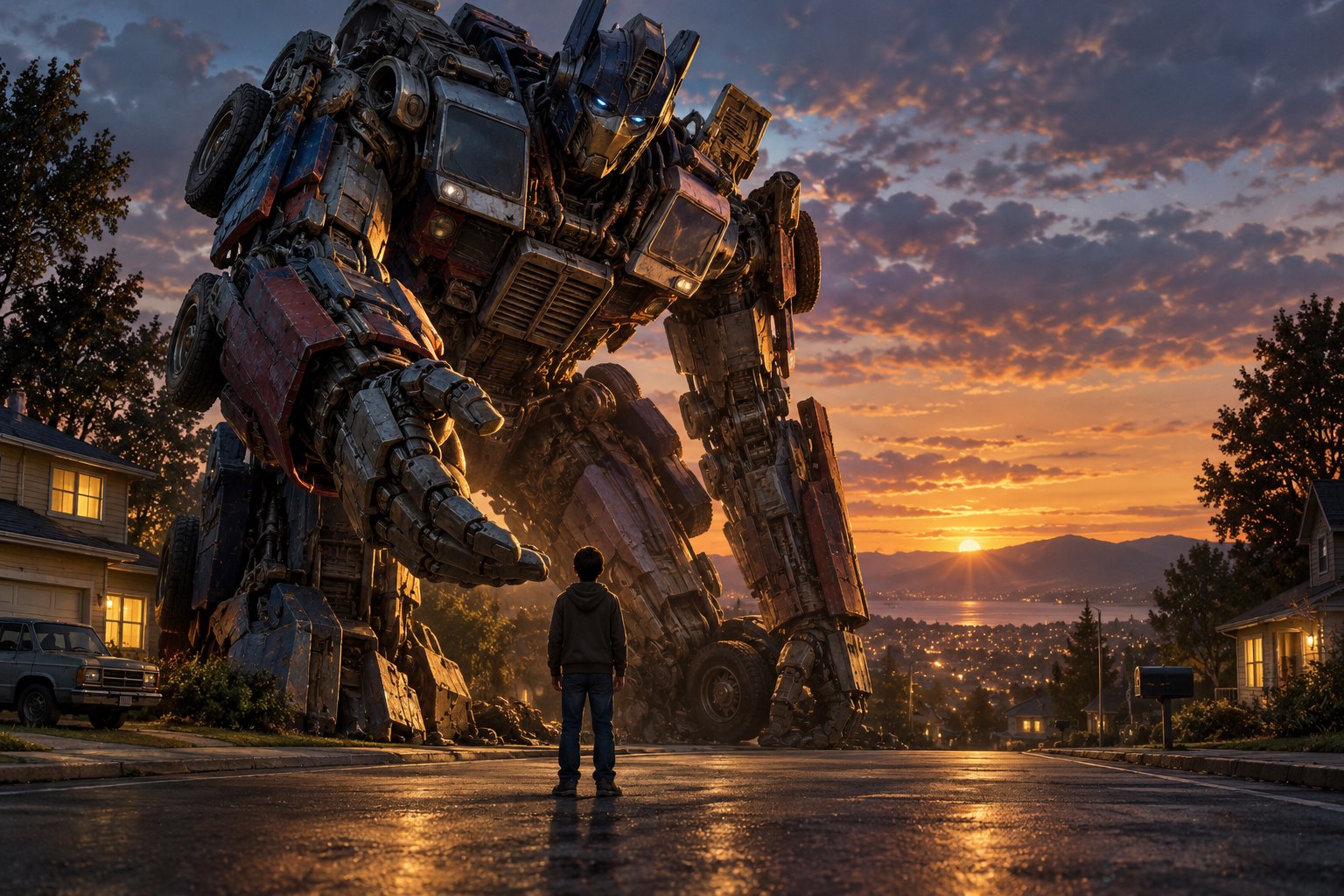
Steven Spielberg and Michael Bay are associated with the next Transformers movie, according to Deadline’s report of their return. That immediately raises a creative question: which qualities of the original live-action film deserve another life? The most persuasive answer is the relationship between an anxious teenager and a car that turns out to have feelings, loyalties, and priorities of its own.
The reported return does not, by itself, establish a release date, returning cast, or storyline. Nor should the involvement of two familiar names be treated as a verdict on a future film. But revisiting Transformers offers a useful way to judge the opportunity. Directed by Bay, with Spielberg as executive producer, the 2007 movie remains an energetic, uneven demonstration of how personal attachment can make enormous spectacle matter.
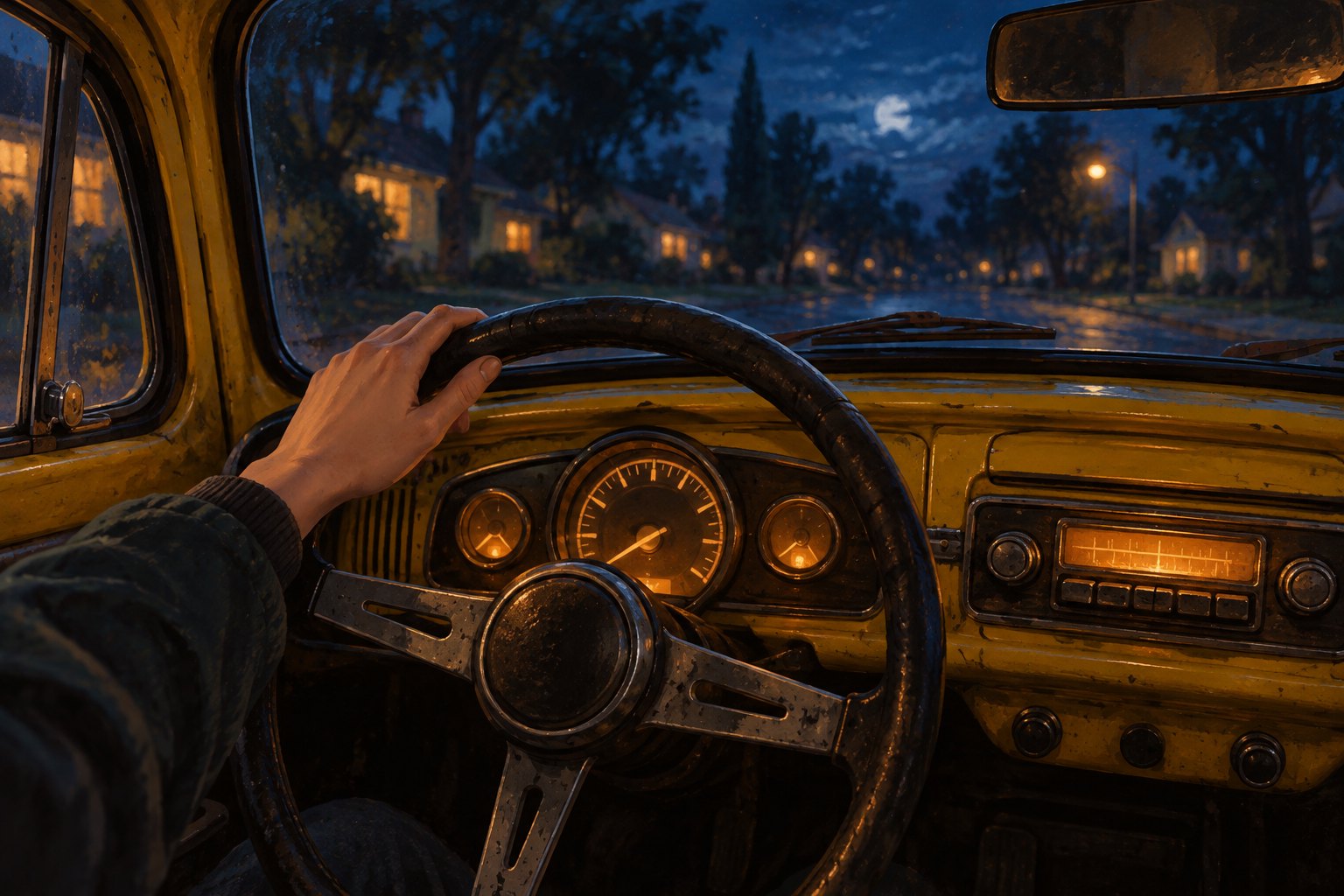
Spoiler warning: The following review discusses the characters and ending of Transformers (2007). The accompanying illustrations are conceptual artwork, not images from the next movie.
Sam’s first transformation happens before the final battle
Sam Witwicky initially wants a car for thoroughly ordinary reasons. He wants independence, social standing, and a better chance of impressing Mikaela Banes. Shia LaBeouf plays those desires with a frantic eagerness that can be exhausting, but it supplies the film with a recognizable starting point. Sam approaches adulthood as something he might obtain through the right purchase.
Bumblebee disrupts that bargain. What looks like property turns out to be a protector with agency. Sam’s purchase does not simply give him access to adventure; it forces him to reconsider the terms of the relationship. A car can be owned. A friend must be trusted.
That distinction gives the film a stronger emotional structure than its elaborate pursuit of the AllSpark might suggest. Sam begins by worrying about how he appears to other people. His growing attachment to Bumblebee asks him to worry about someone else’s welfare. When government agents capture the Autobot, the story makes that shift tangible: Sam’s distress concerns a being he knows, while the authorities see an unfamiliar threat.
The Witwicky motto, “No sacrifice, no victory,” initially sounds like parental advice inflated into a heroic slogan. As Sam becomes responsible for more than his own embarrassment, it acquires substance. The film is most convincing when courage feels like something this nervous kid must improvise.
Bumblebee makes machinery feel personal
Bumblebee’s appeal depends on more than the novelty of a transforming vehicle. His use of radio audio gives him comic timing and a way to intervene in Sam’s life. He can be helpful, playful, and conspicuously opinionated without stopping the movie for an explanation of his personality.
That is efficient character writing through behavior. The audience learns to recognize intention in an engine, a musical cue, or a change of movement. The mechanical body becomes expressive because it responds to the people around it. Much of the pleasure lies in realizing that Sam is not the only participant steering their encounters.
My strongest reservation about the film is that it sometimes loses confidence in this simplicity. Military operations, government secrecy, comic detours, and alien exposition compete for attention. Some of that expansion creates scale; some delays our return to the relationship that makes the scale meaningful.
The distinction also informs our analysis of the storytelling challenge facing Battlefield: an audience needs to understand who depends on whom before a large battle becomes more than coordinated destruction.
Mikaela deserves the attention her abilities earn
Mikaela is the clearest example of the movie both developing and undermining a character. Megan Fox plays someone whose mechanical knowledge and willingness to act make her useful long before the final confrontation. Yet the camera repeatedly emphasizes her desirability, narrowing our view precisely when her competence could broaden it.
That creates a tension between what Mikaela does and how the film presents her. From Sam’s perspective, she begins as someone to impress. From her own perspective, she has practical knowledge, an uncomfortable family history, and reasons to resist being judged by appearances. The more attention the film gives those qualities, the more interesting their relationship becomes.
Her contribution during the climax is especially effective. After Bumblebee loses the use of his legs, Mikaela uses a tow truck to help him move and fight. Her established abilities become essential to the action. The solution is understandable, physical, and rooted in character.
It also reverses the usual arrangement. Earlier, Bumblebee transports and protects the humans. Now a human provides his mobility. Their partnership becomes reciprocal. A future installment could learn a great deal from that exchange: supporting characters become memorable when their particular abilities change what is possible.
Optimus Prime gives the spectacle a moral argument
Optimus Prime brings a different register to the film. His measured authority creates a pause within Bay’s restless style. Where Sam is discovering responsibility, Optimus already carries its burden: leadership means deciding what his people may demand of another world.
“Freedom is the right of all sentient beings” supplies the ethical standard. Humanity’s flaws do not erase its claim to protection. Optimus recognizes another species as deserving a future, even when individual humans respond to the Autobots with suspicion or force.
His willingness to sacrifice himself by taking the AllSpark into his chest gives that belief a cost. Sam ultimately destroys the cube in Megatron’s chest instead. The decisive action belongs to the human who began the story hoping a car might improve his social life.
The film does not explore every consequence with equal patience. Jazz’s death, for example, receives less emotional space than its brutality warrants. That imbalance is a useful warning for the next movie. Declaring that robots are people requires giving their losses time to register, not merely assigning them names and distinctive silhouettes.
Where Bay’s spectacle works—and where it becomes tiring
Bay excels at making familiar surroundings feel inadequate to contain the action. The Autobots around Sam’s home produce comedy because enormous bodies must negotiate a space designed for ordinary family life. Scale becomes a dramatic problem, rather than simply a measurement.
The larger battles are less consistent. Rapid movement, densely layered machinery, and frequent changes of viewpoint can make individual actions difficult to read. The images deliver impact even when the relationships between bodies, streets, and objectives become harder to follow.
My judgment is that the film remains entertaining because its best sequences offer an immediate personal objective beneath the commotion: protect someone, escape capture, keep a friend moving. Those objectives give viewers something to follow when the frame becomes crowded. As our character-focused review of Jumanji explores, fantastic danger lasts in the memory when it changes an identifiable human relationship.
The deeper lesson for Spielberg and Bay’s next chapter
The richest reading of Transformers is about learning to see beyond usefulness. Sam encounters a vehicle and discovers a friend. Mikaela is treated as an attractive passenger but proves indispensable. Optimus encounters a vulnerable, imperfect species and recognizes lives worth defending.
That pattern makes the film more interesting than its loudest moments suggest. Its characters improve when they recognize capacities and needs they initially overlooked. Its weakest moments occur when the filmmaking itself overlooks those things, rushing toward another joke or collision.
One small visual callback fits this preoccupation with appearances: the yellow Volkswagen Beetle at the used-car lot recalls Bumblebee’s original vehicle form. It rewards familiarity with the franchise without requiring it. That is a useful model for Easter eggs in the next installment—details that enrich a scene already doing its dramatic work.
Spielberg and Bay’s reported return creates an opportunity to revisit this combination of wonder, mischief, and responsibility. The creative test will be whether the next film makes its machines feel like someone. The 2007 movie earns its affection whenever it remembers that a transformation becomes meaningful when it changes a relationship.
Original content by this site's editorial team. Published: October 6, 2026 at 09:42:59 PDT (Los Angeles time)