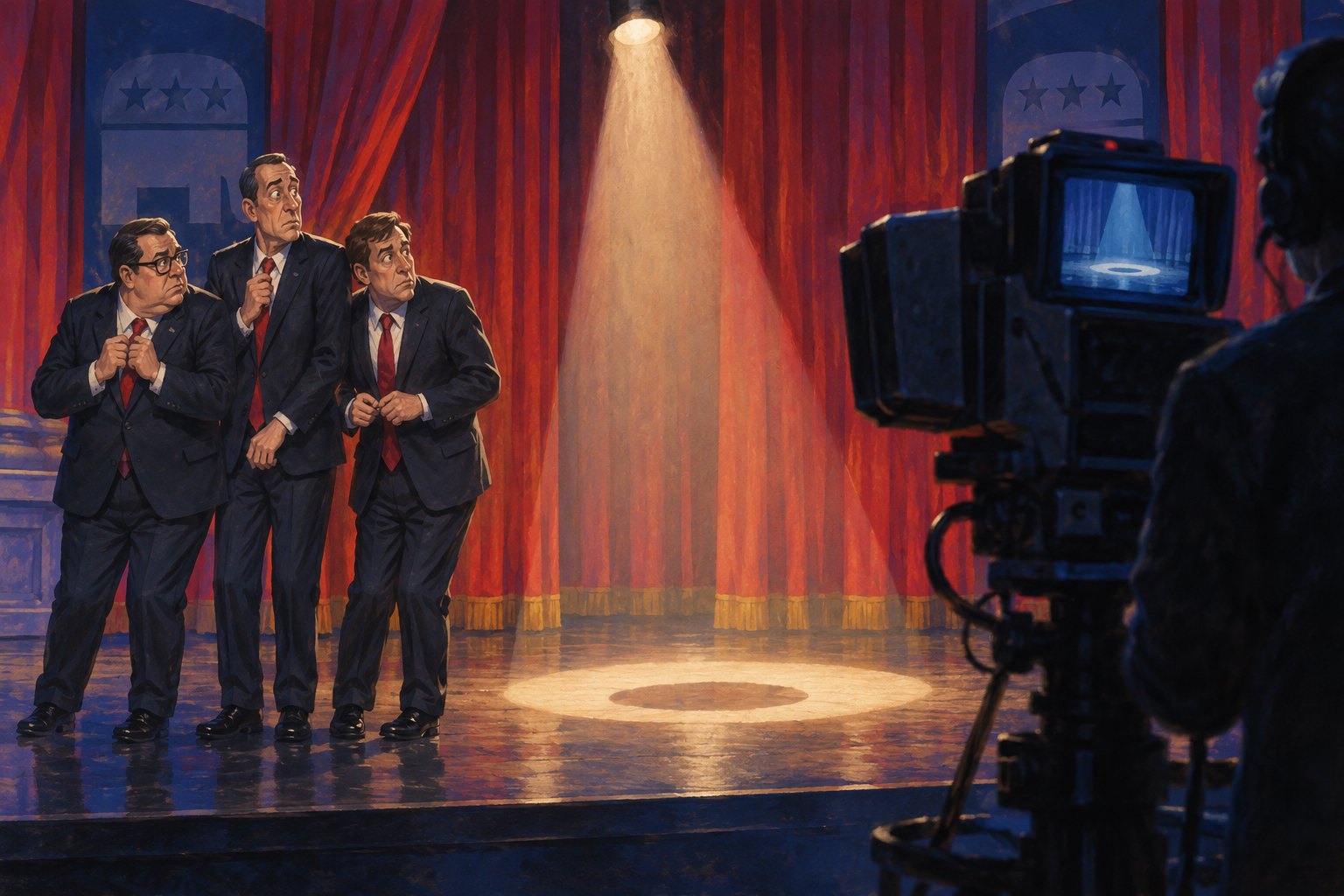
Saturday Night Live turns Republican campaign messaging into a character problem in its midterms-themed cold open: what happens when the people expected to sell confidence become reasons to doubt it? The reported sketch targets Donald Trump and his Republican allies, with Marco Rubio’s alarm, Pete Hegseth’s slam poetry, and Mitch McConnell among its subjects. The advertising premise gives those political impressions a shared purpose—and a useful source of friction.
The most interesting critical angle is the pressure on the supporting players. An ally must appear credible enough to persuade an audience while remaining attached to someone else’s political identity. That tension offers more dramatic material than a familiar face or voice alone. It makes loyalty something a character has to perform.
Spoiler note: This commentary discusses the reported premise and selected jokes from the cold open. It analyzes those elements rather than offering a shot-by-shot recap or an assessment of the full episode.
A Campaign Ad Gives the Impressions Something to Do
A political impression can earn recognition almost instantly. Recognition, however, is only a starting point. A sketch needs a reason for its characters to occupy the same comic world, and a Republican midterm advertising setup supplies one: these people are supposed to make their party appealing.
That objective creates a simple test for every appearance. Does the character communicate reassurance, competence, or solidarity? Or does the attempt to do so expose something less flattering? The audience can understand that test without needing a detailed explanation of every political reference.
Campaign advertising is particularly fertile territory because its purpose is to eliminate ambiguity. It packages a candidate, a party, or a cause into an easily understood promise. Comedy can work in the opposite direction, letting an inconvenient feeling break through the packaging. Fear is especially disruptive because it suggests that the person delivering reassurance may need reassurance themselves.
My reading of the premise is that the allies matter because they complicate the sales pitch. A leader can insist that everything is going well. The people associated with him offer another place to look for strain. In character terms, the sketch’s question becomes whether they can keep their public assignment separate from their own discomfort.
Rubio’s Panic Makes Loyalty Personal
One reported line gives that discomfort an unusually direct expression: “Oh my God! He tricked us!” Associated with the sketch’s Rubio portrayal in coverage of the cold open, the exclamation turns a political alliance into a story of perceived betrayal.
The revealing word is “us.” It places the speaker inside the group experiencing the problem. He is no longer merely describing a situation for voters; he is implicated in it. That is a useful comic reversal for a figure appearing within a campaign-messaging premise, where the expected posture is command.
The line also offers the character a possible defense. Claiming to have been deceived can acknowledge that something went wrong while limiting personal responsibility. That does not establish anything about the real Rubio’s beliefs. It describes the dramatic logic available to the fictionalized version: panic and self-exoneration can arrive in the same breath.
For me, this is where the premise becomes more interesting than a collection of insults. The character’s problem is not simply that he looks foolish. It is that his explanation for looking foolish may further weaken the political message he is associated with. His attempt to account for his predicament becomes part of the predicament.
Hegseth’s Slam Poetry Turns Messaging Into Performance
The reported Hegseth slam-poetry segment introduces a different comic vocabulary. Where alarm suggests a loss of control, a conspicuous performance can suggest an attempt to seize it. The shift in form matters even before considering individual lines.
Spoken-word performance foregrounds rhythm, emphasis, and the speaker’s presence. Put that form inside a political advertising parody and a useful question emerges: is this character communicating with voters, or demonstrating an image of himself? Those goals can overlap, but they are not interchangeable.

The comic potential lies in that distinction. A performer can sound absolutely certain while offering an audience little reason to share that certainty. Delivery becomes the thing being advertised. Read this way, the Hegseth device makes political self-presentation visible as a performance with its own habits and demands.
There is also a limit to the device. An unexpected performance style is not automatically a developed joke. The stronger version of this kind of satire makes the stylistic detour expose a character’s priorities. The weaker version asks viewers to laugh simply because an official is doing something incongruous. That is the standard I would bring to the segment: does the poetry reveal an attitude, or merely decorate an impression?
Trump’s Allies Expand the Satire’s Field of View
Coverage also identifies McConnell and Trump as targets of the midterms-themed opening. Their inclusion widens the ensemble, but it does not by itself establish a detailed argument about either portrayal. What can be discussed more securely is the value of distributing attention across a political group.
A Trump-centered sketch risks making everyone else a spectator. An allies-centered premise gives the surrounding figures a stake in what is happening. Their association with the central figure becomes something they must manage in public, and that management can reveal character.
This is also a useful distinction in screen criticism more broadly. Our discussion of how satire handles responsibility and self-deception in Digger considers a related critical problem: exposing a powerful figure is only part of the work. The surrounding behavior helps determine what the satire actually asks us to notice.
The Audience Should Watch the Relationship, Too
The best question to bring to this cold open is not simply whether an impression resembles its subject. It is what the character wants from the people watching. Approval, forgiveness, admiration, and reassurance produce different kinds of comedy, even when they share the same campaign backdrop.
That attention to relationships also informs our commentary on Taylor Swift’s appearance in Dakota Johnson’s SNL monologue. A recognizable guest or political figure supplies immediate interest; the interaction determines whether that interest develops into a scene.
The deeper promise of this cold-open premise is a satire of borrowed confidence. Political allies are expected to project strength together, yet each personality brings needs that can interfere with the collective message. Panic asks for understanding. A theatrical performance demands attention. Neither necessarily helps sell reassurance.
That is the most productive way to read the reported material: as a comedy about people struggling to embody the message they represent. Its sharpest idea is that a campaign’s chosen messengers can disclose the very uncertainty its advertising exists to conceal.
Original content by this site's editorial team. Published: October 4, 2026 at 13:17:46 PDT (Los Angeles time)