Saturday Night Live takes aim at Pete Hegseth and Robert F. Kennedy Jr. through a cold open built around speeches associated with the USS Lincoln. The immediate attraction is recognizable political impersonation. The more interesting critical question concerns the people on the receiving end: what happens when a public address becomes an exhibition of the speaker’s personality?
TV Insider identifies both men’s speeches as the sketch’s targets, while other coverage emphasizes Hegseth’s treatment of sailors and the ship’s return. Those elements establish a useful way into the comedy. A military audience gives political boasting a particular context: the people listening have responsibilities and experiences that cannot be answered simply by sounding forceful.
Commentary and limited spoilers: This analysis discusses the reported premise and one reported joke. It evaluates their comic implications rather than offering a complete scene-by-scene recap or treating parody dialogue as evidence about the real people portrayed.
Why the USS Lincoln Setting Matters
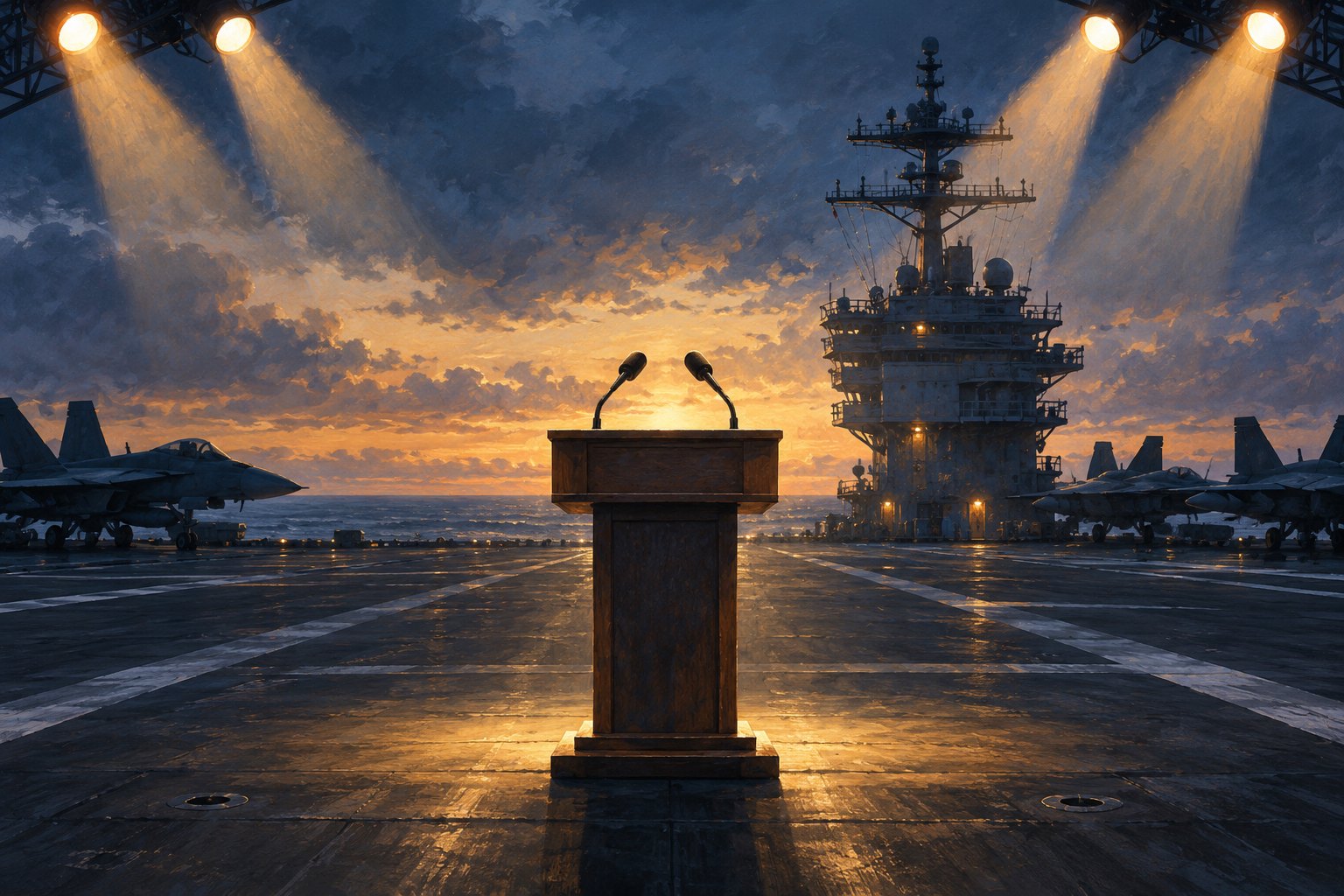
A speech aboard a naval vessel arrives with expectations already attached. The setting suggests discipline, responsibility, and recognition of service. For a satirist, those expectations are valuable because they create a standard against which a speaker’s behavior can be judged. The venue supplies seriousness before anyone opens their mouth.
That makes the choice of setting more consequential than a convenient background for familiar impressions. A generic press conference puts the emphasis on what an official says to the public. A speech to sailors asks a more personal question: does this official understand the people directly in front of him?
My reading of the premise is that this relationship offers its strongest potential. The comic tension sits between the authority a speaker brings into the room and the attention he owes the audience. An impressive setting can amplify a speaker’s stature, but it can also expose how poorly his performance fits the occasion.
There is a useful distinction here between spectacle and dramatic situation. Spectacle gives us a recognizable figure in a recognizable place. A dramatic situation gives the participants different needs. The official wants to communicate something about himself or his leadership; the listeners have reasons to care about what his words mean for them. Political comedy acquires substance when those needs collide.
Read Hegseth’s Caricature Through the Audience
Coverage highlighting the sketch’s mockery of Hegseth’s treatment of sailors points toward a relationship worth examining, rather than merely an inventory of personal mannerisms. The question becomes how the caricature exercises authority. Does the speech acknowledge the listeners as people, or does their presence chiefly give the speaker an occasion to perform?
That is a critical lens, not a factual claim about every exchange in the sketch. It is also a stronger basis for interpreting a political character than asking whether an impression sounds convincing. Vocal accuracy can establish recognition quickly. A character’s relationship to other people determines what that recognition is used to say.
Consider the audience’s position within the premise. Sailors attending an official address do not occupy the same social role as customers choosing a comedy show. The ceremony carries hierarchy with it. That imbalance allows a speech to become uncomfortable even before a joke reaches its punch line: one person has the microphone, while the others must absorb the performance.
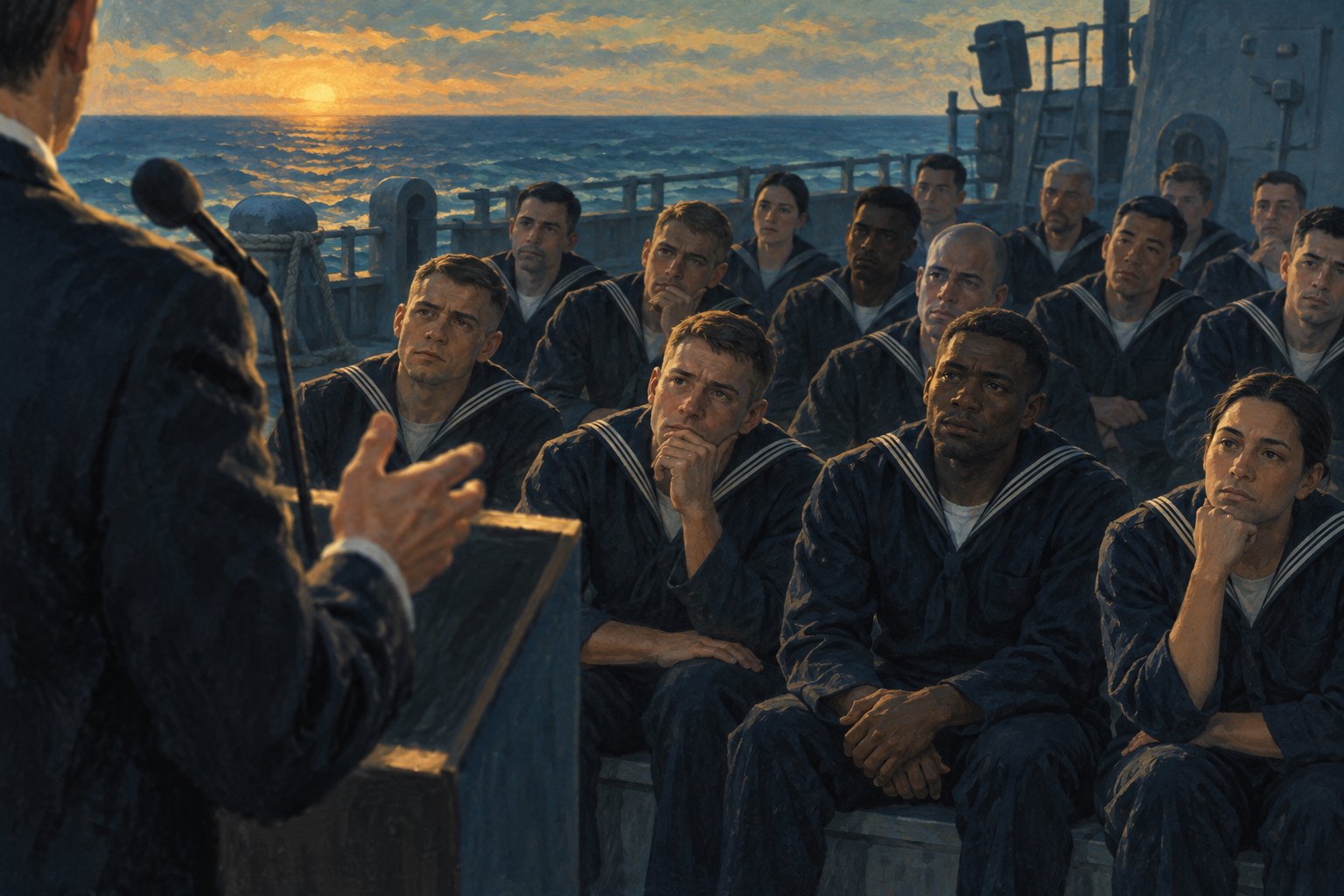
For me, this is the most productive perspective from which to approach the cold open. Keep the listeners in mind while considering the speakers. A boast means something different when heard by people who might reasonably expect acknowledgment, clarity, or reassurance. The setting makes those expectations part of the joke’s moral weight.
What the RFK Jr. Joke Does With Comparison
One line highlighted in Yahoo’s coverage calls someone “the only man who snorts more rhino horn than me.” It is an intentionally grotesque comic comparison. It should be understood as parody dialogue, not as a verified allegation of anyone’s behavior.
The wording has a specific mechanism. The first part presents an outrageous distinction about another person. The final two words, “than me,” turn that distinction into a self-own. The speaker cannot complete the comparison without including himself in the absurdity.
That reversal is more revealing than the shocking image alone. A speaker who appears to be introducing or describing somebody else ends up volunteering an equally ridiculous account of himself. The line briefly collapses the distance between the person making the judgment and the person being judged.
Placed within a premise featuring Hegseth and RFK Jr., that kind of joke invites a reading of public authority as mutual performance. Association can validate people, but comedy can reverse the process: a comparison meant to establish stature instead spreads embarrassment. The men’s proximity becomes part of the satirical argument.
The limitation is that outrageous imagery can dominate everything around it. Viewers may remember the animal reference and forget the setting. In my judgment, the more durable element is the sentence’s self-implicating structure. It gives the speaker a comic blind spot that survives beyond the initial shock.
Political Impressions Need More Than Recognition
A topical cold open faces a difficult compression problem. It must establish who is being portrayed, orient viewers to the situation, and find jokes before familiarity turns into repetition. Recognition helps with the first task. It cannot automatically accomplish the other two.
For this premise, the useful test is whether the USS Lincoln setting changes how we understand the caricatures. If a joke could be transferred unchanged to any podium, its relationship to the occasion may be thin. If the joke exposes a mismatch between a speaker’s priorities and his listeners’ needs, the situation is doing real dramatic work.
That distinction also helps separate provocation from construction, a question explored in our commentary on what makes provocation funny in an SNL monologue. An uncomfortable subject can attract attention. The arrangement of character, expectation, and reversal determines what the attention rewards.
Self-directed embarrassment introduces another useful comparison. Our analysis of Shane Gillis’s self-deprecating nickname considers how a performer controls an unflattering description. Political caricature can invert that relationship: the character speaks confidently while the audience recognizes an embarrassment he does not.
The Deeper Question: Who Is the Speech For?
The most compelling interpretation of the USS Lincoln premise concerns attention. Public ceremonies appear to identify their audience clearly, yet a speaker can address a group while remaining preoccupied with his own image. Satire makes that possibility visible by pushing the performance past the point of dignity.
Hegseth and RFK Jr. provide recognizable targets, but the sailors give the premise its ethical center. Reading from their position changes the standard of judgment. The question is no longer simply whether the men sound authoritative. It is whether their authority produces anything useful for the people listening.
That is why I find the audience relationship more promising than the sheer outrageousness of an isolated line. The reported premise creates room for a pointed criticism of leadership as performance. Its deepest comic possibility lies in a simple failure of perspective: a speaker may believe the occasion exists to display him, while everyone facing him has a different reason for being there.
Original content by this site's editorial team. Published: October 11, 2026 at 09:00:49 PDT (Los Angeles time)