
A great movie soundtrack changes our understanding of the person on screen. A confident entrance can become a confession of insecurity; an ordinary drive can suggest the life someone desperately wants. Spirited Away, Shrek 2, The Social Network, Drive, Inside Llewyn Davis, and Moonlight offer six especially persuasive examples of what film music can accomplish this century.
These are our editorial selections, chosen for the relationship between music and storytelling. Here, soundtrack includes original scores, existing songs, and performances within the story. Those forms work differently, but each can give us access to feelings a character struggles to express.
Spoiler warning: The discussion includes major character developments and endings.
Spirited Away (2001): Music That Takes a Child Seriously
Joe Hisaishi’s score gives Hayao Miyazaki’s extraordinary spirit world an emotional scale we can recognize. Chihiro begins the film unhappy about moving. Before the bathhouse’s strange rules and threatening inhabitants dominate her experience, the delicate piano of “One Summer’s Day” makes her unease worth hearing.
That choice matters. An adult might dismiss her reluctance as childish complaining. The music allows sadness and uncertainty to exist without demanding that she justify them. Once her parents are transformed into pigs and she must work for Yubaba, that initial vulnerability remains beneath her growing resourcefulness.
The train journey toward Zeniba is the essential listening moment. After the bathhouse’s frantic activity, the film gives Chihiro time to sit, look, and travel. Hisaishi’s restrained accompaniment makes this pause feel like part of her development. Courage includes enduring uncertainty when there is no immediate task to keep fear occupied.
Listen for: How the quieter music preserves Chihiro’s sensitivity even as she becomes more capable. Her strength never requires emotional numbness.
Shrek 2 (2004): A Villain Tries to Control the Love Story
Shrek’s visit to Fiona’s parents exposes an insecurity his jokes cannot resolve: perhaps loving her means becoming someone her world will accept. The soundtrack’s playful familiarity makes that anxiety accessible without draining the comedy of energy.
The decisive musical sequence is Fairy Godmother’s performance of “Holding Out for a Hero,” sung by Jennifer Saunders. Inside the ballroom, she supplies the entertainment for a romantic outcome she intends to control. Outside it, Shrek and his allies struggle to interrupt that outcome. The editing lets one performance serve competing versions of the story.
From Fairy Godmother’s perspective, heroism should look like Prince Charming. From Shrek’s, it means reaching Fiona before someone else determines her future. The song becomes an argument over who gets to define a desirable partner.
That gives the spectacle more substance than a familiar pop hook alone could provide. It also connects with the question of how unconventional romantic heroes challenge a community’s expectations: appearance becomes a public judgment that the lovers must decide whether to accept.
The Social Network (2010): Ambition With an Emotional Undertow
Trent Reznor and Atticus Ross give David Fincher’s dramatization of Facebook’s beginnings a sound that can feel purposeful and unsettled at once. Electronic momentum suits the work of building something rapidly. The exposed piano of “Hand Covers Bruise” suggests a more vulnerable story beneath the achievement.
The distinction is especially useful when watching the film’s version of Mark Zuckerberg. His verbal speed encourages us to mistake command of an argument for command of himself. “You have part of my attention,” he tells a lawyer, turning apparent indifference into a weapon.
The music complicates that performance of superiority. Following the opening breakup, it makes his movement through campus feel isolated rather than victorious. Later conflicts over ownership and loyalty extend a pattern: connections can be created technologically while becoming harder to sustain personally.
Listen for: The tension between forward motion and emotional stasis. The enterprise expands, but the film keeps returning to a person who cannot simply build his way out of rejection. This is an interpretation of a dramatized character, not a diagnosis of the real individual.
Drive (2011): The Sound of Someone Imagining Himself as a Hero
Cliff Martinez’s score and songs including Kavinsky’s “Nightcall” and College and Electric Youth’s “A Real Hero” help make Drive’s unnamed protagonist seem both inviting and remote. The music offers an emotional fluency that his sparse conversation rarely supplies.
His attachment to Irene and her son creates the possibility of an ordinary life. Against that possibility, the soundtrack’s luminous electronic textures can sound like a private fantasy: protection, intimacy, belonging. Yet his involvement in a robbery and the violence that follows expose how poorly that fantasy fits his methods.
The elevator sequence makes the contradiction impossible to ignore. Tenderness gives way to extreme brutality, and Irene witnesses a side of him that romantic atmosphere cannot explain away. The film asks us to reconsider what we have accepted as reassuring.
“A Real Hero” therefore works best as a question hanging over the character. What does his idea of heroism allow him to do, and what does it cost? It is the kind of relationship between atmosphere and moral tension explored in our discussion of what gives a stylish crime film emotional weight.
Inside Llewyn Davis (2013): Talent Cannot Guarantee a Future
In the Coen brothers’ portrait of a struggling folk singer, music is work, identity, and the strongest evidence for taking a difficult person seriously. The soundtrack, produced by T Bone Burnett, gives Llewyn something his daily behavior frequently obscures: the ability to hold another person’s attention without antagonizing them.
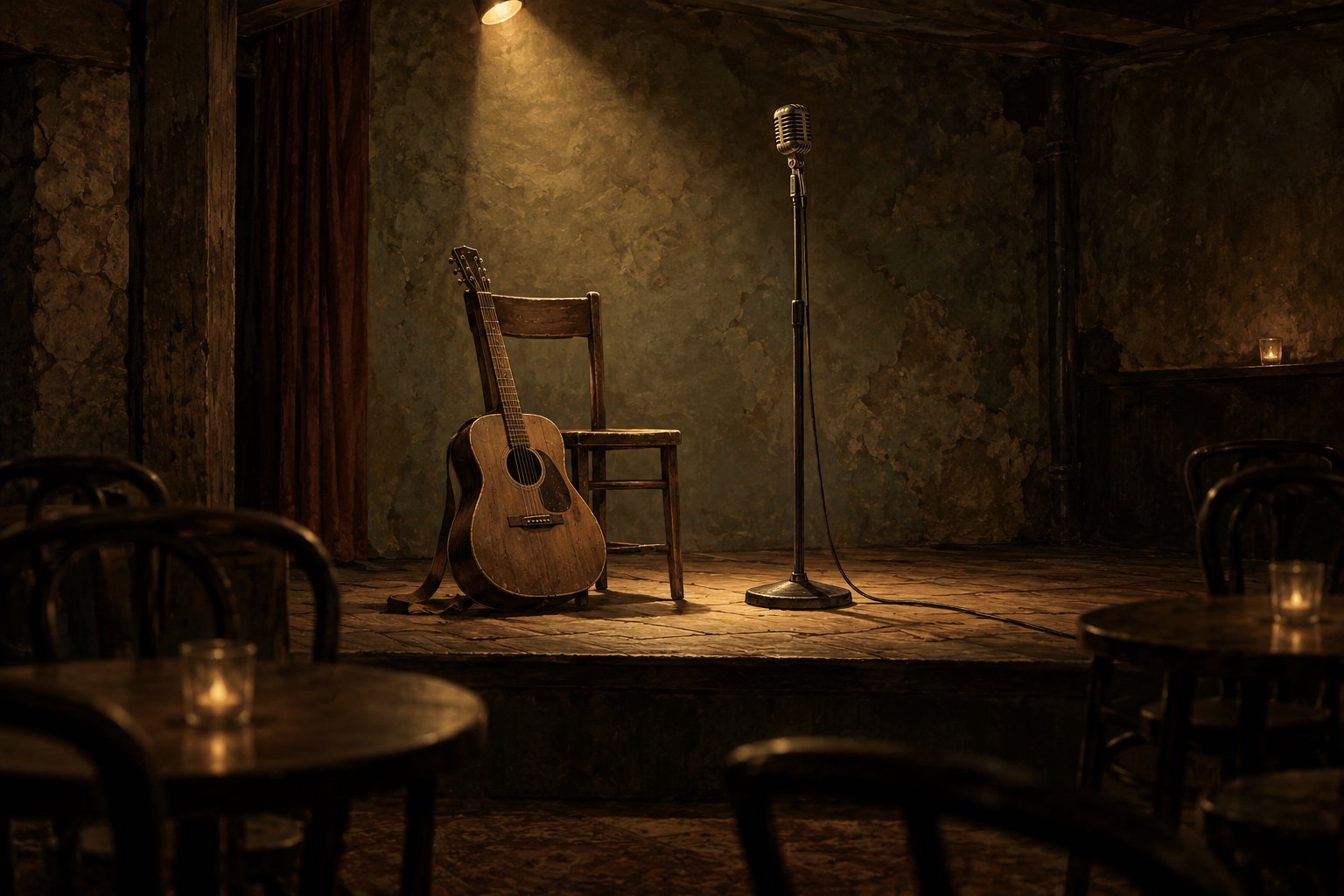
Oscar Isaac’s performances let us hear why Llewyn persists. His singing has concentration and emotional authority. The film then refuses to convert those qualities into a promise of success. After his Chicago audition, Bud Grossman’s verdict—“I don’t see a lot of money here”—answers a different question from the one Llewyn hoped his performance would settle.
That gap is the film’s wound. Llewyn needs artistic worth to become practical security, and the world offers no dependable exchange rate. Meanwhile, grief over his former musical partner complicates the very idea of performing alone.
Listen for: The difference between Llewyn singing and Llewyn defending himself. The music allows us to recognize his gifts without excusing the harm he causes.
Moonlight (2016): A Score That Keeps Vulnerability Audible
Nicholas Britell’s music follows Chiron through the three chapters of Barry Jenkins’s film without treating his changing appearance as proof of an entirely new person. Strings and piano offer tenderness; slowed and pitch-altered textures give that tenderness weight and instability.
The approach fits a character whose survival depends partly on concealing himself. As an adult, Chiron has developed a physically imposing exterior. The music helps us remain attentive to the frightened child and uncertain teenager within that presentation.
When he reconnects with Kevin, Barbara Lewis’s “Hello Stranger” gives their diner encounter an emotional invitation neither man could easily deliver in conversation. Familiarity and distance occupy the same room. A song can make reunion feel possible before either person knows what it means.
Chiron’s eventual admission, “You’re the only one,” makes the stakes painfully specific. His reserve has never meant an absence of feeling. The soundtrack’s achievement is to keep that feeling present without making him explain it at every turn.
What These Six Soundtracks Understand About Character
Across these films, music often reveals the distance between a person’s public behavior and private need. Mark performs superiority; Llewyn performs indifference to compromise; the Driver performs control. Chiron’s guardedness protects a desire for connection. Chihiro and Shrek must discover which expectations deserve their obedience.
On a rewatch, ask three questions: Who can hear the music? Whose feelings does it seem to express? Does the next action confirm or challenge that impression? Fairy Godmother’s ballroom performance and Llewyn’s audition become especially revealing through those distinctions.
The greatest movie soundtracks reward listening beyond recognition. They let us hear what a character wants, then leave enough room to judge what that character does.
Original content by this site's editorial team. Published: October 25, 2026 at 08:55:45 PDT (Los Angeles time)