
Seth Rogen has addressed the long-developing Figment movie, but his rare comment offers little concrete guidance about when audiences might see it. Asked by Entertainment Weekly about its development, he responded, “Let me get back to you on that.” Asked what he could reveal about the character’s interpretation, he said, “I can’t tell anything.” Those remarks establish a limited public response, without establishing a production timetable. [Reporting on Rogen’s remarks](https://wdwnt.com/2026/09/seth-rogen-comments-on-figment-movie-4-years-after-announcement/).
For anyone searching for a release date, a confirmed storyline, or a first look at the film, this exchange does not provide those answers. What it does invite is a worthwhile creative question: how could a movie turn a character associated with a Disney World attraction into someone whose choices hold our attention across a feature?
This is spoiler-free development commentary and adaptation analysis. It offers no verdict on a completed Figment film and treats possible storytelling approaches as possibilities.
What Rogen’s response actually tells us
A brief, guarded answer can acquire more significance than its wording supports. Readers may interpret it as encouraging evidence of ongoing work, while others may hear uncertainty. Neither interpretation establishes how far the project has progressed. Rogen’s unwillingness to discuss specifics leaves its practical status unresolved in this exchange.
That distinction matters because a movie’s public profile and its readiness for production are separate things. A recognizable character and a familiar filmmaker give audiences something to discuss. They do not, by themselves, tell us whether a screenplay is ready, a production schedule exists, or a finished film will deliver a particular tone.
Our editorial assessment is therefore cautious: the comment is a reason to revisit the idea, while expectations should remain flexible. A fuller announcement would be more useful if it explained the story’s central relationship and identified a concrete production milestone. Until then, enthusiasm is best directed toward the character’s potential.
The ride offers a conflict between control and curiosity
Disney’s description of Journey Into Imagination With Figment provides a clear starting point for character analysis. Dr. Nigel Channing, played in the attraction by Eric Idle, attempts to demonstrate the connection between the senses and imagination. Figment disrupts his presentation as visitors travel through the Imagination Institute’s sensory laboratories. These are details of the attraction, with no implication that they describe the proposed film. [Disney’s attraction description](https://www.disneyworld.co.uk/attractions/epcot/journey-into-imagination-with-figment/).
Read dramatically, that setup contains two competing perspectives. Channing wants a demonstration to proceed according to a plan. Figment introduces the unexpected. The comedy comes from the distance between an orderly explanation of imagination and imagination behaving in ways that refuse to stay orderly.
From Channing’s perspective, interruption threatens his authority. From Figment’s, the interruption can be the discovery. That is a useful distinction for an adaptation because it gives the characters different ideas about what a successful experience looks like. One wants to complete the presentation; the other makes the detour worth taking.
My reading is that this disagreement offers more dramatic potential than a sequence of whimsical environments alone. A film could explore the discomfort of losing control and the pleasure of finding something the original plan could never have produced. Whether the eventual project uses Channing or a different relationship remains a separate, unanswered question.
A movie needs consequences for Figment’s playfulness
A ride can move visitors from one entertaining disruption to the next. A feature benefits from carrying an emotional consequence forward. After a surprising encounter, someone should want something different, misunderstand another character, or face a choice that was previously avoidable.
For a potential Figment film, the challenge would be to preserve playfulness while giving it direction. If every problem can disappear through an unrestricted burst of imagination, suspense may become difficult to sustain. Viewers need to understand why a particular obstacle matters and why an easy solution cannot satisfy the character’s deeper need.
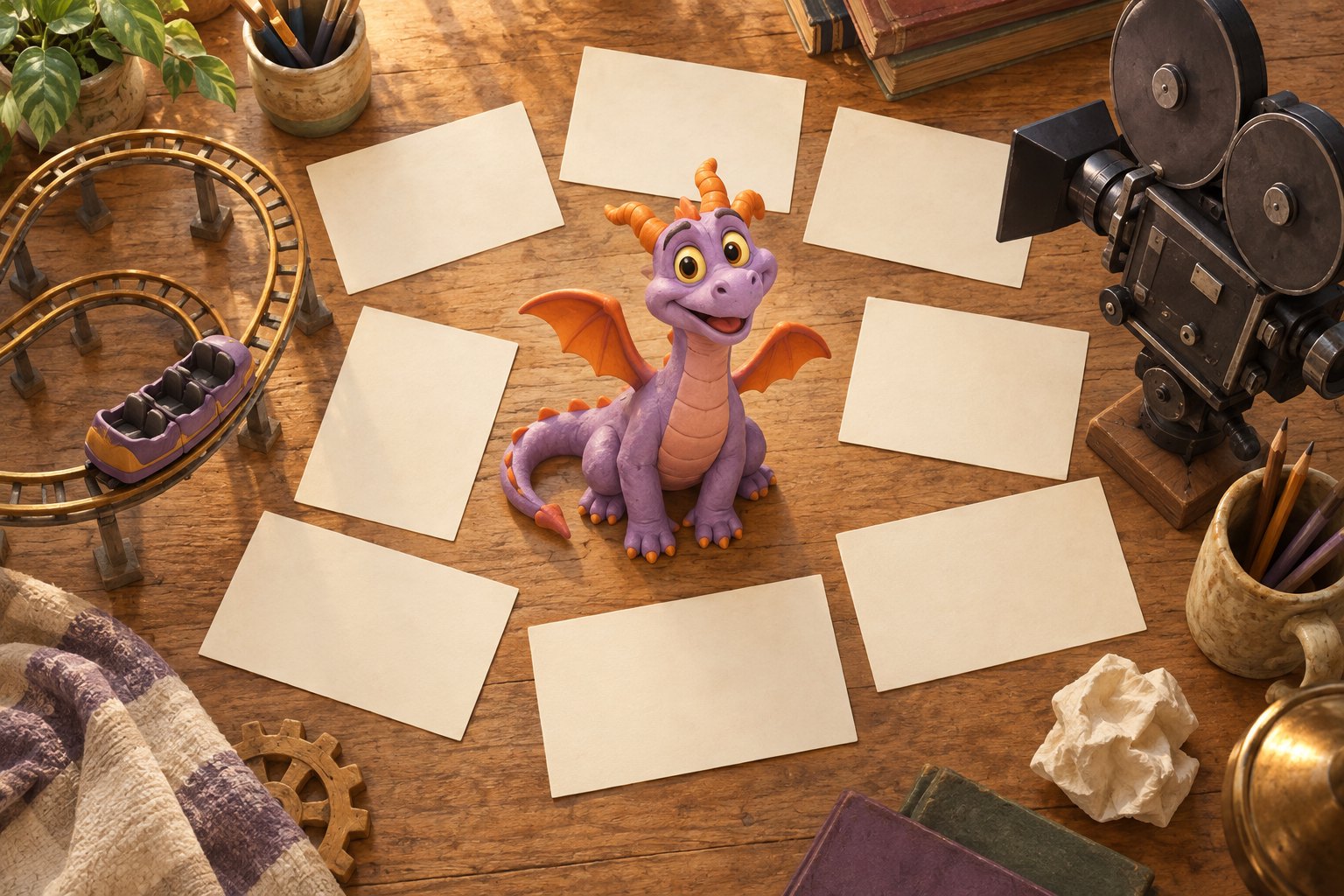
One possible approach would be to make understanding another person harder than transforming the surroundings. Visual invention could open doors without automatically repairing trust or overcoming embarrassment. That is a hypothetical storytelling principle, rather than a proposed plot: spectacular ability becomes more interesting when it cannot solve every kind of problem.
The distinction also protects Figment from becoming a device that exists only to help someone else. A strong screen interpretation would give his behavior a recognizable intention. Even a character defined by surprise needs an emotional logic, so that viewers can look back at an unexpected choice and understand why he made it.
This emphasis on preserving a character’s identity across formats connects with our analysis of the adaptation challenge facing Andrew Scott’s Sea Wall. The source formats differ, but both invite attention to what makes a character compelling before the cinematic presentation grows around them.
The humor should reveal how Figment sees the world
The most promising comic question is what Figment notices that another character overlooks. A joke built around competing perceptions can reveal personality while moving a scene forward. An isolated reference may produce recognition without telling us anything about the person making it.
That suggests a useful standard for the eventual dialogue: could the line belong to almost any comic sidekick, or does it express Figment’s particular way of thinking? Memorable dialogue usually feels inseparable from the character’s desires and circumstances. There is no verified film dialogue here to quote or assess, and inventing lines would obscure the distinction between anticipation and criticism.
Visual comedy deserves the same care. An impossible space could delight viewers immediately, then become more rewarding if the way characters navigate it exposes their differences. The audience would be watching personality expressed through action, with the environment serving the relationship.
Familiarity should open the door for new viewers
A Figment movie would need to welcome people who have never experienced the attraction. Its first responsibility would be to make the character interesting within the film itself. Recognition can enrich that encounter, but the essential emotional information should be available on screen.
That is also how references to the ride could earn their place. A familiar detail would be most effective when it contributes to the setting, a joke, or a character decision. Without verified footage, there are no film Easter eggs to identify. A checklist of hoped-for appearances would tell us more about expectations than about the movie.
The broader problem of spectacle competing with relationships also informs our character-focused commentary on Practical Magic 2. For Figment, the corresponding question would be whether each expansion of the imaginative world brings its characters into sharper focus.
The deeper promise is a change in perspective
Rogen’s comment leaves the movie’s future uncertain in practical terms. Creatively, however, the attraction suggests a meaningful possibility: a story in which imagination changes how characters interpret their circumstances and one another.
That would give the film something to build beyond novelty. The emotional destination could be the ability to meet uncertainty with curiosity, while still acknowledging that other people have needs and limits. In my view, a satisfying Figment adaptation would leave audiences with affection for a distinct personality and a renewed appetite for looking closely. The next substantial update will matter most when it begins to show how that personality becomes a story.
Original content by this site's editorial team. Published: September 15, 2026 at 09:06:10 PDT (Los Angeles time)