
Sergei Loznitsa’s Imperium has won Best Film in Official Competition at the 2026 BFI London Film Festival. Announced on October 18, the award recognizes an archival documentary that returns to Soviet life through footage recorded by Italian cameramen in the early 1970s. The distinction matters: this is the festival’s Official Competition prize, a category separate from its documentary award. [BFI’s award announcement](https://www.bfi.org.uk/london-film-festival/news/competition-winners-announced-70th-bfi-london-film-festival)
The more interesting question is what that attention brings into view. An empire can describe itself through borders, institutions, and official achievements. A camera also records faces, habits, clothes, and gestures that complicate those descriptions. Imperium invites a discussion of how people become visible inside a political system that claims to speak for them.
Scope and spoilers: This critical introduction discusses the film’s documented structure and subjects, including its opening location. It is an interpretation of verified program descriptions, rather than a firsthand screening review. No unverified dialogue is quoted.
From Moscow to lives beyond the capital
According to the BFI’s program description, Imperium begins in Moscow before moving into territories whose cultural and religious differences expose relationships between colonizers and Indigenous populations. Loznitsa found the material in Rome’s Audiovisual Archive of the Labour and Democratic Movement. That movement away from the capital provides a concrete starting point for understanding the film. [BFI’s film introduction](https://www.bfi.org.uk/london-film-festival/news/official-competition-films-70th-bfi-london-film-festival)
My reading of this structure is that geography becomes a question of authority. A capital can present itself as the place where a country’s meaning is decided. Moving outward makes that assumption harder to sustain. What seems coherent from an administrative center may look much less coherent to someone whose language, beliefs, or daily needs sit outside its preferred narrative.
For viewers, the useful adjustment is to stop treating each location as another illustration of a single national identity. Ask instead what changes when the people occupying the frame become the starting point. Their lives need not be representative of an entire region to deserve attention.
Reading people without inventing their inner lives
A character-focused approach requires special care with an archival documentary. These are people recorded by cameras, with lives extending beyond whatever survives on film. They cannot automatically be assigned the clear motivations or completed emotional journeys we expect from fictional protagonists.
A smile might express pleasure, politeness, embarrassment, or awareness of being filmed. A solemn expression cannot establish political dissent. Responsible criticism can examine how an image directs our attention while acknowledging that a person’s private thoughts remain inaccessible.
That distinction makes the human stakes more substantial. Viewers can recognize someone’s individuality without claiming to know everything about them. The question becomes how much room a documentary gives people to remain complex, rather than whether every face can be recruited as evidence for a thesis.
Our discussion of why the working crew matters in Alien approaches a related critical principle through fiction: large ideas acquire emotional weight through particular lives. With archival subjects, that attention also carries a responsibility to resist invented psychology.
Belief, language, and desire complicate the official picture
MoMA’s description identifies several subjects within Imperium: local languages and traditions, fashion presentations and department stores, Orthodox Christmas observances, and Muslim prayer. Its account places religious practice alongside official atheism and consumer aspiration alongside limits on access to luxury goods. These are documented subjects, not reconstructed scenes. [MoMA’s program notes](https://production-gcp.moma.org/calendar/events/11705)
The interpretive value of such material lies in contradiction. A state’s account of itself cannot exhaust what its inhabitants believe or want. Religious practice suggests commitments that cannot be reduced to public doctrine. The attraction of desirable goods raises questions about how promises of collective well-being meet individual aspiration.
Language deserves equally close attention. A viewer reading English subtitles may receive the apparent meaning of a sentence while overlooking the significance of the language being spoken. Listening for difference can help resist the assumption that a shared political boundary creates a shared cultural identity.
None of these observations licenses an easy conclusion about every person shown. Practicing a tradition does not automatically make someone a conscious political dissident. The more productive reading allows ordinary continuity, personal attachment, and political pressure to coexist.
The archive is evidence—and a point of view
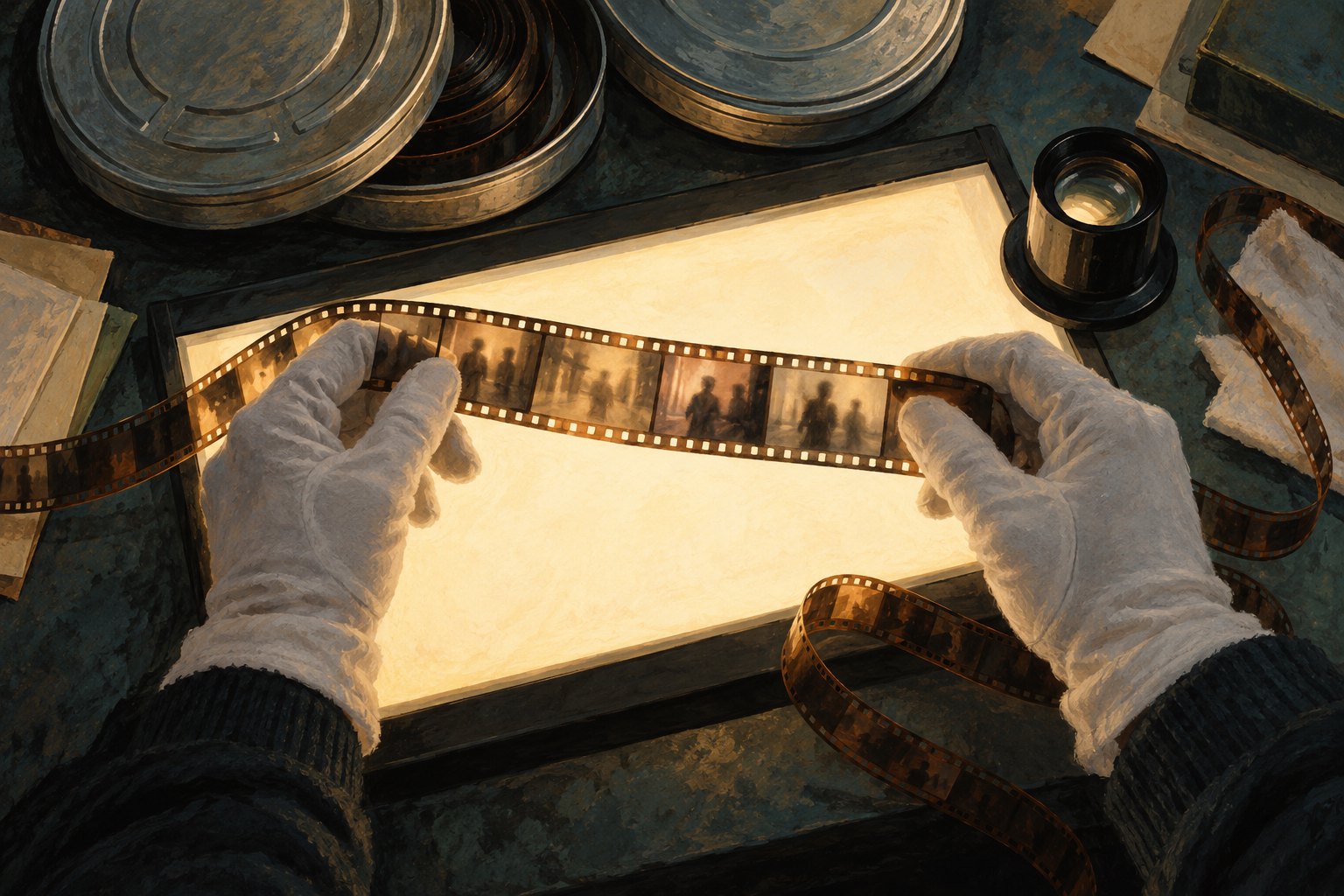
Historical footage can feel uniquely persuasive because the people and places existed before the lens. Yet a surviving image always has boundaries. Someone chose where to stand, when to record, and what to leave outside the frame. Later editing gives those decisions another context.
That makes archival filmmaking an encounter between different acts of looking. The original camera records under particular circumstances; the later filmmaker selects and arranges; the present-day audience brings knowledge unavailable to the people pictured. None of those positions is neutral or interchangeable.
A useful viewing practice is to separate observation from inference. First identify what an image actually shows. Then consider how its placement encourages a judgment. Finally, ask what additional knowledge would be necessary to make that judgment confidently. This does not drain a documentary of emotion. It makes the emotional response more accountable.
The distinction also matters when publicity precedes viewing. As our commentary on what an opening sequence can reveal argues, a meaningful introduction creates expectations without settling the value of the complete film. An award likewise offers a reason to pay attention, while leaving the viewer’s judgment open.
What the London win invites us to consider
The strongest interpretive possibility in Imperium is the tension between political scale and individual existence. An empire makes enormous claims about unity, progress, and belonging. An ordinary life may fit those claims only partially, uneasily, or temporarily.
Looking closely at that mismatch avoids two shortcuts: treating everyone as a passive product of the state, or imagining every personal difference as deliberate resistance. Human beings can participate, adapt, believe, desire, and preserve attachments in combinations that defeat a tidy label.
That is the deeper question worth taking into Loznitsa’s film after its London victory: what can an image preserve that the institution surrounding it cannot fully explain? The most rewarding response may begin with a modest discipline—letting the people in the frame remain more complicated than the story an empire tells about them.
Original content by this site's editorial team. Published: October 24, 2026 at 11:30:32 PDT (Los Angeles time)