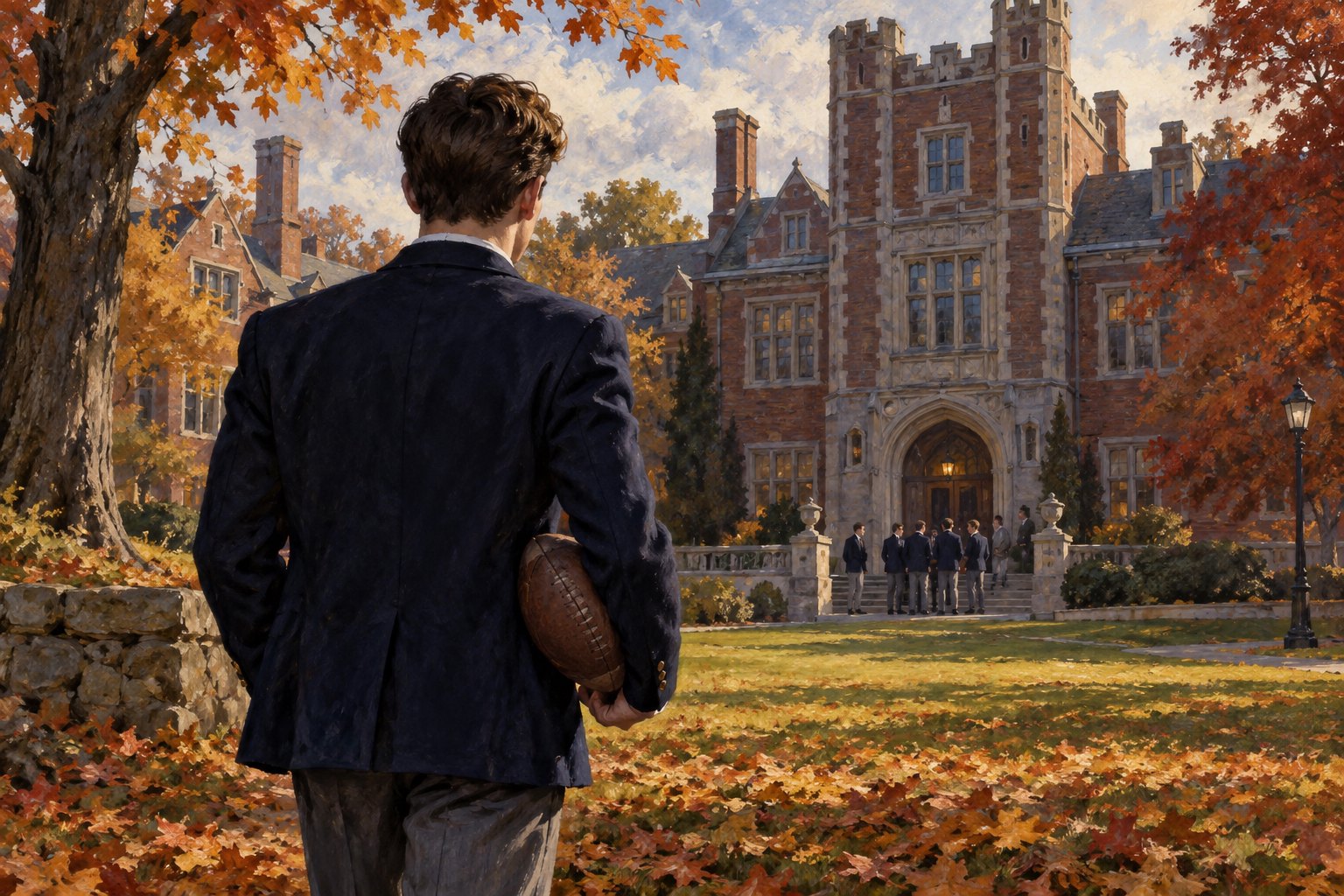
School Ties gives the nostalgia surrounding young Matt Damon and Ben Affleck an uncomfortable edge. Its handsome campus promises opportunity; its students decide who deserves to enjoy it. The claim that a movie like this could never be made today is an opinion about contemporary filmmaking, not an established production fact. What deserves closer attention is how effectively the film makes acceptance feel temporary.
The high-school setting also has a concrete production history. Middlesex School in Concord, Massachusetts, stood in for the fictional St. Matthew’s. Released in 1992, the film was directed by Robert Mandel and written by Dick Wolf and Darryl Ponicsan. Damon and Affleck appear in its ensemble, but Brendan Fraser plays its central character, David Greene. Those distinctions matter: this is David’s story, and celebrity hindsight can obscure his predicament. [The American Film Institute’s production record](https://catalog.afi.com/Catalog/moviedetails/59385) documents the credits and campus location.
Spoiler warning: The following review discusses antisemitic harassment, the cheating accusation, and the ending.
David Greene wants an education—and a place among friends
David arrives from Scranton with a football scholarship and a chance to reach Harvard. St. Matthew’s offers something his athletic ability can help secure but his family background cannot take for granted. He wants the opportunity. He also wants the ordinary pleasures surrounding it: teammates, friendship, romance, and the feeling that he belongs.
Fraser makes those desires compatible. David’s ambition never cancels his need for affection, and his physical confidence does not protect him from humiliation. That combination gives the film its emotional weight. A student can be powerful on the field and vulnerable everywhere else.
His decision to conceal his Jewish identity follows encounters with casual antisemitism. The concealment is a calculation made under pressure. David must decide how much of himself the room will tolerate before he has enough security to challenge it.
The film becomes especially perceptive when classmates later treat that silence as a betrayal. Their reasoning transfers responsibility from the people making disclosure dangerous to the person managing that danger. Friendship becomes conditional on David accepting their explanation of his own experience.
Matt Damon makes Charlie Dillon’s insecurity revealing
Charlie Dillon has the family connections David lacks, yet he experiences his future as an obligation. Harvard represents an inherited expectation. David’s arrival threatens his standing on the football team, while Sally Wheeler’s interest in David intensifies his resentment.
Damon gives Charlie enough insecurity to make his cruelty intelligible without making it defensible. Charlie can recognize David’s appeal and resent it at the same time. He wants the assurance that his name makes him exceptional, especially when another boy demonstrates qualities he cannot inherit.
His antisemitism offers a convenient way to reinterpret competition. David’s success no longer needs to count as evidence of talent or character; Charlie can turn it into an accusation that someone has entered a world where he does not belong.
My strongest response to Damon’s performance comes from that instability. Charlie’s envy briefly permits intimacy, then becomes a reason to punish the person he envies. The film understands how a confession of weakness can coexist with a determination to preserve power.
Ben Affleck’s smaller role belongs to a larger problem
Affleck plays Chesty Smith, a supporting member of the student ensemble. Watching him through the lens of his later fame can exaggerate the character’s importance. The group itself is the more revealing presence: it supplies an audience for cruelty and a social reward for going along.
That makes the surrounding students essential. An institution’s atmosphere emerges through laughter, hesitation, avoidance, and the willingness to let someone else speak first. Charlie does not need to invent every prejudice he exploits. Much of his work has already been done by the assumptions around him.
The same attention to respectable participation informs our analysis of ambition and institutional complicity in Notre Salut. The settings and stakes differ, but both invite viewers to examine the conduct that makes an institution’s stated values hollow.
Sally and Reece expose the limits of private affection
Sally’s withdrawal after David’s Jewish identity becomes known hurts because their attraction initially offers a relationship beyond his usefulness to the team. Her response reveals how quickly affection can yield to the anticipated judgment of friends.
The screenplay gives Sally less interior life than it gives David or Charlie. That is a limitation: her choices serve David’s disillusionment more fully than they develop her own character. Still, the relationship identifies a recognizable failure of courage. Enjoying someone’s company does not necessarily mean being willing to defend the relationship publicly.
David’s roommate, Chris Reece, has a more complicated trajectory, moving from hurtful suspicion toward defending him. The distinction matters. The film allows individual conduct to change without suggesting that David owes everyone unlimited patience while they reconsider his humanity.
Questions of visibility and acceptance also run through our character-focused reading of Girls Like Girls. In both discussions, being recognized is only the beginning; the consequential question is how other people respond.
The honor-code hearing puts prejudice into procedure
The cheating dispute gives the film its strongest dramatic structure. Charlie cheats, David knows it, and Charlie redirects the accusation toward him. The students’ deliberation then exposes how easily an apparently principled process can reproduce the group’s existing loyalties.

The disturbing element is the students’ ability to sound responsible while reasoning unfairly. Family background becomes a substitute for evidence. David’s earlier silence about his religion becomes an argument against his credibility. The honor code provides respectable language for a judgment already shaped by exclusion.
When the majority finds against him, David answers, “I’ll honor your traditions.” The line is bitter because compliance now requires dishonesty. His classmates have created a situation in which their procedure defeats its stated purpose.
Rip Van Kelt ultimately tells the headmaster that he saw Charlie cheat. His intervention saves David from the accusation, but it does not vindicate the student tribunal. The truth emerges because someone finally accepts responsibility for saying what he knows.
A forceful drama with visible machinery
School Ties sometimes arranges its conflicts too neatly. Academic pressure, romantic rivalry, athletic competition, and prejudice converge with the efficiency of a classroom case study. Several supporting characters feel designed to represent a response rather than surprise us as individuals.
Yet that directness also makes the film accessible. Fraser gives its argument an emotional center, while Damon complicates the easy assumption that privilege always feels comfortable to its beneficiaries. The result is an earnest, effective drama whose best moments emerge when its characters reveal more than the lesson requires.
Calling it impossible to make today does little to assess those strengths and weaknesses. A useful contemporary discussion would ask how a filmmaker might preserve David’s agency, deepen the supporting characters, and distinguish the depiction of hatred from an invitation to enjoy it. Those are creative questions, not proof of impossibility.
The ending changes the terms of David’s ambition
David’s final position is clear: “You used me for football. I’ll use you to get into Harvard.” He keeps his goal while abandoning the hope that the school’s approval will establish his worth. Charlie’s final insult receives an equally blunt answer: “You’ll still be a prick.” Both exchanges appear in the [film’s dialogue transcript](https://www.springfieldspringfield.co.uk/movie_script.php?movie=school-ties).
The deeper victory is David’s refusal to make either departure or forgiveness the price of dignity. He can remain, pursue his education, and insist that the institution remember what happened. His continued presence becomes a demand for accountability.
That is why School Ties retains its sting. David earns an opportunity, discovers its conditions, and chooses to proceed with his eyes open. The school can give him access. It no longer gets to define who he is.
Original content by this site's editorial team. Published: October 3, 2026 at 05:35:57 PDT (Los Angeles time)