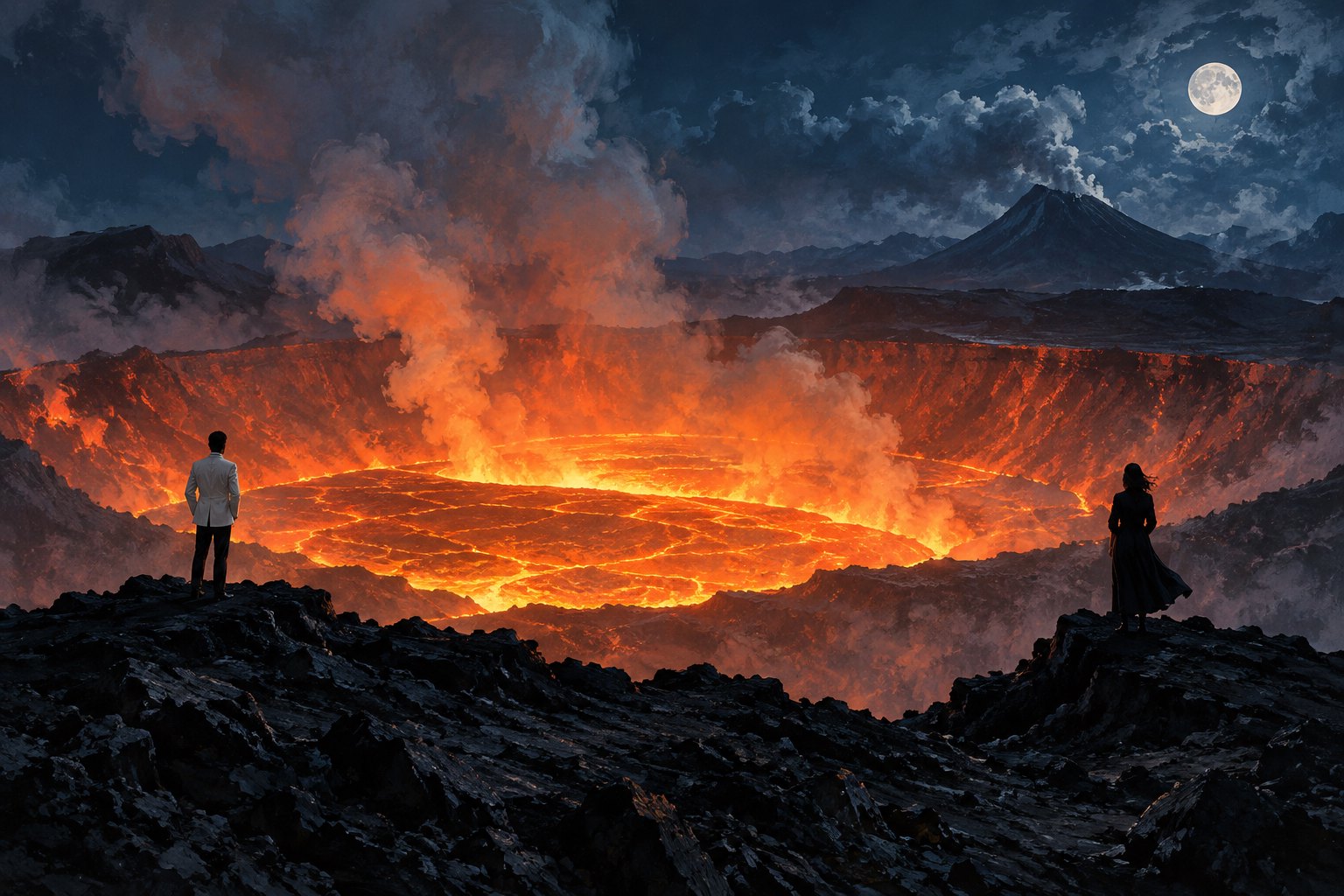
Sacrifice gives Anya Taylor-Joy’s character an alarming mission: offer Chris Evans’s character to a volcano. The absurdity is an effective invitation, but the more interesting conflict concerns ownership. What happens when one person’s search for purpose turns another person into the means of achieving it?
This is a spoiler-light first-look analysis of the announced premise, not a review based on a screening. The discussion below separates established setup from interpretation and does not reveal the ending or attribute unverified dialogue to the characters.
What Sacrifice is about
Netflix’s official first look identifies Evans as Mike Tyler, a struggling action star attending an environmental charity gala in a Greek mine. Taylor-Joy plays Joan, whose followers take the event hostage. They believe three people must be sacrificed to a volcano within three days to avert extinction. Romain Gavras directs and co-wrote the screenplay with Will Arbery.
That establishes a darkly comic collision between public image and absolute belief. It does not establish whether Joan’s prophecy is true within the film’s world. Keeping that distinction intact matters: a character’s certainty is information about the character, not automatic confirmation of the story’s supernatural rules.
Mike Tyler: when attention becomes a threat
Mike’s predicament reverses the usual appeal of celebrity. A comeback depends on people noticing you again. Being selected for sacrifice makes that renewed attention horrifying. Read through his perspective, the premise turns recognition into a trap: someone has decided he matters, but her definition of importance could kill him.
This is a more productive starting point than simply laughing at a vain actor. Vanity can be funny without making the person beneath it disposable. A compelling version of Mike would allow embarrassment, self-interest, and ordinary fear to coexist. Wanting to survive should not require him to become admirable first.
His profession also creates a useful distinction between appearing heroic and making a consequential choice. An actor can understand the outward signs of courage while having no special preparation for danger. The dramatic question is whether he can act when nobody has guaranteed that the action will look good.
That is also why vulnerability matters more than physical presence here. Our discussion of strength and vulnerability in action casting considers a related problem: a commanding performer becomes interesting when the story gives that command a limit. Mike’s situation offers an especially cruel limit—he cannot simply decide which role everyone else assigns him.
Joan: conviction does not settle the moral question
From Joan’s perspective, an approaching catastrophe would make hesitation feel intolerable. That belief supplies urgency without requiring the audience to accept her solution. The crucial distinction is between understanding why someone acts and agreeing that the action is justified.
Her demand also exposes a problem in the word sacrifice. Giving up something of your own and taking someone else’s life are radically different acts. A leader can blur them by speaking collectively: humanity needs this; the world demands it. The individual who pays the price may have no voice in that collective language.
My reading of the setup is that Joan becomes most unsettling when her concern remains recognizable. Anxiety about the future is intelligible. Treating a person as an expendable answer to that anxiety is the dangerous leap. Making her merely ridiculous would simplify the conflict and weaken its emotional pressure.
The strongest character question, then, is not whether she believes intensely enough. It is whether her belief leaves room to recognize Mike as a person. Can a mission supposedly devoted to life accommodate the refusal of the life standing directly in its path?
The charity gala puts virtue on display
An environmental fundraiser inside a mine is an immediately suggestive setting. As an image, it places polished social ceremony against a landscape associated with extraction. My interpretation is that this juxtaposition invites scrutiny of how a worthy cause becomes a backdrop for the people claiming to support it.

There is a familiar temptation in this kind of satire: once wealthy guests look foolish, the film can seem to have completed its argument. But hypocrisy is a starting point. The harder question is what responsibility would require from these particular people when applause, invitations, and flattering photographs no longer count as evidence.
Joan’s intervention potentially turns an abstract cause into a bodily demand. Yet that escalation should not erase the difference between fraudulent generosity and coercion. The guests can deserve criticism while still having a legitimate claim to safety. Holding both thoughts at once would give the comedy something sharper than easy punishment.
Why the volcano makes the character conflict stranger
A volcano is an extravagant destination because it resists the social transactions surrounding celebrity. It cannot be impressed, persuaded, or embarrassed. Symbolically, it confronts human claims of importance with something indifferent to them.
That contrast creates several possible kinds of humor. A polished public persona may become useless. Grand declarations may sound suddenly small. The audience may laugh at the mismatch between someone’s self-image and the situation without wishing for that person’s destruction.
This is where tone will determine whether the premise develops into satisfying film commentary. Relentless mockery can flatten characters; solemnity can smother an outrageous setup. The promising middle ground allows a ridiculous predicament to contain recognizable fear. Comedy need not suspend empathy to remain sharp.
For another perspective on characters struggling to matter, our character-focused guide to nine TIFF films explores how belonging and recognition shape a story’s emotional stakes. In Sacrifice, the uncomfortable possibility is that being assigned great significance may be as threatening as being ignored.
The deeper issue is who gets to define a meaningful life
The premise’s richest implication concerns the stories people impose on each other. Celebrity turns a person into an image available for public use. Fanatical certainty can turn a person into an instrument available for a cause. Those processes differ enormously in consequence, but both can make the individual harder to see.
For Mike, the meaningful challenge would be discovering a reason to act beyond recovering an audience. For Joan, it would be confronting the possibility that purpose does not grant authority over another person. These are interpretive possibilities, not claims about where their completed arcs lead.
That is why the volcano is only the beginning of the attraction. The premise earns attention through an outrageous threat; its deeper promise lies in the argument beneath it. Wanting your life to mean something is human. Deciding that someone else must surrender theirs to make that meaning possible is where the horror begins.
Original content by this site's editorial team. Published: September 19, 2026 at 12:13:45 PDT (Los Angeles time)