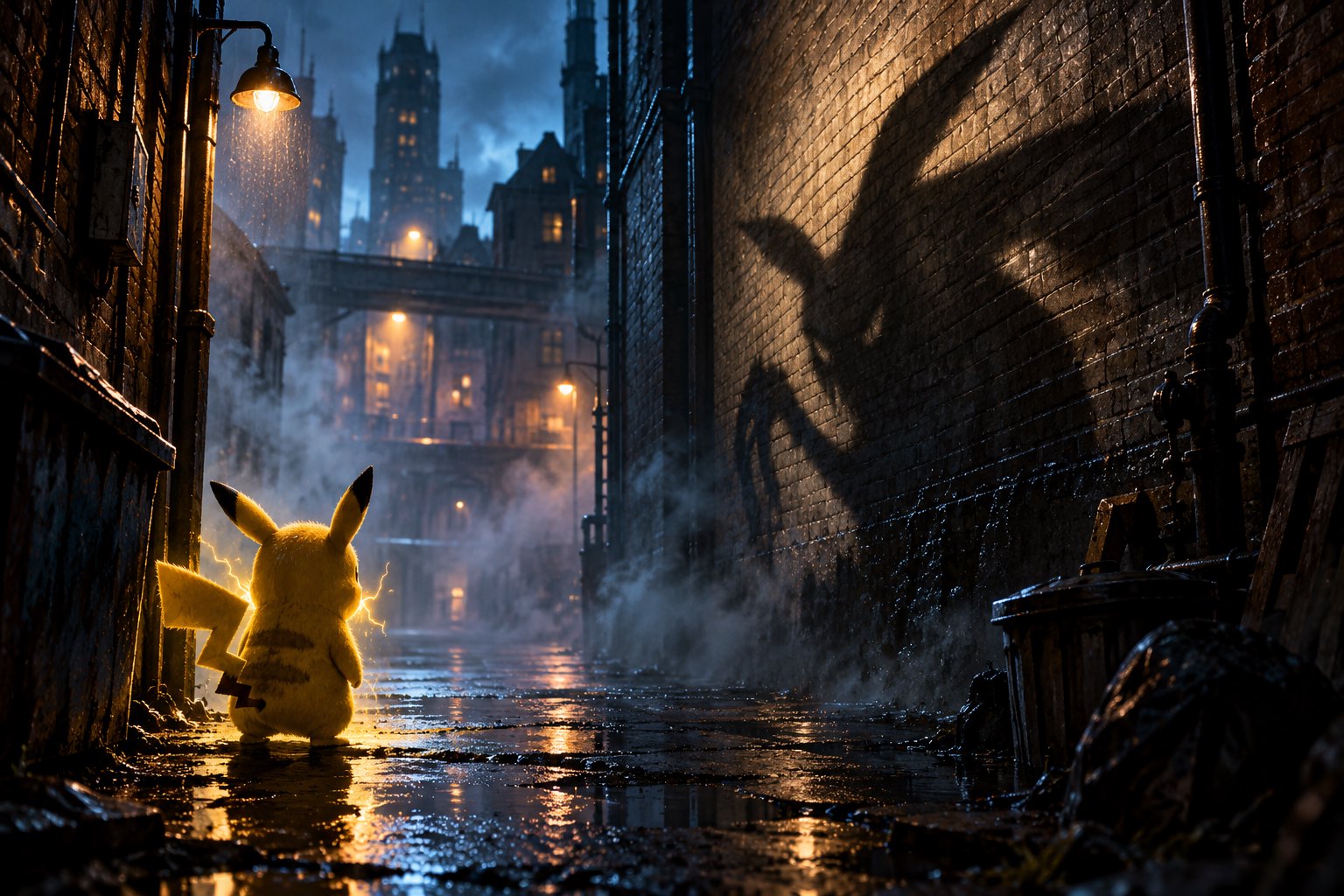
Pokémon could support a compelling horror movie. Whether that movie should be R-rated is a harder question. The franchise’s most unsettling possibilities involve broken trust: a companion becoming unfamiliar, a powerful creature being treated as property, or someone losing control of their own mind. Graphic violence could intensify those ideas, but it could also distract from them.
The prospect of an R-rated adaptation should be treated as a creative proposition, not a production announcement. There is no verified announcement established here for such a film. My judgment is that a more frightening Pokémon story is easier to imagine than an officially sanctioned adult horror release—and that the strongest argument for one already exists inside Pokémon Detective Pikachu.
Major spoilers follow for Detective Pikachu, including its villain and ending. Proposed horror scenarios are hypothetical.
Detective Pikachu makes companionship feel uncertain
The 2019 film follows Tim Goodman as he investigates his father Harry’s disappearance with Harry’s amnesiac Pikachu partner. Tim can understand Pikachu’s speech; other people cannot. That arrangement supplies the comedy, but it also creates a surprisingly fragile emotional situation: Tim’s closest ally offers an experience nobody around him can validate.
Tim’s question, “Can no one else hear him?” plays as comic disbelief. Seen through a horror lens, it also expresses isolation. Imagine depending on a voice that everyone else dismisses as an animal’s cry. The existing film makes that difference a route toward intimacy. A hypothetical horror adaptation could make the same difference a source of uncertainty without changing the basic premise.
Justice Smith gives Tim a guarded quality that matters more than the mystery’s elaborate machinery. He seems reluctant to need anyone. Pikachu’s chatter pushes against that reserve, gradually turning an unwanted encounter into a relationship Tim cannot casually abandon.
That is the film’s most useful lesson for a darker adaptation: establish what companionship provides before threatening it. A creature attacking a stranger creates immediate danger. A trusted partner becoming unreadable creates danger with a history.
Pikachu’s missing memory gives the jokes an anxious edge
Ryan Reynolds’s delivery keeps Pikachu entertaining, but the character’s confidence rests on remarkably little certainty. He presents himself as an investigator while lacking the memories necessary to investigate his own involvement. His professional swagger becomes a way of holding himself together.
“They can’t understand me, kid” sounds reassuring because it gives Tim an explanation. Yet it also defines the limits of Pikachu’s world. He has one person who can hear him and no reliable account of how he reached this situation. Beneath the wisecracks is a character who needs connection as urgently as Tim does.
The film becomes emotionally sharper when Pikachu believes he may have betrayed Harry. His fear is no longer simply that something dangerous happened. It is that he helped it happen. That distinction would sustain psychological horror far better than making a familiar Pokémon suddenly bloodthirsty.
For me, the weakness is how quickly the film moves between emotional discoveries and its next spectacle. The briskness keeps the adventure accessible, but it limits the time Pikachu spends confronting uncertainty. A horror version could slow that passage down: let suspicion affect an ordinary conversation, a familiar gesture, or the decision to accept help.
Mewtwo reveals the difference between power and cruelty
Mewtwo initially occupies the frightening position of a being whose abilities exceed the protagonists’ understanding. The investigation encourages suspicion of him, while the eventual revelations redirect responsibility toward Howard Clifford. The apparent monster is also an exploited individual.
Howard uses technology to control Mewtwo and attempts to merge Ryme City’s people with Pokémon. Read as horror, the violation is profound: individuals lose the right to determine what happens to their bodies. Howard describes transformation as progress, but his plan gives its supposed beneficiaries no meaningful choice.
The film’s most disturbing idea is therefore not that Pokémon possess extraordinary powers. It is that a person with authority can convert those powers into an instrument of coercion. Mewtwo’s imposing appearance makes him easy to fear; Howard’s respectable position makes him easy to trust. The story exposes the weakness of both assumptions.
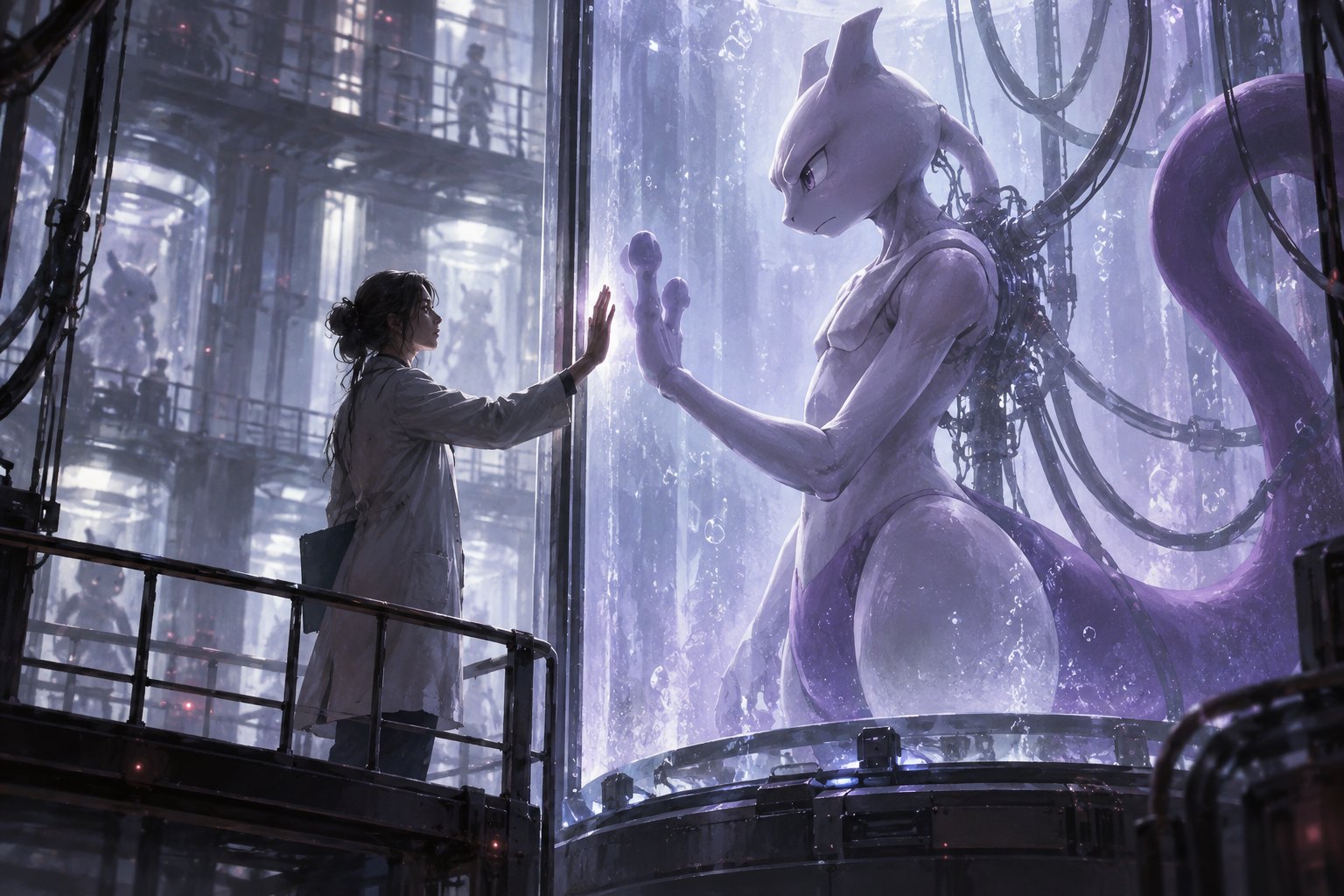
A hypothetical laboratory horror film could build on that tension by following a researcher who gradually recognizes the subject’s personhood. Every apparently routine procedure would then become a moral decision. Suspense could arise from whether the researcher will obey instructions, help the captive, or misinterpret an attempt at communication.
That approach also gives Mewtwo a perspective beyond being an impressive threat. What does confinement feel like to someone everyone assumes is too powerful to deserve protection? The question is frightening because strength offers no guarantee of freedom.
Our discussion of authority and controlled menace in Green Room offers a useful companion reading: horror becomes more disturbing when power operates through decisions and instructions, rather than spectacle alone.
What an R rating would actually need to contribute
An adult rating is not a storytelling achievement. For an R-rated Pokémon film to justify its approach artistically, the harsher material would need to reveal something that a gentler presentation could not adequately express.
Three choices would matter more than the volume of violence:
- A sustained viewpoint. Follow someone whose attachment to a Pokémon makes each threatening development personally costly.
- Consequences that persist. Let fear change relationships and decisions instead of disappearing when an action sequence ends.
- Respect for the creatures’ agency. Give Pokémon motives, boundaries, and opportunities to refuse human demands.
There is a danger in treating adult audiences as people who simply want childhood imagery damaged. Recognition can supply an initial shock, but it cannot carry a feature. A horror film needs characters worth staying with after the novelty wears off.
This is also why survivor perspective matters. As our character-focused ranking of the Halloween films explores, the people experiencing fear help determine whether a franchise installment has emotional substance. Pokémon would face the same dramatic test.
Would an official Pokémon horror movie happen?
Creative suitability and commercial willingness are separate questions. My expectation is that a suspenseful adventure would be a more plausible direction than an explicit horror film, because it could explore unease while retaining a broad audience. That is an editorial inference, not information about an unannounced development plan.
An R-rated release would also have to explain its relationship to the wider franchise. A recognizable character can connect audiences across generations; restricting one of that character’s major screen appearances creates a different proposition. That does not make the project impossible, but enthusiasm for the concept alone does not establish a business case.
Nor does a frightening scene require an entire franchise to change identity. Uncertainty, silence, offscreen space, and a character’s inability to reach a companion can produce dread without explicit injury. The most persuasive pitch would begin with a particular story that needs telling, then let its intensity determine the appropriate treatment.
The deeper horror is losing the freedom to connect
Detective Pikachu ultimately reveals that Harry’s consciousness has been carried within Pikachu, allowing Tim to rebuild a relationship with his father before recognizing him. Howard’s scheme turns a related possibility into forced transformation. The emotional distinction is between an act that preserves someone and an act that appropriates them.
That contrast gives the film more thematic weight than its busy finale initially suggests. Tim must learn to accept connection, while Howard refuses to respect separation. One relationship grows through attention; the other imposes a single person’s wishes on everyone.
A great Pokémon horror movie could explore the space between those impulses. It would understand why someone loves their companion, then make the terms of that relationship uncertain. An R rating might serve such a story. But the essential ingredient would remain the same as in the warmest Pokémon adventure: believing that the creature beside you has an inner life worth protecting.
Original content by this site's editorial team. Published: November 1, 2026 at 06:19:25 PST (Los Angeles time)