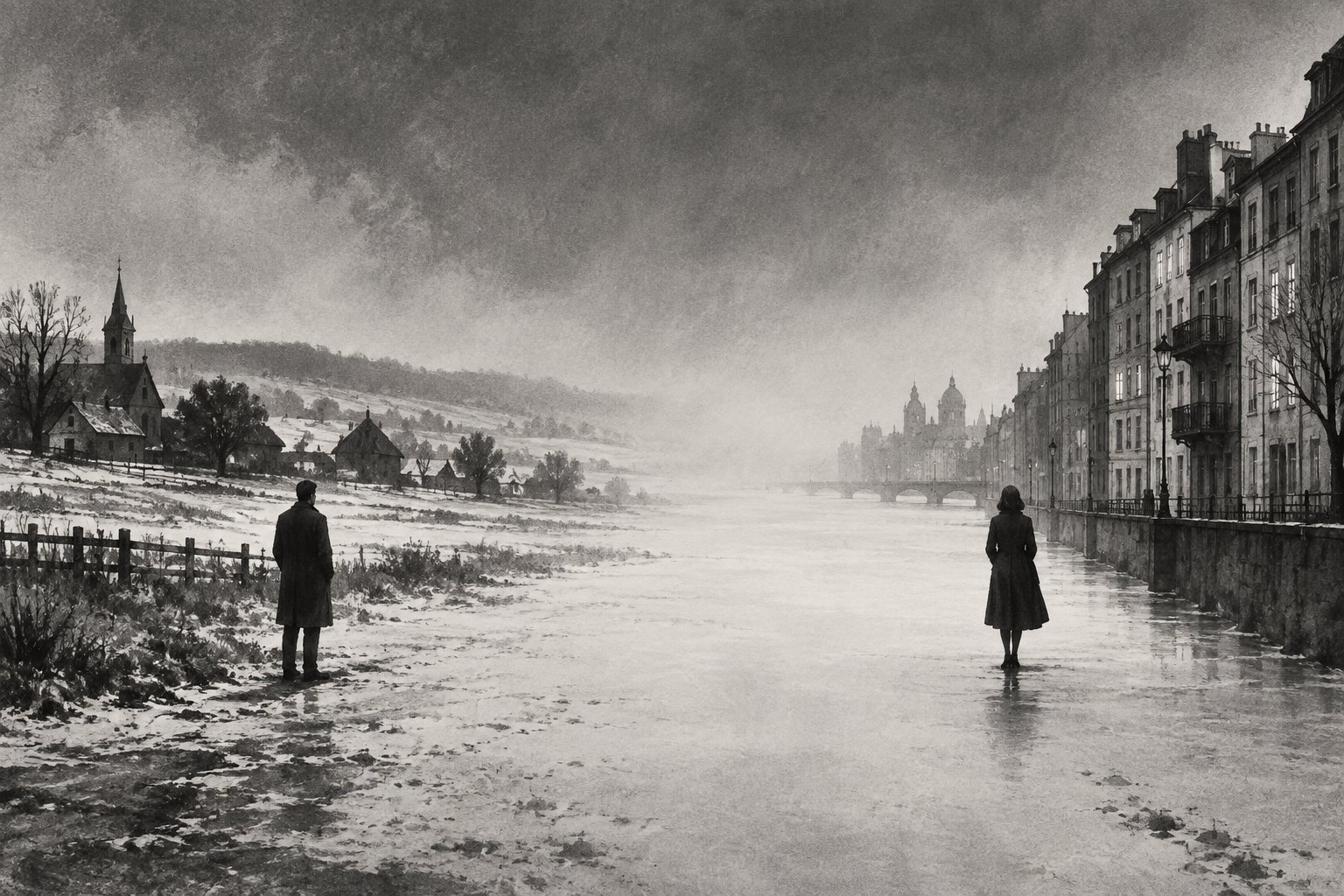
Paweł Pawlikowski makes Europe’s fractures visible through the choices people cannot make together. In Cold War (2018), a musician sees departure as liberation; the singer he loves has reasons to stay. Their disagreement turns a political border into something painfully intimate: the point at which one person’s imagined future stops including the other person’s needs.
Anthony Lane’s recent New Yorker profile brings renewed attention to Pawlikowski’s treatment of divided identities and contested belonging. Cold War offers a particularly revealing way into that subject. Its achievement, in my reading, is to make history consequential without allowing history to explain away its characters’ behavior.
Spoilers follow for the entire film, including its ending.
Learning to turn family history into fiction
Pawlikowski’s background in documentary filmmaking and his experience of living across European borders provide context for his attention to displacement. But biography alone cannot account for the precision of his films. The crucial artistic step is selection: deciding which encounter, hesitation, or absence can carry the weight of years.
The film’s production notes establish an essential distinction. Wiktor and Zula share the names of Pawlikowski’s parents, whose turbulent relationship inspired the project, but their circumstances are substantially fictionalized. Treating Cold War as a literal family chronicle would misunderstand its construction.
That distance gives the characters room to remain difficult. They need not illustrate an explanation the director has already settled upon. The film asks us to observe two people whose attraction is unmistakable and whose compatibility is much harder to establish. Its emotional honesty comes partly from refusing to confuse those things.
Zula sees an opportunity where Wiktor sees a compromise
Wiktor, played by Tomasz Kot, helps assemble a folk performance troupe in postwar Poland. Zula, played by Joanna Kulig, auditions and becomes its star. The institution that brings them together offers more than musical employment: it creates a setting in which talent can change someone’s prospects.
For Zula, that possibility matters immediately. Her confidence has an abrasive edge, and Kulig makes it difficult to separate genuine assurance from practiced self-protection. Zula understands that being watched can be useful. She also understands that the person judging her may want something beyond a good performance.
Wiktor’s cultivated restraint creates a different impression. He appears to have the authority to recognize talent and shape it. Yet the relationship raises a question that remains unresolved: can he love Zula without trying to arrange the conditions under which she becomes most legible to him?
The troupe’s growing political obligations make their differences sharper. Official demands reshape its repertoire, while Irena’s resistance contrasts with the administrator Kaczmarek’s willingness to accommodate power. Wiktor’s discomfort is real, but discomfort does not automatically become courage. Pawlikowski gives compromise a recognizable human form: someone stays quiet while another person changes the terms.
The missed escape exposes an unequal understanding of freedom
Wiktor plans to escape westward through Berlin. Zula does not join him. It would be easy to organize the entire romance around that failure and make her the obstacle to their happiness. The later dialogue complicates such a verdict.
Explaining herself, Zula says, “I wasn’t up to it, wasn’t good enough.” Her words suggest that the crossing involved more than political risk. Leaving also meant entering a world in which Wiktor might know how to live and she might not.
That distinction changes how the scene should be judged. His invitation may be sincere, but sincerity cannot guarantee that he understands its cost. What looks to him like a shared beginning may look to her like surrendering the position she has worked to secure.
The exchange demonstrates how brief dialogue can change our understanding of a relationship. Zula supplies very little explanation. The little she supplies forces us to reconsider the apparent simplicity of his offer.
Paris gives them proximity without belonging
When the lovers meet again in Paris, Wiktor asks, “So, are you happy?” It sounds ordinary, but the question tests the story each has been telling about life without the other. A new city and another relationship have not made that story convincing.
Paris eventually allows them to share a life, but their disagreements acquire new forms. Wiktor tries to build a recording career for Zula. Her voice travels into another language and another cultural setting, while she becomes increasingly uncomfortable with the version of herself being presented.
From his perspective, these changes can look like opportunities. From hers, they can feel like corrections. The difference is devastating because both responses are plausible. An arrangement that makes a singer marketable may also make her feel less recognizable to herself.
Music consequently carries an argument that their conversations cannot settle. The recurring “Two Hearts” changes through its performances and arrangements. A melody survives movement across borders, but its survival does not mean its meaning remains intact.

The relationship also becomes cruel. Wiktor strikes Zula during their conflict in Paris. That act should interrupt any comfortable description of their bond as simply passionate. Political pressure and displacement help explain the circumstances surrounding them; neither removes responsibility for what they do to each other.
Beautiful images, uncomfortable omissions
Łukasz Żal’s monochrome cinematography and the film’s nearly square frame concentrate attention on faces, bodies, and the spaces separating them. The compositions are beautiful, but their dramatic value lies in how insistently they make us look at people who cannot find a stable arrangement together.
Pawlikowski also omits connective material. Years pass between encounters. We meet the lovers again and must assess what has changed through their appearance, behavior, and immediate circumstances. The cuts make time feel spent rather than merely elapsed.
For me, this compression is both the film’s great strength and its limitation. It gives reunions extraordinary force, yet sometimes withholds the ordinary shared life that might make the attachment easier to understand. Viewers who need to see love accumulate through daily companionship may find themselves admiring the construction more than believing the romance.
That makes an illuminating comparison with the domestic bonds in Howl’s Moving Castle. Where that film builds emotional security through a household, Cold War repeatedly deprives its lovers of a durable place to belong.
The ending: devotion without a livable future
Wiktor’s return to Poland leads to imprisonment. The later reunion does not restore the life the couple might once have imagined. By the final sequence, their attachment has outlasted possibilities that could have sustained it.
They exchange vows in a ruined church, take pills, and sit together outside before leaving the frame. The sequence strongly implies a suicide pact, although their deaths are not shown. Its quietness should not make the decision seem uncomplicated or triumphant.
My reading is that Pawlikowski ends with the terrible difference between choosing someone and knowing how to live with them. The lovers can finally perform a gesture of absolute agreement, but the film has shown how little agreement they could achieve in daily life. Their final unity therefore carries grief rather than reassurance.
A musical detail worth hearing again
One subtle reference rewards a second viewing: Wiktor plays “I Loves You Porgy” when testing Zula’s voice. The production notes identify the Gershwin melody as a clue to his connection with Western musical culture. Before escape becomes an explicit plan, his musical vocabulary has already suggested a world beyond their immediate surroundings.
That small choice captures Pawlikowski’s larger method. Europe’s divisions appear in what someone sings, what someone recognizes, and what someone assumes a loved one will understand. Cold War is most powerful when those assumptions fail. Its borders are historically specific; the pain of discovering that love does not produce identical needs is not.
Original content by this site's editorial team. Published: September 29, 2026 at 06:15:30 PDT (Los Angeles time)