Pétros ení brings Pope Leo XIV into a documentary about St. Peter’s tomb, linking a present-day religious leader with the person whose memory gives the burial place its significance. The immediate attraction is that connection. The more interesting critical question is whether a film about such an imposing spiritual inheritance can preserve the vulnerability of the human being at its center.
Scope and spoilers: This is an analysis of the film’s reported material, not a review based on a firsthand screening. It discusses the described opening and central themes. Statements made about the documentary are identified separately from dialogue within it.
Peter as a person before he becomes a monument
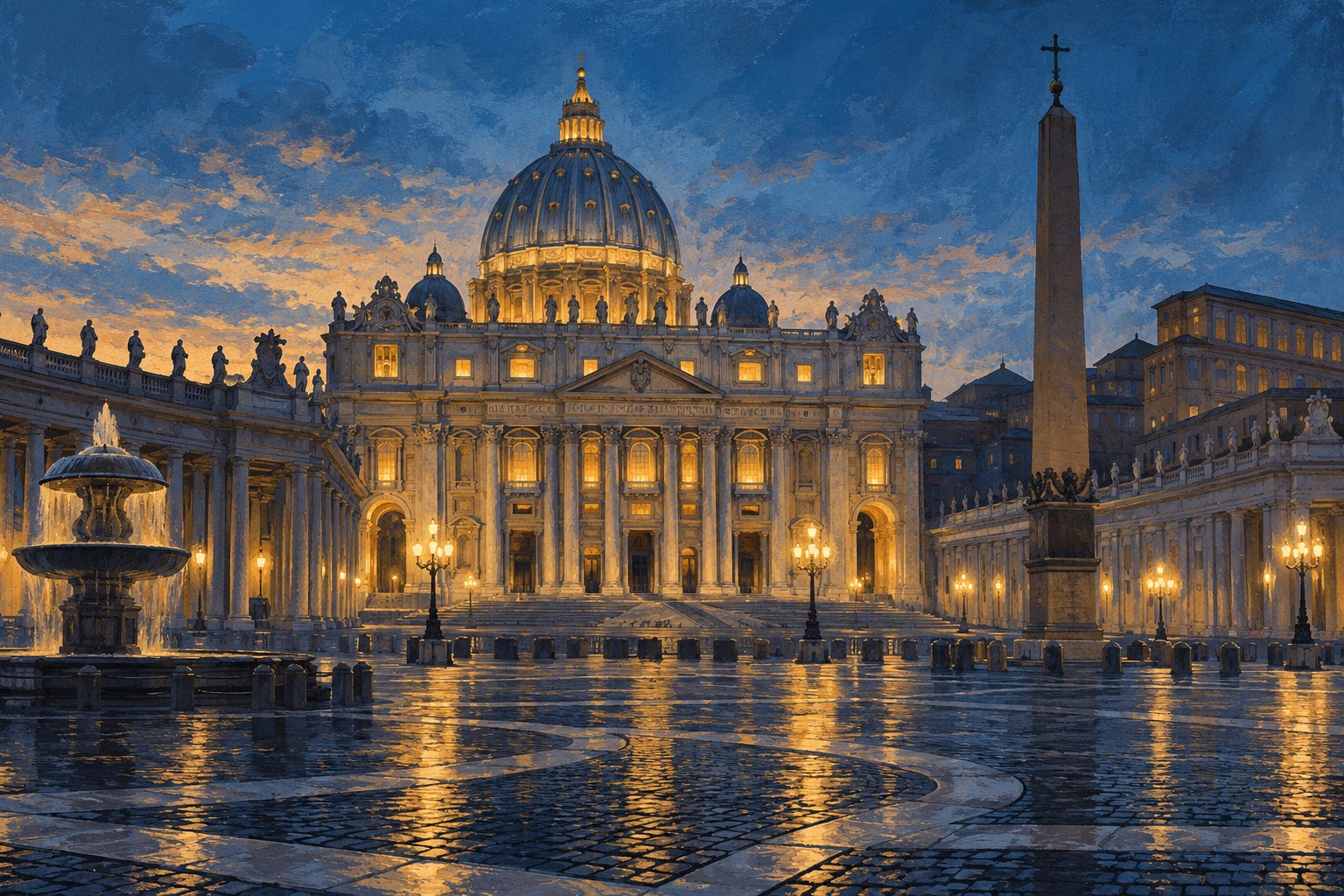
In its account of the film, Vatican News describes Chris Pratt guiding viewers toward Peter’s burial place and emphasizes Peter’s imperfection. Speaking about the project, Pratt said, “He was a weak man. He was a human being.” The report also describes an opening in which Pratt crosses St. Peter’s Square at night and enters the basilica alone. These details underpin the interpretation that follows. [Vatican News’ account of Pétros ení](https://www.vaticannews.va/en/vatican-city/news/2026-10/petros-eni-new-film-on-st-peter-with-an-appearance-by-pope.html).
Pratt’s observation is useful because it resists the flattening effect of reverence. A revered figure can become so thoroughly identified with an institution that his individual struggles disappear. The person becomes an emblem, and the audience is asked to admire him before it has any opportunity to understand him.
Weakness provides a different point of entry. It allows viewers to consider religious responsibility as something carried by a fallible person. From that perspective, the tomb matters because someone lived, struggled, and died—not simply because a magnificent building directs attention toward it.
My reading is that this is the documentary’s strongest reported dramatic proposition. Its emotional stakes need not depend on a surprise discovery. They can emerge from the distance between how small a person feels and how consequential a life becomes. That is a recognizable human tension even for viewers who do not share the film’s religious convictions.
Chris Pratt’s role: making room for the viewer
The described solitary entrance suggests a deliberate relationship between the guide and the setting. One person approaches a vast building. Before expertise enters the conversation, there is an encounter with scale.
As a storytelling choice, that arrangement can make an imposing subject approachable. A guide who appears to be discovering something gives the audience permission to discover it too. Viewers need not arrive with architectural vocabulary, theological training, or an established emotional relationship with the place.
There is also a critical distinction between communicating wonder and prescribing it. A documentary can show someone responding deeply to a location while leaving room for a viewer to respond differently. The most persuasive version of that encounter would make Pratt’s feelings intelligible without treating them as instructions.
This is where celebrity participation becomes a matter of film form. A familiar face can help viewers enter unfamiliar territory, but familiarity cannot carry the argument by itself. The guide earns his place when his attention directs ours toward something worth noticing.
That distinction also informs our discussion of documentary intimacy and the limits of understanding: feeling close to a person is an experience a film creates, and viewers still have to decide what that closeness helps them know.
A tomb carries evidence and meaning differently
A film about St. Peter’s tomb invites two related forms of attention. One concerns material evidence: what is being examined and how an interpretation is reached. The other concerns significance: why people care about the place and what they believe their connection to it means.
Those questions can strengthen each other, but they require different explanations. A moving account of devotion does not, by itself, establish an archaeological identification. An archaeological argument does not fully explain why someone experiences a place as sacred.
For viewers, the useful habit is to notice transitions between these kinds of explanation. When a documentary moves from an object to a statement about its meaning, what connects them? Is the connection supplied by historical context, an expert’s reasoning, religious tradition, or the emotional force of the presentation?
Asking that question is compatible with being moved. Indeed, understanding the steps of an argument can deepen an emotional response. Careful explanation gives viewers something more durable than the impression that a location must be important because it has been beautifully photographed.
The same principle applies to craft. Our consideration of how studying film sharpens creative judgment emphasizes the value of understanding cinematic choices. Here, attention to how images and explanations work together is part of taking the subject seriously.
What Pope Leo’s presence adds
Pope Leo’s participation gives Pétros ení an additional interpretive voice. His presence carries an authority viewers will recognize, although they may understand or respond to that authority differently.
For a Catholic audience, the connection between Peter and a living pope can make continuity feel personal. For other viewers, the appearance can illuminate how a religious institution understands its origins. Neither response requires pretending that everyone brings the same beliefs into the theater.
The important critical question is what the appearance helps explain. A recognizable religious leader can provide context, reflection, and a sense of lived commitment. The strongest contribution would give viewers a more precise understanding of Peter’s importance, beyond the significance of having a pope appear on screen.
That is also why Peter’s humanity remains essential. If the film’s interpretive center is a fallible person, its encounter with present-day authority becomes more demanding. Leadership must be considered alongside vulnerability, rather than allowing the grandeur of an office to resolve every tension.
The deeper question beneath the stone
The most productive way to approach Pétros ení is to hold the person, the place, and the institution in view at the same time. The person gives the story emotional stakes. The place gives memory a physical focus. The institution carries that memory forward and explains its continuing significance.
My provisional judgment is that the human dimension offers the richest route into this material. Monumental settings can inspire admiration almost immediately. Understanding why an imperfect person remains worthy of sustained attention takes more patient storytelling.
A firsthand assessment would still need to establish how effectively the finished film develops that idea through pacing, sound, evidence, and competing perspectives. Its reported premise, however, points toward a worthwhile question: what does it mean to build an enduring understanding of strength around someone remembered as weak? That question can outlast the spectacle of the basilica—and give the search beneath it a human purpose.
Original content by this site's editorial team. Published: October 16, 2026 at 14:11:54 PDT (Los Angeles time)