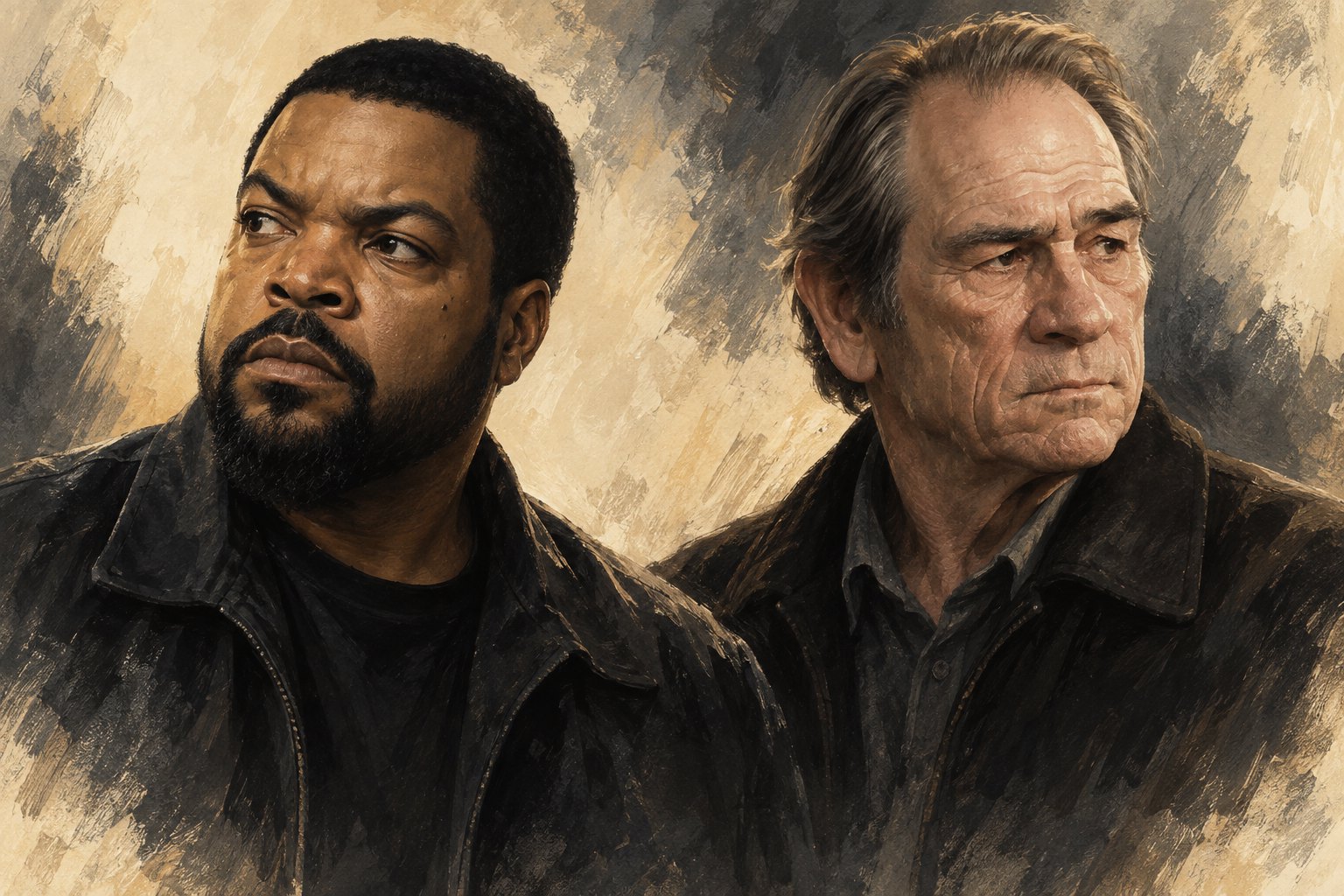
Outside Man, the Brian Helgeland project starring Ice Cube and Tommy Lee Jones, has landed global rights backing from Focus Features, according to Deadline. The business development gives the film a substantial new point of interest. For moviegoers, however, the immediate attraction is more personal: two actors whose presence can make a conversation feel like a contest, even before either raises his voice.
That is an enticing foundation for a movie. It also sets a demanding standard. Putting recognizable performers together creates anticipation; giving their characters reasons to surprise each other creates drama. The distinction will matter much more than the acquisition headline once audiences can judge the film itself.
This is spoiler-free commentary on the announcement, not a review of the finished film. The reported deal and the named talent support a discussion of expectations. They do not support a verdict on scenes, dialogue, character arcs, or an ending.
What the Focus Features acquisition establishes
The central news is straightforward: Focus Features has taken global rights to Outside Man. That identifies a company taking responsibility for the film’s commercial future across international markets. It does not, by itself, tell a prospective viewer when a local screening will happen, how extensive the release will be, or which viewing options will become available.
For readers tracking new movie releases, those distinctions are useful. A rights announcement is a meaningful step, but it is not a release calendar. Nor does it reveal the finished movie’s quality. The involvement of a distributor can encourage attention without settling whether a story fulfills its promise.
There is a related question in our discussion of how a film’s release story shapes its reception: business decisions can become the dominant way audiences understand a movie before they encounter its characters. With Outside Man, the more productive response is to register the deal and then ask what the creative combination might offer.
Ice Cube and Tommy Lee Jones bring expectations into the room
My interest in this pairing begins with their contrasting expressions of authority. Ice Cube can make directness feel like a defensive boundary: the expression suggests that someone has heard enough and is deciding whether another explanation deserves his time. Jones can make scrutiny feel almost administrative, as though a person’s entire argument has been inspected and found wanting. These are subjective impressions of their screen personas, not descriptions of their roles here.
Put those qualities into a shared dramatic space and several possibilities emerge. Agreement could be as compelling as disagreement. Two people who seem difficult to impress might communicate through small adjustments rather than declarations. A moment of attention, an interrupted reply, or a decision to stay in the room could carry unusual weight.
The danger would be treating those familiar qualities as complete characterization. An actor’s recognizable toughness can establish a scene quickly, but it cannot explain everything a character wants. If every encounter merely confirms that both men are formidable, the pairing could become repetitive. The richer possibility is that each performer makes the other’s apparent certainty harder to maintain.
The character question: who gets to change the conversation?
A useful way to assess any eventual scenes between these leads will be to follow the exchange of initiative. Who enters with a purpose? Who forces the other person to revise a position? Whose choice makes the next scene necessary? Those questions reveal whether both characters possess agency, even when one has fewer lines.
Equal dramatic importance does not require equal speaking time. A quiet character can control an encounter through refusal; a talkative one can expose powerlessness by filling every silence. What matters is whether the film makes their behavior legible from their own perspectives. Each should have something to gain, something to protect, and a limit that the other cannot simply talk away.
That concern also informs our look at the difference between a casting announcement and a character with an independent perspective. A role becomes interesting through its decisions and consequences. A famous name cannot supply those automatically.

What Helgeland’s storytelling needs to make visible
With Brian Helgeland’s name central to the project, the filmmaking question is how the story will convert these performers’ presence into specific human behavior. The strongest version of this collaboration would let character emerge through action rather than repeatedly explaining what kind of men the audience is watching.
That can be a matter of staging. Holding two people in the same frame allows viewers to watch one react while the other speaks. Separating them into close-ups can make a conversation feel private, combative, or emotionally disconnected. Neither choice is inherently better. Its value depends on what the relationship requires at that moment.
Dialogue deserves the same attention. A memorable line earns its place through the pressure around it: what someone risks by saying it, what another person refuses to acknowledge, or how its meaning changes later. No dialogue is quoted here because the announcement does not establish any. Inventing a sharp exchange would substitute an imagined movie for the one Helgeland and the actors must deliver.
What to watch for as Outside Man takes shape
Further material will be most useful when it clarifies the dramatic relationship, rather than simply repeating the cast list. A scene can reveal more than a montage if it shows what each person wants and why their objectives cannot comfortably coexist. Even then, promotional editing should be treated as an invitation to watch, not evidence that a complete character arc works.
My provisional interest is strong because this pairing suggests room for restrained, attentive acting. The eventual test is whether the film lets certainty become vulnerable: whether a look changes meaning, whether listening alters a decision, and whether one character’s presence leaves the other unable to continue exactly as before.
The deeper promise of Outside Man lies in that possibility of mutual consequence. Focus Features’ global acquisition gives audiences a business development to follow. Ice Cube, Tommy Lee Jones, and Brian Helgeland give them an artistic question worth keeping open: can familiar screen authority become the starting point for discovering people we do not already understand?
Original content by this site's editorial team. Published: October 7, 2026 at 00:53:52 PDT (Los Angeles time)