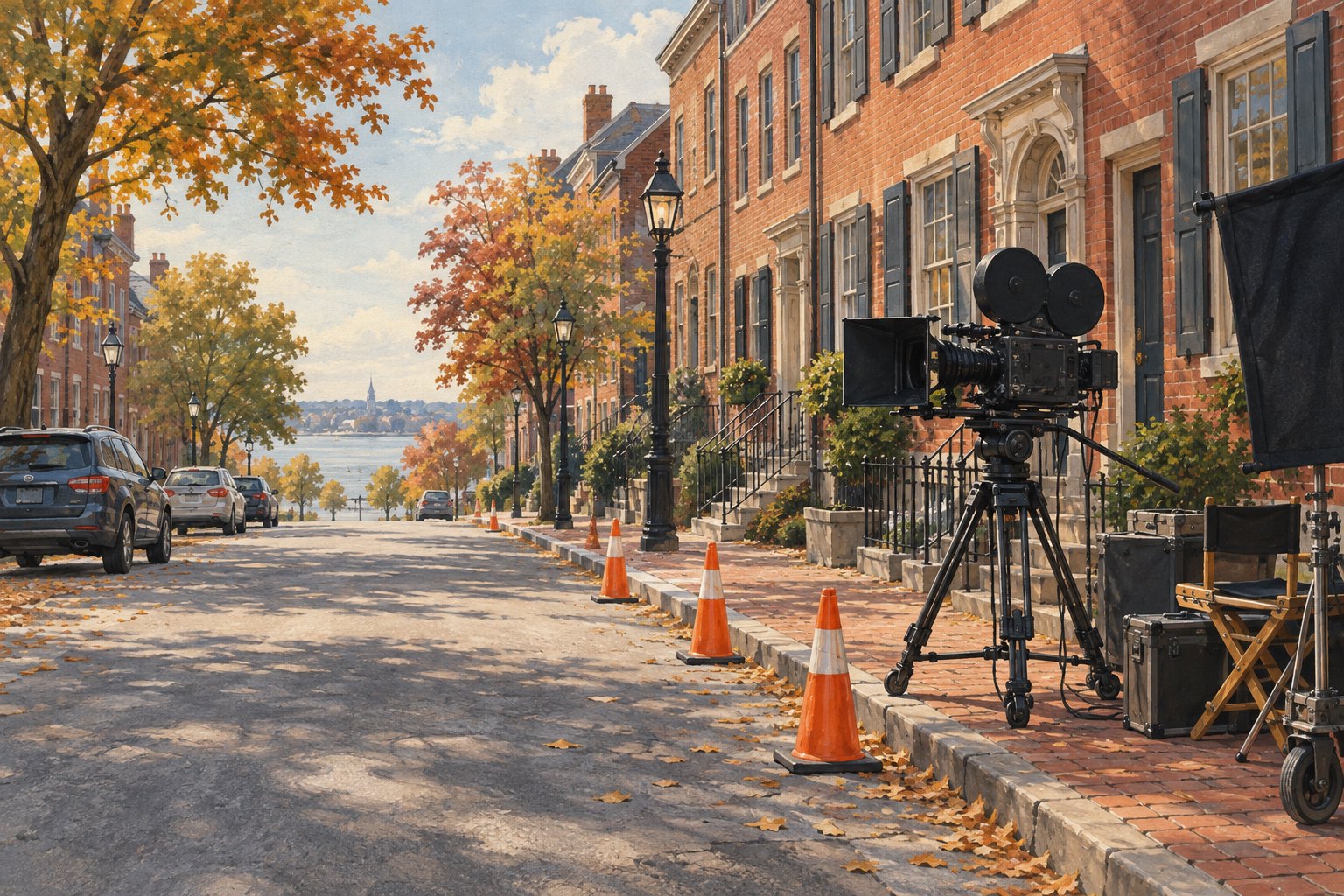
Movie production in Old New Castle is expected to disrupt traffic and parking, according to the Delaware News Journal. For residents, workers, and visitors, the immediate concern is practical: a familiar route or usual parking space may become unavailable while filming activities occupy the area.
Before making a trip, check current municipal notices and posted restrictions for the streets you intend to use. This article does not establish a street-by-street closure schedule or parking map. Its purpose is to explain how to prepare for the reported disruption—and why the space a film production needs can extend well beyond what eventually appears on screen.
What the Old New Castle filming news means for your trip
The central reported fact is straightforward: movie production will affect traffic and parking in Old New Castle. That does not, by itself, establish that every street will close, every business will become inaccessible, or every visitor will face the same delay. Those are separate questions that require location-specific information.
It helps to separate three things before leaving home: whether you can drive through an area, whether you can park there, and whether you can reach your destination on foot. An answer to one does not necessarily answer the others. A street might be accessible to pedestrians while vehicle movements are restricted; available parking elsewhere does not establish that the walk from it will suit everyone.
For an appointment or other time-sensitive visit, confirm access with your destination and allow flexibility in your arrival plans. Avoid relying on an assumed delay estimate. The existence of filming tells you to prepare for changes, but it cannot tell you how many minutes your individual journey will take.
Five details to check before driving or parking
- The exact street segment: Look for boundaries or intersections, rather than assuming a restriction applies to an entire street.
- The applicable hours: Check when a restriction begins and ends, including whether it applies while your car would remain parked.
- The type of restriction: A parking restriction, a full road closure, and a temporary traffic hold create different problems for a journey.
- Access to your destination: Confirm how to reach the entrance, particularly if you need an accessible drop-off point or are expecting a delivery.
- A workable alternative: Identify a lawful parking option and approach route before arriving, then follow current signs and traffic directions.
These are planning questions, not a description of restrictions confirmed for every part of Old New Castle. They are especially useful when a general filming announcement leaves you uncertain about a specific trip.
If you already have a vehicle parked nearby, check notices where it is standing. A space that was available when you arrived may have a later restriction. Visitors should also avoid treating an empty curb as evidence that parking is permitted; temporary restrictions can explain why an otherwise desirable space is vacant.
Why a movie needs more space than the camera sees
From the audience’s perspective, a location scene may consist of someone stepping outside, crossing a street, or getting into a car. The image feels ordinary because the production has organized everything around that action. The work required to create that apparent simplicity is usually outside the frame.
In location filmmaking generally, equipment, lighting, sound recording, vehicle positioning, and crew movement can all require space. Repeated takes may also require control over activity behind the actors. These are possible reasons for a production footprint, not verified details of the equipment or methods being used in Old New Castle.
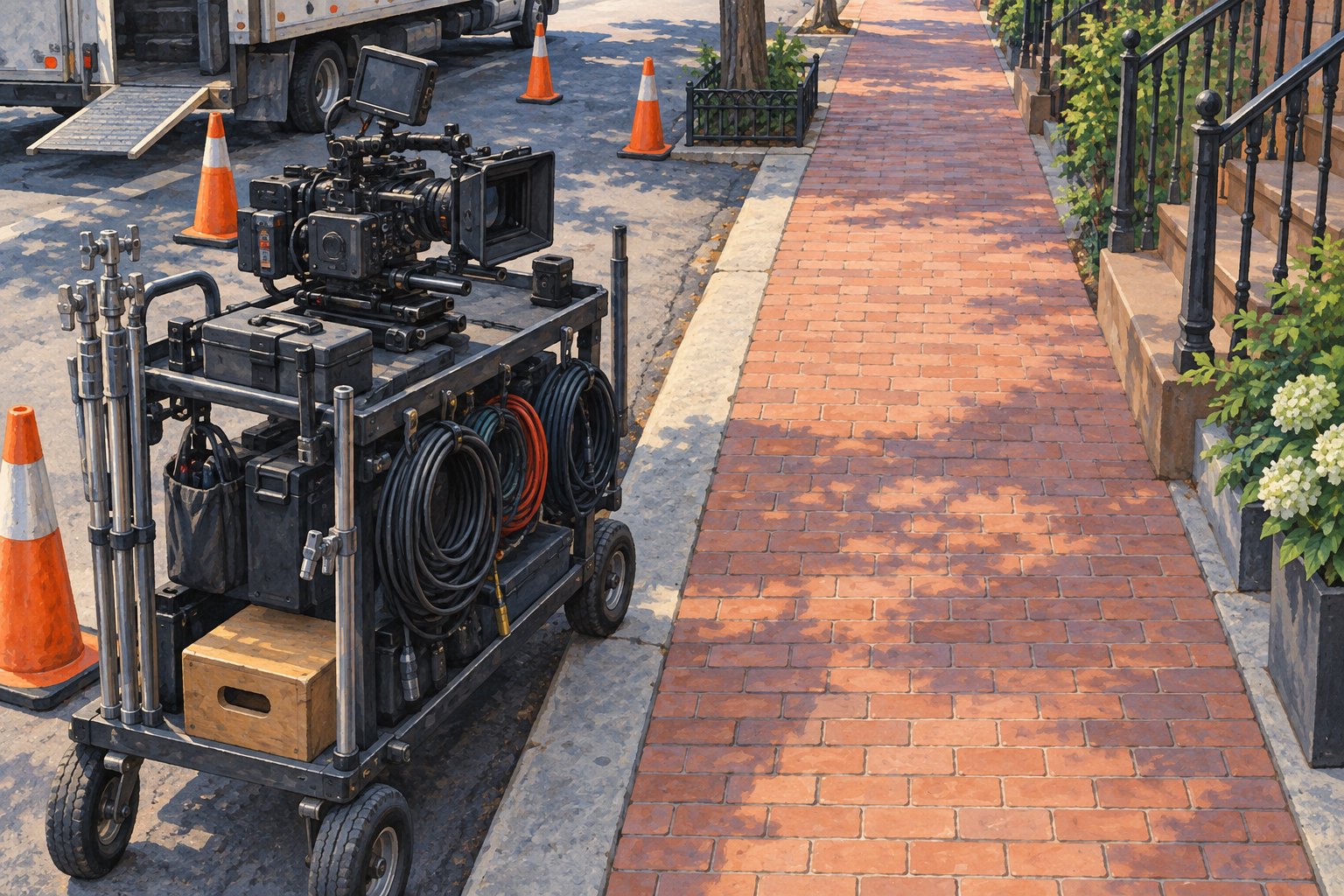
Continuity provides a useful example. If a conversation is filmed from several angles, background movements need to make sense when those shots are edited together. Uncontrolled traffic can complicate that process. Sound presents another challenge: an interruption that a passerby barely notices can make dialogue difficult to use.
Understanding those needs explains why filming can disrupt a neighborhood. It does not establish that any particular restriction is necessary or proportionate. That judgment depends on the actual plan, its duration, and the alternatives available to people who live and work there.
The creative question: What does the location give the story?
For film viewers, the interesting question extends beyond recognizing a street. A location becomes dramatically valuable when it shapes how characters behave. The distance between two doorways, the visibility of someone approaching, or the difficulty of finding privacy can affect a scene without a character explaining any of it.
Imagine, as a general filmmaking example, a conversation staged across a street rather than across a table. Distance might make an apology feel tentative. Passing activity might prevent a private exchange. The setting can turn an otherwise simple conversation into a negotiation over whether two people will move closer. None of those possibilities describes a confirmed scene in this production.
That relationship between physical choices and character is also central to our discussion of how practical stunt work can put character under pressure. Production choices become meaningful criticism when we can connect them to something the audience actually sees and feels.
Likewise, our analysis of the intimate challenge facing the Sea Wall adaptation considers how filmmaking might preserve a character’s emotional presence. For Old New Castle’s production, an equivalent assessment must wait for evidence of the finished storytelling. A location announcement cannot support judgments about performances, dialogue, plot, or hidden references.
How to judge the production’s relationship with the neighborhood
In our view, the most useful standard is how clearly a production’s needs are translated into information people can act on. A general warning about inconvenience is less helpful than a notice that identifies the affected area, applicable hours, access arrangements, and a contact for unresolved questions.
Residents and businesses also experience disruption differently. A visitor may be able to reschedule. Someone expecting a delivery or needing access close to a doorway may have much less flexibility. Good planning should recognize those differences rather than treating every affected person as a driver looking for another space.
The deeper significance of the Old New Castle story is that a filming location remains a functioning place throughout production. Cinema can make everyday streets feel extraordinary, but the routines outside the frame still matter. For now, the sensible response is to verify access before traveling and keep artistic expectations separate from logistical facts. Eventually, the film can be judged by what it makes of the setting; the disruption deserves attention on its own terms.
Original content by this site's editorial team. Published: September 15, 2026 at 06:36:52 PDT (Los Angeles time)