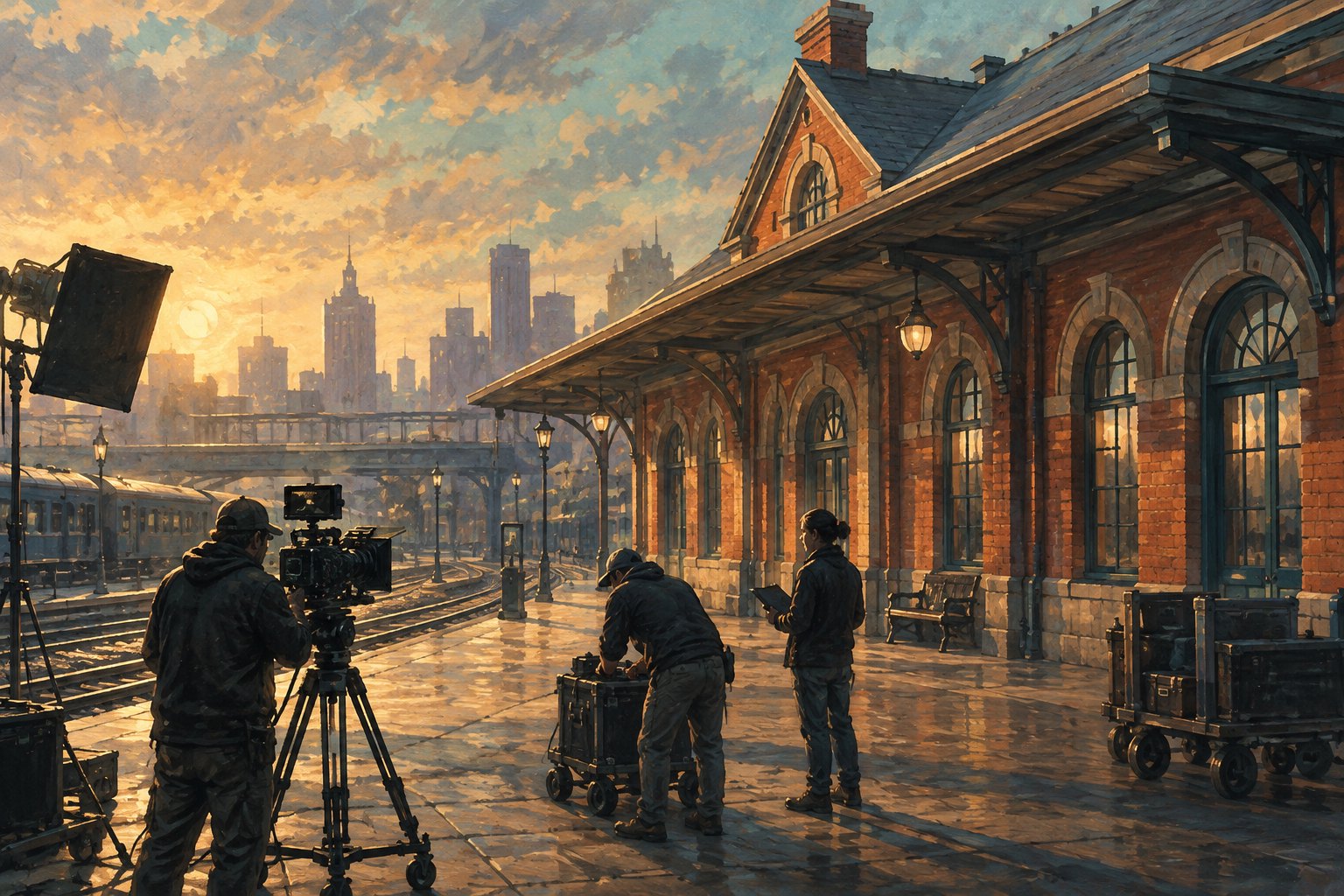
A movie crew has filmed scenes at Newark’s historic train station, according to the Newark Post. For local readers, the immediate attraction is seeing a familiar landmark become part of a movie. For film viewers, the more interesting question is what that location will contribute: a recognizable backdrop, a convincing sense of place, or a setting that changes how we understand the people on screen.
The reported shoot establishes the location’s involvement. It does not, by itself, establish what happens in the scenes or how they will appear in the finished film. This is therefore a spoiler-free look at the station’s storytelling possibilities, rather than a review of an unseen movie. The distinction matters because a location can suggest plenty without confirming a single plot point.
What the Newark Station Shoot Actually Tells Us
The central news is straightforward: a movie production used Newark’s historic train station to film scenes. That is a meaningful local development, but it leaves several different questions open. A filming location is not necessarily the place where a story is set. A historic building does not automatically indicate a period movie. And filming several scenes somewhere does not tell us how much screen time that place will receive.
Those distinctions help prevent a familiar leap from production news to imagined movie. The station might appear prominently, briefly, or in fragments that make its identity difficult to recognize. None of those possibilities should be treated as a description of this production.
For now, the useful critical starting point is the choice of setting. A railway station has a clear everyday purpose, but its dramatic meaning depends on whose experience the camera follows. The same doorway can promise escape to one character and separation to another.
A Station Gives Characters Something to Do
From a character’s perspective, a station is a place of practical decisions. Where should I wait? Who am I looking for? What am I carrying? Am I ready to leave? Such questions can make a scene active even when very little appears to happen.
Consider a hypothetical exchange between someone departing and someone staying behind. Their dialogue might be polite, even ordinary. Yet one person keeps checking the exit while the other tries to prolong the conversation. The setting gives those movements a purpose. An emotional imbalance becomes visible without either person explaining it.
That is an example of what a station scene can accomplish, not a claim about the scenes filmed in Newark. It also suggests a fair standard for judging them eventually: does the location help the actors express a relationship, or does it merely surround the exchange with attractive scenery?
My preference is for the first approach. A memorable location earns its place when the action would lose something if moved elsewhere. A departure should influence timing, attention, or choice. Otherwise, the station risks functioning as a handsome postcard.
Watch the Space Between People
One of the most revealing things to watch in any station sequence is blocking: where performers stand and how they move through the frame. Someone seated while another person remains standing may seem settled, stranded, guarded, or simply tired. The surrounding action determines which interpretation makes sense.
Distance matters, too. A wide shot can keep two people visibly apart while allowing us to see the space neither is willing to cross. A closer shot can remove that geography and make a public conversation feel intensely private. Neither choice is automatically better; each directs our attention toward a different part of the relationship.
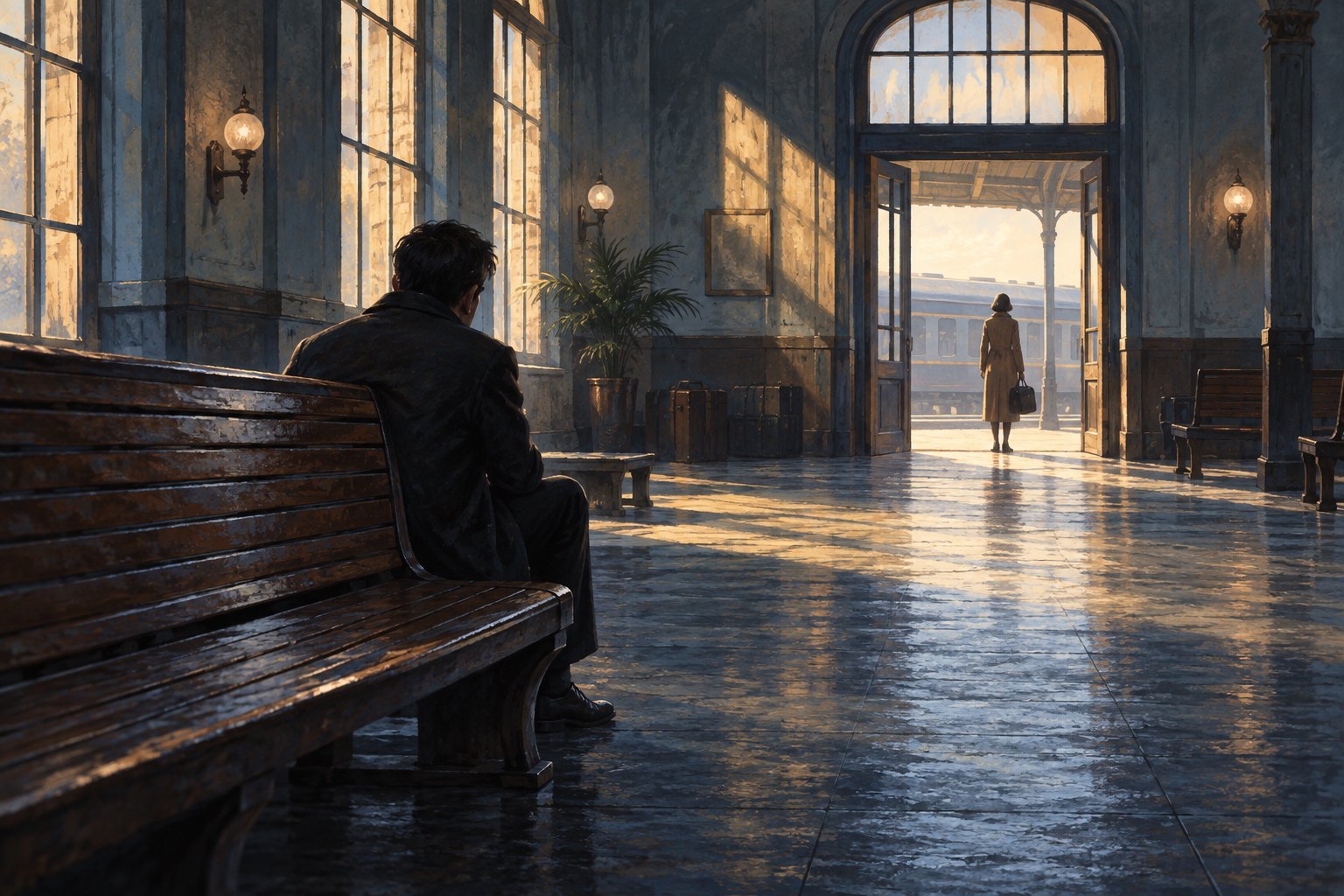
The illustration imagines that visual principle; it does not depict the Newark production or reconstruct its station. The seated figure and the figure near the doorway occupy different relationships to departure. Their placement creates a question before any dialogue begins.
This is closely connected to how performance and visual choices give a film its emotional force. A setting becomes expressive through the filmmaker’s decisions about attention, movement, and duration.
Historic Architecture Does Not Explain the Story
The word historic invites certain expectations: nostalgia, permanence, a connection with earlier lives. But those associations belong initially to the viewer. They become part of a film’s meaning only when the movie gives us a reason to make the connection.
An older building might provide a striking contrast with a character’s uncertain future. It might also function as an entirely ordinary place that the character barely notices. Both approaches can work. Insisting that every architectural detail symbolizes memory would impose an interpretation before examining the scene.
For the Newark footage, the most useful question will be whether the camera asks us to notice the building. An extended exterior view gives architecture a different emphasis from a brief glimpse behind a performer. A return to the same space later in the movie could change its emotional significance, but that possibility remains hypothetical until the film can be assessed.
Local recognition adds another layer. Viewers who know the station may bring personal associations to its appearance. Other viewers will encounter only the place the film constructs. A strong scene should communicate clearly to both audiences, even if each finds something different in it.
Sound and Editing Will Shape the Station’s Role
A location’s screen identity also depends on what we hear. In a hypothetical station scene, footsteps could emphasize an uncomfortable silence, while surrounding activity could make a private disagreement feel exposed. These are possible sound choices, not observations about the Newark shoot.
Editing determines how those elements accumulate. Holding a shot after someone leaves can shift attention toward the person left behind. Cutting immediately to the traveler can make departure feel like forward movement. The physical action may be similar, but the emotional emphasis changes.
That is why production activity alone cannot support a verdict about the finished movie. The location supplies material; performance, framing, sound, and editing give that material a particular effect. As our discussion of when a movie earns the benefits of a bigger screen argues, visual scale matters most when it serves the experience of watching.
What Will Make Newark’s Screen Appearance Matter?
When the finished scenes become available, three questions will offer a useful way into them:
- Whose experience organizes the scene? Notice which character receives our attention before and after an arrival, departure, or conversation.
- Does the setting affect a choice? Look for a practical detail that changes what someone does, rather than assuming the location carries meaning on its own.
- What changes during the scene? A shift in trust, confidence, or understanding can matter more than the amount of physical action.
The deeper appeal of a station on screen is its unequal meaning for the people sharing it. One person’s beginning can be another person’s ending. The building remains while individual lives move through it.
Newark’s historic station offers an intriguing place to explore that tension. Whether this movie does so remains a question for the finished work. For now, its appearance in a production is worth noticing—and the eventual test will be whether we remember only the landmark or also what happened to someone there.
Original content by this site's editorial team. Published: September 26, 2026 at 11:21:11 PDT (Los Angeles time)