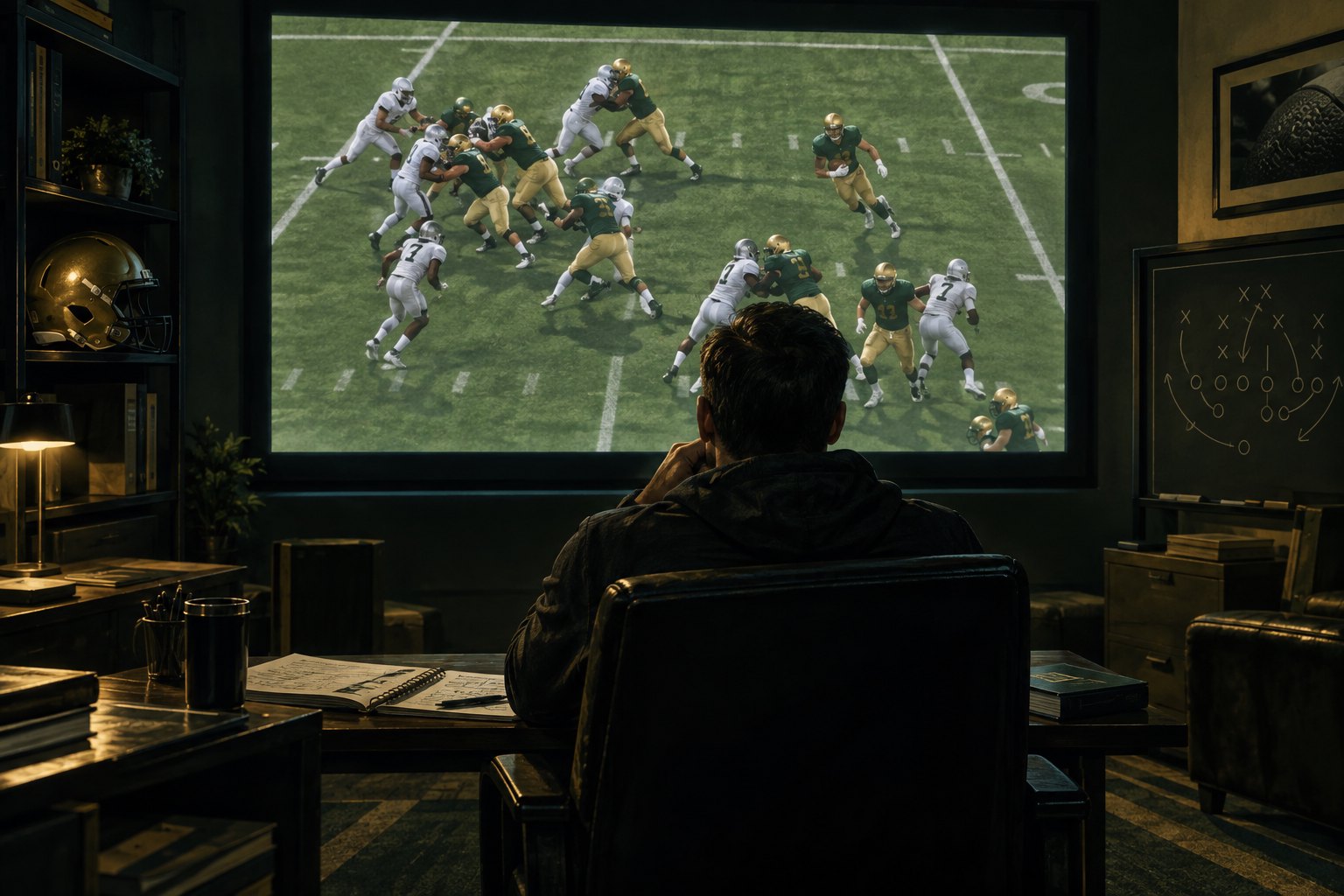
Nate Bennett and Baylor’s run game are the subjects of S11’s football film review. Here, “film” means game footage: the subject is athletic performance, rather than a feature film with a plot, cast, or scripted dialogue. The central question is how an individual player’s actions relate to the effectiveness of a collective offense.
The headline establishes that focus, but it does not establish the review’s findings. Without verified access to the complete analysis and the plays it discusses, there is no responsible basis for announcing that Bennett excelled, struggled, or explained Baylor’s rushing performance. What follows is an analytical guide to the evidence that would support those judgments, rather than a claim to have reviewed the underlying tape.
Start With Bennett’s Actions, Then Widen the Frame
Putting a player’s name in a headline naturally directs attention toward that individual. A useful review must then widen the frame. Where was Bennett aligned? What did he do immediately after the snap? Which nearby players affected his available space? What happened before the action most viewers remember?
Those questions matter because visible involvement and responsibility are different things. A player can be close to the decisive moment without causing it. Conversely, someone outside the viewer’s immediate focus can change the play by occupying a defender or creating room for a teammate.
Any assessment of Bennett should therefore begin with observable movement. Describing where a player went is a firmer starting point than declaring what he intended. Assignments, reads, and coaching expectations require additional evidence; a replay does not automatically reveal them.
This distinction also protects against turning a real athlete into a stock character. Confidence, toughness, and hesitation can become convenient explanations when the reviewer has not yet explained the play. The more useful question is what the player could reasonably do in the circumstances visible on screen.
Baylor’s Run Game Requires a Collective Explanation
A running play produces an easily remembered outcome: the ball advances, stalls, or goes backward. Explaining that outcome requires watching the relationships around it. Blocking position, defensive movement, the runner’s path, and the timing of contact can all contribute.
For Baylor, the key analytical challenge is separating the space an offense creates from what a player does with that space. A productive result does not establish that every participant executed well. An unsuccessful result does not establish that every participant failed.
Consider a hypothetical run in which a defender reaches the backfield before the ball carrier can approach the intended opening. That sequence would demand attention to how the penetration occurred before any judgment about the runner’s decisiveness. In another hypothetical, an opening might exist briefly and disappear before the runner arrives. Timing would then become central. Neither example describes a verified Baylor play; each illustrates why the sequence matters.

Three Passes Through a Play
A disciplined viewing method can make a Bennett-focused review more informative without pretending that spectators possess the team’s playbook. Each pass should answer a different question.
First: Watch the Entire Sequence at Full Speed
Follow the play from the formation through its conclusion. Resist stopping at the first awkward movement. Full speed preserves the pace at which participants must react and helps establish when space becomes available or disappears.
For Bennett, this first viewing should locate his involvement within the whole action. The initial task is identification, not grading. A useful written description should let a reader understand the sequence before encountering the reviewer’s verdict.
Second: Examine the Moment That Changed the Play
On replay, look for the earliest event that materially changed the available options. That might be contact between two players, movement across a gap, or a change of direction. Slow motion can clarify body position and timing, provided the analysis remembers how briefly those conditions existed.
A freeze-frame can show an apparent opening while concealing how quickly it closed. It can also make a difficult response look obvious because the viewer already knows the outcome. Returning to full speed is an essential check on that hindsight.
Third: Look for Comparable Plays
A single sequence supports a narrow observation. A broader claim about Bennett or Baylor’s run game needs multiple relevant examples. Comparisons are most useful when the reviewer explains what is similar and what has changed.
Different defensive positioning or different offensive movement can make superficially similar plays function differently. A persuasive review includes sequences that challenge its explanation as well as those that support it. Otherwise, a highlight package can masquerade as a pattern.
Separate What the Camera Shows From What the Reviewer Infers
Clear analysis gives readers a way to distinguish evidence from interpretation. These statements operate at different levels:
- Observation: A player changes direction after a defender enters the space ahead of him.
- Interpretation: The change of direction appears to respond to that defender.
- Assignment claim: The player was instructed to make that specific response.
The first may be visible. The second is an explanation that should fit the sequence. The third requires support beyond confident narration. Applied to Bennett, this distinction keeps an assessment precise without stripping it of judgment.
Camera coverage matters, too. If an angle excludes a participant whose movement could explain the outcome, that uncertainty belongs in the review. Good criticism does not need absolute certainty, but it should make the limits of its view understandable.
Why Individual Narratives Need Context
Sports coverage often becomes easiest to tell when one person carries the story. That instinct also shapes football movies. Our character-focused analysis of Jerry Maguire explores how individual ambition acquires meaning through relationships. In game analysis, the practical equivalent is watching how one player’s opportunities depend on others.
The distinction between a compelling personal story and demonstrated performance also informs our commentary on athletic identity in Mr. Irrelevant. Those dramatic questions can sharpen an audience’s awareness of storytelling, but they cannot establish what happened on Baylor’s tape. Real players deserve evaluations grounded in their actions.
The Meaningful Verdict Must Follow the Evidence
The strongest angle on Nate Bennett and Baylor’s run game is the relationship between individual contribution and collective opportunity. A convincing review would identify the relevant plays, explain the decisive movements, consider competing explanations, and show whether its conclusions hold across comparable situations.
The available headline alone cannot settle that evaluation. It identifies a subject worth examining, while leaving the actual verdict unverified. The deeper value of football film study lies in making an outcome understandable: showing how several people’s actions intersect, sometimes within a fraction of a second, to create the moment everyone remembers.
Original content by this site's editorial team. Published: September 15, 2026 at 11:33:14 PDT (Los Angeles time)