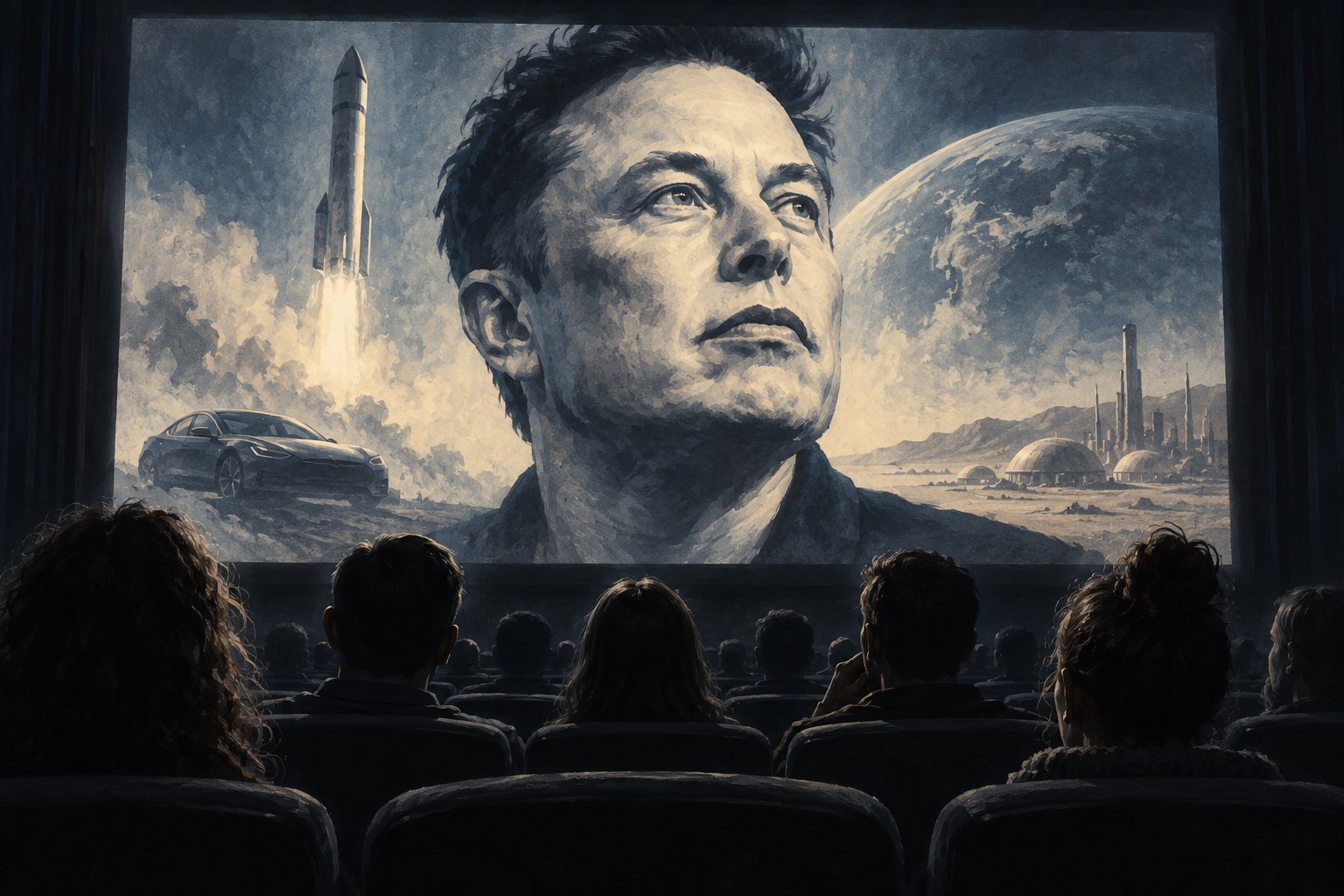
Musk takes on an ambitious question: how did Elon Musk become so powerful? The New York Times’ assessment finds the answers unsatisfying. That is a criticism of explanatory achievement, distinct from whether a viewer finds the subject fascinating, troubling, or admirable. A film can sharpen our feelings about someone while leaving the workings of their influence difficult to describe.
The useful question for audiences is therefore precise: what would count as an adequate answer? My view is that an explanation must connect choices to opportunities, opportunities to authority, and authority to consequences. Otherwise, even a compelling portrait can leave its central question hanging.
Scope: This spoiler-free commentary examines the film’s central question and the standard implied by that critical response. It is not a firsthand review of the finished film; specific scenes, dialogue, and an ending are not assessed here.
What does “power” mean in this story?
The first challenge is defining the thing being explained. Wealth, visibility, ownership, persuasion, and decision-making authority are related, but they are not interchangeable. Someone can command attention without controlling an outcome. Someone else can shape an outcome while remaining almost invisible. A film asking how Musk acquired power needs to make those distinctions legible.
For the viewer, a useful test is whether a passage identifies an ability: to approve something, prevent something, set conditions, secure cooperation, or make other people bear a consequence. That makes power observable. Simply establishing that the central figure is famous or forceful does less explanatory work.
This matters dramatically, too. A recognizable face supplies an immediate center of attention. A clearly established decision supplies stakes. When we understand who can choose and who must live with that choice, the story becomes more than an account of a remarkable individual.
Musk’s perspective: intention needs a separate test
Looking at the central figure’s perspective does not require accepting his explanation of himself. It means distinguishing what he says he wants, what he appears to believe, and what his actions demonstrably accomplish. Those categories can overlap, but a persuasive account should not quietly treat them as identical.
For a film about Musk, self-description would be valuable evidence of how he presents his ambitions. It would not, by itself, prove why another person supported him or why a particular decision went his way. Equally, an unfavorable impression of his personality would not establish the cause of a business or public outcome.
The dramatic opportunity lies in the distance between intention and effect. A character may understand an action as necessary, bold, or beneficial while someone affected by it experiences something very different. Following that distance can reveal competing interests without requiring the filmmaker to claim access to anyone’s private thoughts.
The strongest character analysis therefore asks a modest question before a grand one: what can we actually establish about this choice? That question protects the film from turning either admiration or suspicion into an all-purpose explanation.
Other people must have more to do than describe him
A biography organized around a prominent person can make everyone else seem like supporting evidence. People appear to confirm a trait, supply an anecdote, or describe an encounter. Their presence may deepen a portrait while leaving their own decisions unexplored.
To explain power, those other perspectives need agency. What did a person know at the time? What did they hope to gain? What alternatives seemed available? What might disagreement have cost? These questions reveal the circumstances in which cooperation, resistance, and dependence become possible.
That is a standard for evaluating Musk, not a claim about particular participants or testimony. The distinction matters because a witness can be credible about a personal experience without possessing a complete explanation of the larger story. Respecting testimony includes respecting its limits.
Our discussion of evidence and interpretation in Brother Joseph Again approaches a related problem: a compelling piece of evidence still needs an argument connecting it to the conclusion being drawn.

The viewer’s perspective: momentum can feel like proof
Film gives an argument rhythm. A cut can suggest a connection; a pause can make an answer seem evasive; a succession of examples can create the feeling of an irresistible pattern. These are expressive tools. Evaluating them means asking what the underlying evidence supports.
In approaching Musk, viewers can separate three levels of explanation. First comes sequence: one event happened before another. Next comes contribution: an action helped make an outcome possible. Finally comes necessity: without that action, the outcome would not have occurred. Each level asks more of the evidence.
A clear chronology is useful, but chronology alone does not establish causation. Likewise, several incidents that suggest a recurring disposition may justify a character judgment without explaining how that disposition translated into durable authority.
This is where a film’s emotional effectiveness and analytical completeness can diverge. We may feel we have discovered the answer because the assembled material produces a coherent impression. A stronger test comes afterward: can we state the connection in ordinary language, including what remains uncertain?
How to judge the answer without demanding everything
No single film can explain every condition behind a person’s influence. Completeness is an unreasonable requirement. Clarity about scope is a reasonable one. An account can choose a limited question and answer it well, provided it does not imply that its answer covers everything else.
Three questions offer a practical way to assess the explanatory promise of Musk:
- What specific form of power is being examined? Attention, money, organizational control, and public influence require different evidence.
- Which decisions connect the beginning to the outcome? Look for identifiable choices and constraints, rather than relying only on impressions of character.
- What would challenge the interpretation? A convincing argument should leave room to consider evidence that complicates its preferred account.
These questions do not require detached viewing. Anger, admiration, and discomfort can be meaningful responses. They become more useful when we can identify what produced them and whether that material supports the broader conclusion.
The distinction between making something visible and establishing accountability also runs through our analysis of The Social Reckoning. Recognition begins an inquiry; further explanation gives it direction.
A deeper reading: what the audience takes away
The most demanding interpretation of Musk’s central question concerns the audience’s understanding of agency. An account that makes one person seem capable of everything can leave viewers with a vivid portrait and a diminished sense that choices were ever available.
An explanation that identifies decisions has a different effect. It makes an outcome look contingent: people acted under particular conditions, alternatives existed, and some choices carried greater weight than others. That does not promise an easy solution. It gives the audience something more useful than awe or dismay.
For me, that is the standard behind the question of whether Musk satisfies. The lasting value would be an ability to explain how influence becomes authority—and to recognize the difference the next time a powerful person fills the screen.
Original content by this site's editorial team. Published: October 10, 2026 at 09:34:21 PDT (Los Angeles time)