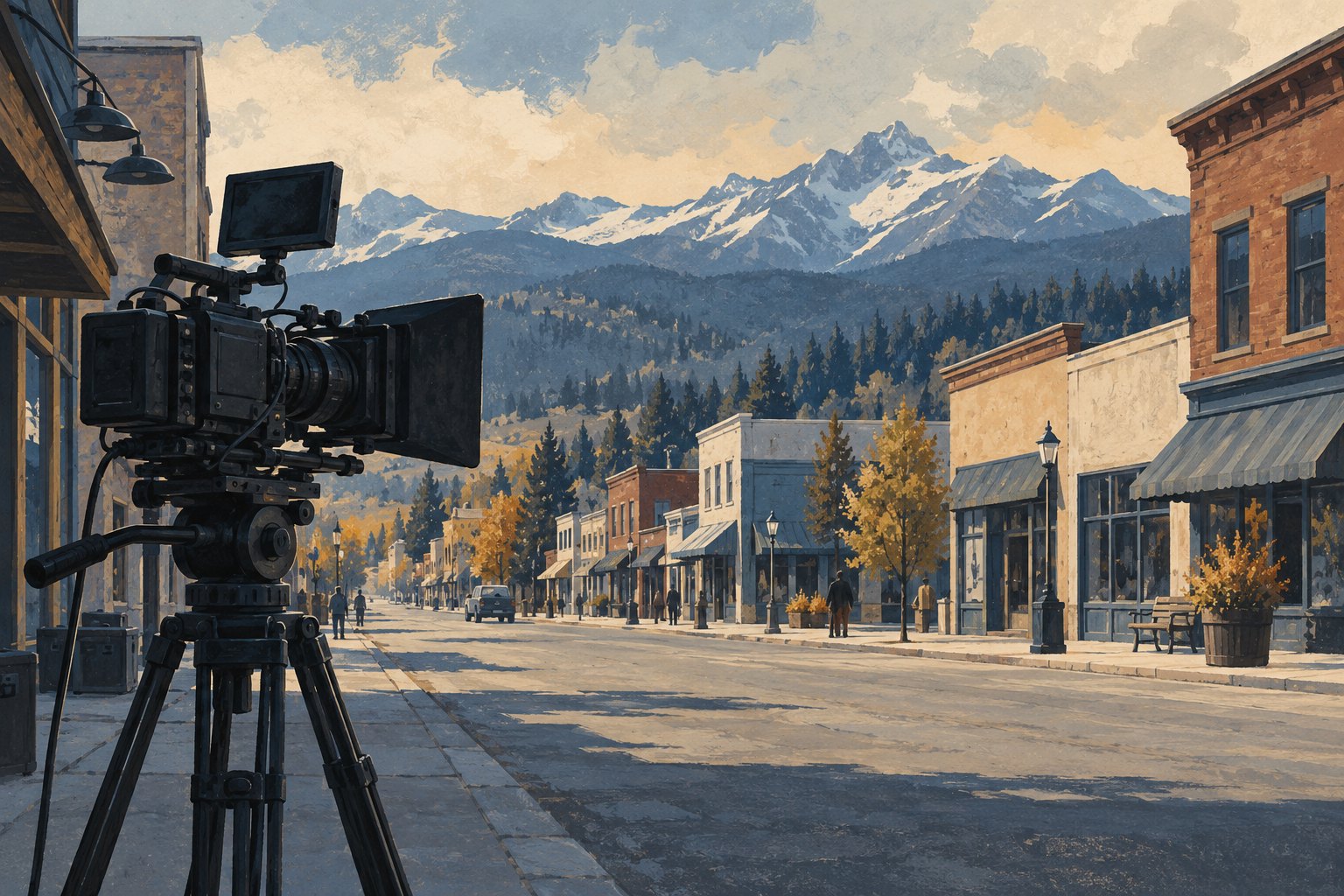
A film shoot in Montana has become the subject of controversy over an apparent resemblance to Renee Good’s killing, according to The Guardian. The immediate issue is the relationship between a staged scene and a real death: what that resemblance suggests to people encountering the production, and what responsibility filmmakers have when their images invite such a comparison.
The distinction between an apparent echo and an established reenactment matters. Resemblance alone does not establish a filmmaker’s intention, the scene’s place in a screenplay, or the argument of a finished movie. It does, however, create a legitimate subject for film criticism before a release: how a production’s use of recognizable imagery affects the people outside its intended audience.
This is commentary on the filming controversy, not a review of a completed film. No assessment of performances, dialogue, or plot is offered without verified material.
What the Renee Good comparison establishes
The reported controversy centers on a Montana shoot that appears to echo Good’s killing and has unsettled a town. That is a narrower claim than saying the production is an authorized account of her life, a direct reconstruction of her death, or a deliberate attempt to distort either. Those conclusions require evidence beyond the resemblance itself.
For readers trying to understand the story, three questions deserve separate answers. What was staged? Why did it prompt the comparison? How will the footage function in the completed work? Evidence answering one question cannot automatically answer the others. A production image might establish a visual similarity while revealing little about the scene’s eventual meaning.
This distinction also prevents a real person from disappearing inside speculation about a movie. Good’s name should not become shorthand for an assumed plot, motive, or political message. Reporting must establish those connections before criticism evaluates them.
A filming location is also somebody’s everyday life
The Montana setting gives this controversy a dimension that a debate over a trailer would not have. Location filming brings the act of representation into a shared physical environment. A street can be a filmmaker’s backdrop and somebody else’s route to work, neighborhood, or place of business.
In principle, those different relationships to a location can produce different experiences of the same activity. A crew may understand a scene through its script and production plan. A passerby may encounter only its most disturbing visible element. Neither perspective supplies the entire story, but the difference helps explain why context matters before footage reaches an editing room.
It would be premature to assign particular grievances or experiences to Montana residents without verified accounts. The broader editorial judgment is straightforward: people living around a production deserve to have their concerns described specifically. Treating a town as uniformly outraged would be as careless as dismissing every objection as hostility toward filmmaking.
Useful follow-up reporting would establish what residents were told, which aspects of the shoot prompted objections, and how the production responded. These questions concern the conduct of filming. They remain meaningful even if the eventual movie proves thoughtful or artistically successful.
Character perspective determines what an audience understands
For a finished film, the most revealing question would be whose experience organizes the scene. Screen time alone cannot answer it. A character can occupy the center of an image while the movie gives another person control over its emotional meaning.
Consider the difference between seeing an event through someone’s limited awareness and watching it from an apparently all-knowing position. The first can make uncertainty palpable. The second can make a contested interpretation feel settled. Neither approach is inherently dishonest, but each asks the audience to accept a different relationship between what is visible and what is knowable.
These are possible filmmaking choices, not descriptions of the Montana footage. Their relevance is that a recognizable incident can serve very different dramatic purposes depending on the surrounding characterization. Does the person facing violence have an existence beyond that moment? Are their relationships and decisions developed? Or does their suffering mainly advance someone else’s story?

My critical standard would be whether the film grants its characters meaningful lives beyond the incident that makes them narratively useful. Ordinary behavior, conflicting desires, and relationships can provide that depth. A speech declaring someone’s importance cannot necessarily compensate for a story that otherwise treats them as disposable.
Editing can turn resemblance into an argument
A scene’s meaning also depends on what surrounds the recognizable image. A reaction shot can direct sympathy. A sound heard before its source becomes visible can establish apprehension. An edit can imply a causal connection between actions that the viewer has not actually seen occur together.
That is why an isolated glimpse of filming cannot support a complete verdict. The finished sequence might complicate an initial impression, reinforce it, or introduce a different perspective. Waiting for that evidence is part of responsible criticism. It does not require suspending scrutiny of the production’s public conduct.
Our discussion of the distinction between witnessing and spectacle raises a related issue: visibility does not supply context by itself. In a dramatized scene, every addition of context is also a creative decision that deserves examination.
How to assess the film without letting controversy decide
When substantial footage or a completed film becomes available for assessment, viewers can apply a few concrete tests:
- Identify the factual claim. Does the work present itself as fiction, reconstruction, or an account of identifiable events?
- Track access to perspective. Whose knowledge, uncertainty, and emotions does the audience share?
- Examine the aftermath. Does the story explore consequences, or move quickly past the suffering that supplied its dramatic impact?
- Separate intention from achievement. A filmmaker’s explanation can clarify a goal; the actual scenes determine whether the film fulfills it.
The distinction between advance concern and a final artistic judgment also informs our commentary on how much an early warning should influence expectations for a movie. Here, the stakes include the representation of a real death, making precision especially necessary.
The deeper issue is who gets a full story
The Montana controversy raises a question that extends beyond whether a staged image resembles Good’s killing. When cinema draws emotional force from recognizable suffering, what does it give audiences in return: greater understanding of a person, or simply a forceful image?
My view is that a film earns that emotional force through attention to character, circumstance, and consequence. The eventual work must be judged through those choices. The present controversy deserves equally careful attention to the people affected by the shoot. In both cases, the essential critical obligation is the same: look beyond the dramatic moment and ask whose life the frame leaves out.
Original content by this site's editorial team. Published: October 9, 2026 at 13:30:34 PDT (Los Angeles time)