Marie Antoinette turns twenty in 2026, and its most unsettling quality remains the intimacy of its extravagance. The clothes, desserts, and enormous rooms offer pleasure while revealing how little freedom their owner possesses. Sofia Coppola’s film makes royal isolation tangible: you can have an audience for everything you do and still have nobody who understands you.
Written and directed by Coppola, the 2006 film stars Kirsten Dunst as Marie and Jason Schwartzman as Louis XVI. Its central concern is the young queen’s experience inside a court that scrutinizes her marriage and behavior. Those credits and that premise are established in [Sony Pictures’ film overview](https://www.sonypictures.com/movies/marieantoinette).
Spoilers follow, including discussion of the ending. My assessment: this remains a beautifully controlled character study whose narrow perspective produces both its emotional power and its political limitations.
Marie Arrives as a Person and Becomes a Position
The border handover establishes the film’s governing cruelty. Marie must leave her Austrian belongings and companions behind, including her dog. Before she can become a French royal, the recognizable pieces of her previous life must be removed.
What makes this passage effective is its administrative calm. Nobody needs to shout. The procedure itself communicates that her attachments matter less than the role waiting for her. From Marie’s perspective, marriage begins with a lesson in dispossession.
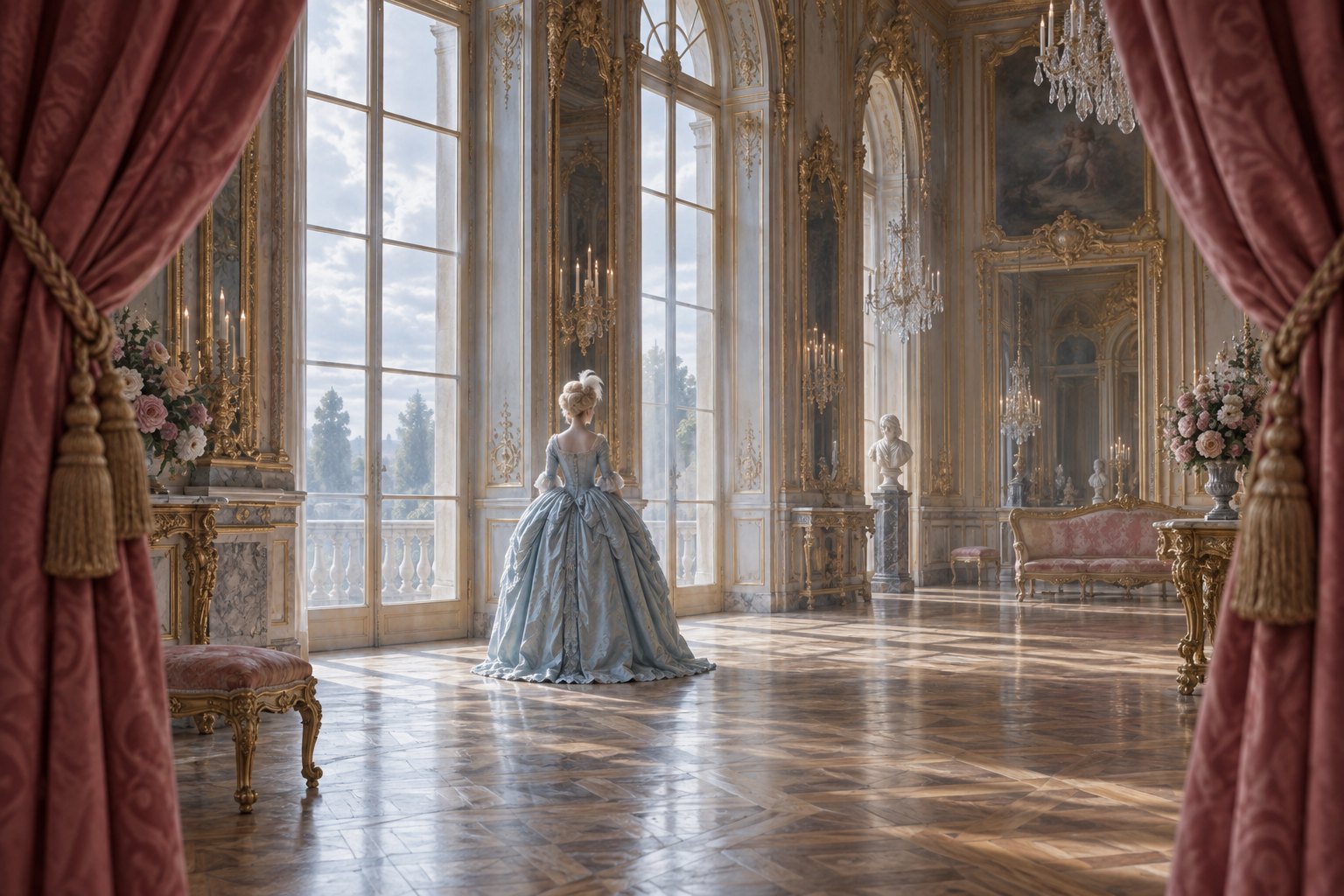
The dressing ceremony develops that idea through comedy. As precedence determines who may hand her clothing, Marie protests, “This is ridiculous.” The answer is devastatingly economical: “This, madame, is Versailles.” The exchange appears in the [film’s dialogue transcript](https://www.springfieldspringfield.co.uk/movie_script.php?movie=marie-antoinette).
Etiquette transforms a basic physical need into an exhibition of rank. Dunst’s exasperation makes the absurdity accessible, but the scene also introduces a difficult question: what happens when someone raised within these rules eventually gains the power to enforce them?
Marie’s treatment of Madame du Barry provides an answer. Her refusal to acknowledge the king’s mistress lets her exercise the very hierarchy that humiliates her. She can be vulnerable and snobbish within the same sequence. That contradiction keeps Coppola’s sympathy from becoming a claim of innocence.
Louis and Marie Cannot Make Their Marriage Private
Schwartzman’s Louis is an essential counterweight to Dunst. His reserve leaves awkward spaces where Marie wants reassurance. Their unconsummated marriage becomes a subject for family intervention and court gossip, turning uncertainty between two people into a public failure.
For Marie, the pressure is especially corrosive because she is expected to solve a problem she cannot control alone. Her mother’s correspondence treats her ability to inspire her husband as a diplomatic responsibility. Affection becomes work, and every unsuccessful attempt seems to threaten her position.
Louis’s interest in locks offers a useful character contrast. A mechanism has an intelligible problem and a possible solution. Emotional intimacy requires him to respond to another person’s uncertainty. Schwartzman makes withdrawal understandable without making it harmless.
The film’s line “We are too young to reign” briefly strips away the protective ceremony. It sounds like the recognition that nobody has prepared these people for the authority they inherit. The dialogue is simple; the frightening part is how little practical help that recognition provides.
This is also why the marriage deserves more attention than a conventional chemistry test. As our discussion of character responsibility in The Love Hypothesis argues, a relationship becomes dramatically meaningful through what people can offer each other. Here, shared vulnerability does not automatically produce mutual understanding.
Shopping Gives Marie Choices She Can Actually Make
The shopping and party sequences work because their pleasures are persuasive. Choosing a color, a shoe, or a companion supplies the immediate satisfaction missing from Marie’s prescribed duties. These are decisions with visible results.
My reading is that consumption becomes her substitute for agency. The court has made her body and appearance matters of public interest; fashion allows her to exert some control over that interest. The satisfaction is real, even when its consequences extend beyond her understanding.
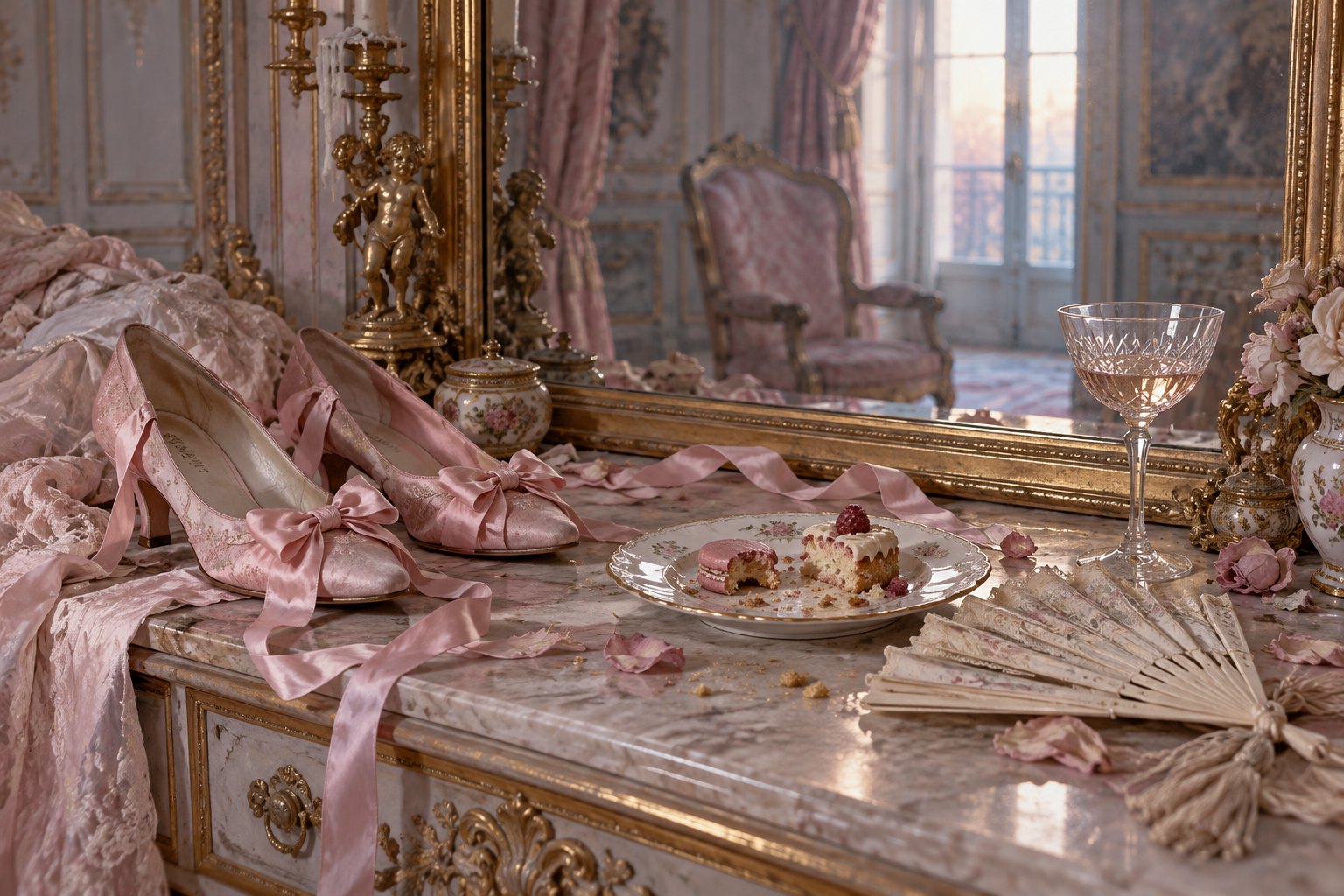
The modern music helps communicate that immediate emotional reward. It brings the characters’ excitement closer to the audience, allowing a period setting to carry the recognizable sensation of a night that ought never to end. Coppola explained that she wanted the music to distinguish the younger characters’ world from that of the adults at court. [Her contemporary interview](https://www.chud.com/7852/interview-sofia-coppola-marie-antoinette/) supports that intention.
Yet the sequence’s seductiveness creates a productive discomfort. Viewers can understand why Marie wants these things while recognizing how thoroughly wanting them occupies her attention. The film invites us into the pleasure before asking us to notice the enclosure around it.
Motherhood and the Fantasy of an Ordinary Life
Motherhood changes the emotional register. Marie’s attachment to her daughter introduces a relationship that she can experience beyond the court’s demand for a male heir. At the Petit Trianon, the film gives her quieter surroundings and a less formal way of inhabiting her body.
Dunst’s strongest contribution is the continuity she brings to these changes. The young woman who wants relief from scrutiny remains recognizable beneath the new clothes and responsibilities. Maturity does not arrive as a speech announcing that she has become a different person.
The retreat nevertheless contains its own contradiction. Marie can seek simplicity because extraordinary resources make that simplicity available. Her desire for closeness to her child is moving; the protected setting cannot teach her what ordinary insecurity feels like.
The film’s romance with Count Fersen extends the attraction of an identity outside official duty. As characterization, it offers the possibility of being desired without first being assessed as a dynastic instrument. It should be understood as the movie’s dramatization, not independent proof of historical events.
The Ending Exposes the Cost of Staying Inside
Coppola deliberately keeps the wider population largely outside Marie’s immediate experience. In her contemporary interview, she described that exclusion as a choice to remain within the queen’s perspective. It explains the film’s form, but it does not settle every objection to it.
For me, this is the film’s clearest limitation. Palace loneliness receives texture, duration, and individuality. The suffering beyond the palace receives far less. The imbalance creates powerful identification while restricting the audience’s sense of the people whose anger eventually breaches that world.
The final movement ends with departure from Versailles rather than an execution scene. The last image returns to Marie’s devastated bedroom. The film’s [plot record](https://en.wikipedia.org/wiki/Marie_Antoinette_(2006_film)) confirms that endpoint.
A room previously associated with ceremony and intimacy becomes evidence of a life that can no longer continue. As in our analysis of how Sunset Boulevard frames its tragedy, the selection of an image determines the emotional question we carry away. Here, absence does the final work.
The Sneaker Cameo—and the Film’s Deeper Meaning
The brief appearance of Converse sneakers among the period shoes is a real visual joke. In an oral history, second-unit director Roman Coppola recalled the inclusion as an improvised idea that suited the characters’ youth. It was a playful decision, rather than evidence that every detail belongs to a rigid symbolic scheme. [The filmmakers’ account](https://www.vogue.co.uk/arts-and-lifestyle/article/marie-antoinette-film) explains its origin.
The cameo also offers a useful way to approach the entire movie: recognizable youthful impulses inhabit an unfamiliar social structure. The connection encourages empathy without requiring historical equivalence.
Twenty years on, the film’s deepest achievement is showing how confinement and privilege can reinforce each other. Marie’s limited freedom helps explain her retreat into pleasure; the resources enabling that retreat make it harder for her to understand anyone outside it. Dunst gives that contradiction a human presence. The palace is beautiful enough to make staying inside desirable, and powerful enough to make understanding the outside feel unnecessary—until the doors no longer hold.
Original content by this site's editorial team. Published: September 27, 2026 at 20:18:37 PDT (Los Angeles time)