
Puella Magi Madoka Magica -Walpurgisnacht: Rising- is scheduled to reach U.S. theaters January 16–19, 2027. The release gives American audiences a concrete window for returning to a story whose central tension remains painfully personal: what happens when saving someone means overriding the life she chose? The dates reported by Crunchyroll are corroborated by the theatrical distributor’s announcement. [Fathom Entertainment’s release announcement](https://www.fathomentertainment.com/news/puella-magi-madoka-magica-the-movie-walpurgisnacht-rising-premiering-exclusively-in-theatres-from-fathom-entertainment-january-16-19/).
For returning viewers, the essential preparation is emotional as much as chronological. Madoka and Homura carry competing ideas of rescue into this continuation. Understanding that disagreement makes the prospect of another film more interesting than simply anticipating a larger supernatural confrontation.
This is a release preview and an interpretation of established character history, not a review based on a screening of the new film. Spoilers for the original story and Rebellion follow.
What the January 16–19 release window means
The announced U.S. window covers four calendar days. Readers planning a visit should check their chosen theater’s individual listing rather than assume every participating location will offer a screening every day. A national announcement establishes the release window; the local booking establishes the showing you can actually attend.
Before buying, confirm the date, start time, language presentation, and theater location. These practical details matter especially when fitting an event release around work, school, or a group outing. Treat any additional dates as unconfirmed until they appear in an actual listing.
The announcement also creates a useful opportunity to revisit the preceding story without rushing. A theatrical return can encourage a fresh look at familiar characters, much as our discussion of how an animation screening puts storytelling in focus considers the value of approaching an event through the film itself.
The conflict Rebellion leaves behind
The official story recap identifies Walpurgisnacht: Rising as a sequel to Rebellion. The crucial background is a pair of reality-changing decisions. Madoka becomes the Law of the Cycle after wishing to prevent witches from being born. Homura subsequently remakes the world and draws Madoka back into human existence. Those actions establish the disagreement beneath the sequel’s premise. [The film’s official story introduction](https://madokamagicausa.com/).
My reading is that these decisions express incompatible definitions of care. Madoka’s choice reaches outward: she accepts a transformed existence in order to change what happens to others. Homura’s choice pulls inward: she refuses a reality in which the person she loves is removed from ordinary life.
Both impulses are understandable. That does not make them ethically interchangeable. Recognizing another person’s suffering gives you a reason to help, but it does not automatically give you authority over that person’s decisions.
This is the dramatic burden the sequel inherits. A convincing continuation needs to preserve the difficulty of that distinction. If either girl becomes merely a symbol of goodness or wrongdoing, their disagreement loses the uncomfortable intimacy that makes it worth examining.
Madoka’s perspective: a wish belongs to its maker
In the official recap’s English wording, Madoka’s wish begins, “I want to erase all Witches before they are born.” The sentence matters because it names a purpose beyond personal survival. It is a declaration of what she wants to change, not simply an expression of willingness to disappear.
From Madoka’s perspective, being protected can therefore become complicated. A comfortable life would not necessarily fulfill her wishes if obtaining it required setting aside the decision that gave her actions meaning. The critical question is whether her ordinary happiness and her moral agency can coexist.
That distinction should guide a character-focused assessment of Walpurgisnacht: Rising. Does Madoka get opportunities to understand, respond, and choose? Does the film allow her desires to exist independently of what other characters want for her? Those are questions for the finished film, not claims about scenes or outcomes.
A story can place someone at the center of every conflict while giving her surprisingly little authority within it. For Madoka, meaningful characterization depends on more than being cherished. It depends on whether her voice can change what happens.
Homura’s perspective: protection carries its own danger
Homura’s position is emotionally persuasive because the wish to keep someone close is immediately recognizable. Abstract assurances about a better world may offer little comfort when the person you care about cannot share an ordinary day with you.
My interpretation of her dilemma is that devotion becomes dangerous when it treats separation as an unacceptable outcome under every circumstance. Once proximity becomes the overriding goal, another person’s independent choice can start to look like an obstacle.
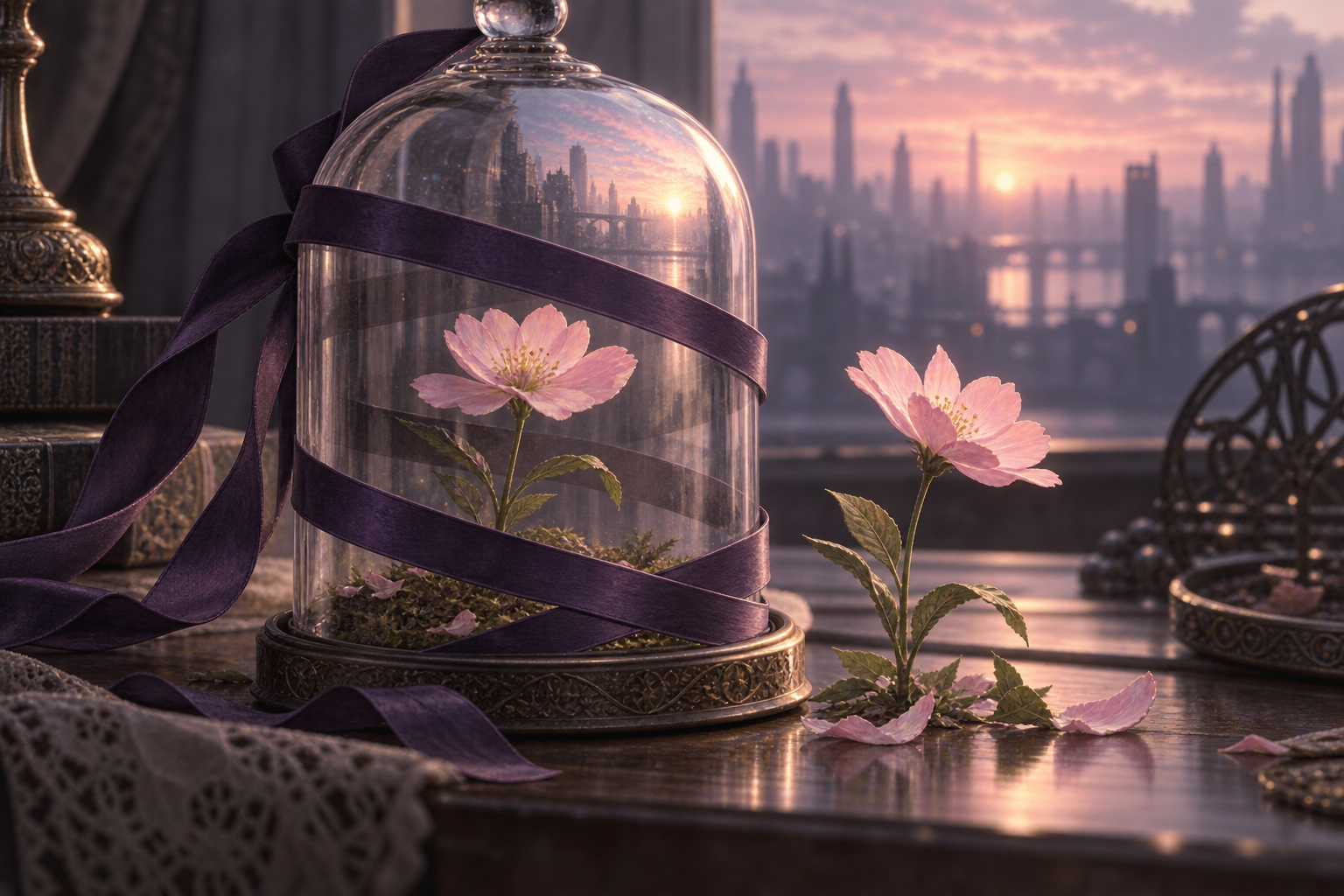
The illustration above is a symbolic accompaniment, not a depiction of a film scene. Its sheltered flower captures the question at issue: protection may preserve something precious while restricting the conditions in which it can grow.
The most revealing test for Homura is therefore relational. Can she acknowledge a desire that conflicts with her own? Can love survive an answer she would not have chosen? Neither question requires dismissing her suffering. They require taking the person she loves equally seriously.
This connection between surroundings and personal freedom also informs our analysis of how an inviting environment can become a psychological trap. In both discussions, apparent comfort becomes more complicated when someone else controls its terms.
How to prepare without turning speculation into plot
Revisit the preceding story with attention to decisions rather than collecting clues indiscriminately. Three questions offer a useful guide:
- What does each character explicitly want, and what do others assume she wants?
- Who understands the consequences of a decision when it is made?
- Whose happiness depends on another person accepting a particular version of reality?
Keep remembered dialogue separate from paraphrase. English subtitle and dub wording can differ, so a familiar quotation should not become evidence for an argument its particular wording cannot support.
The new film’s official synopsis includes the declaration, “We will not forgive Homura Akemi.” That establishes an adversarial position in the promotional setup. It does not establish the film’s final judgment. An accusation is something a drama can investigate, complicate, or challenge.
Likewise, a suggestive image does not establish an Easter egg’s meaning. Without verified scene context, assigning secret significance to every repeated shape or color risks replacing interpretation with invention.
The deeper question awaiting Walpurgisnacht: Rising
The most compelling possibility for this continuation is an examination of whether care can accommodate another person’s freedom. Madoka’s outward-looking wish and Homura’s determination to preserve their connection create a conflict that cannot be measured simply by who suffers more.
A satisfying resolution would need to make room for responsibility as well as sympathy. Pain can explain a decision without settling whether it was fair. Sacrifice can be admirable without making every consequence desirable.
For the January U.S. release, that is the question worth carrying into the theater: can these characters recognize each other as people whose wishes may remain different? The answer belongs to the film. The established story gives it a formidable question to answer.
Original content by this site's editorial team. Published: October 9, 2026 at 00:15:34 PDT (Los Angeles time)