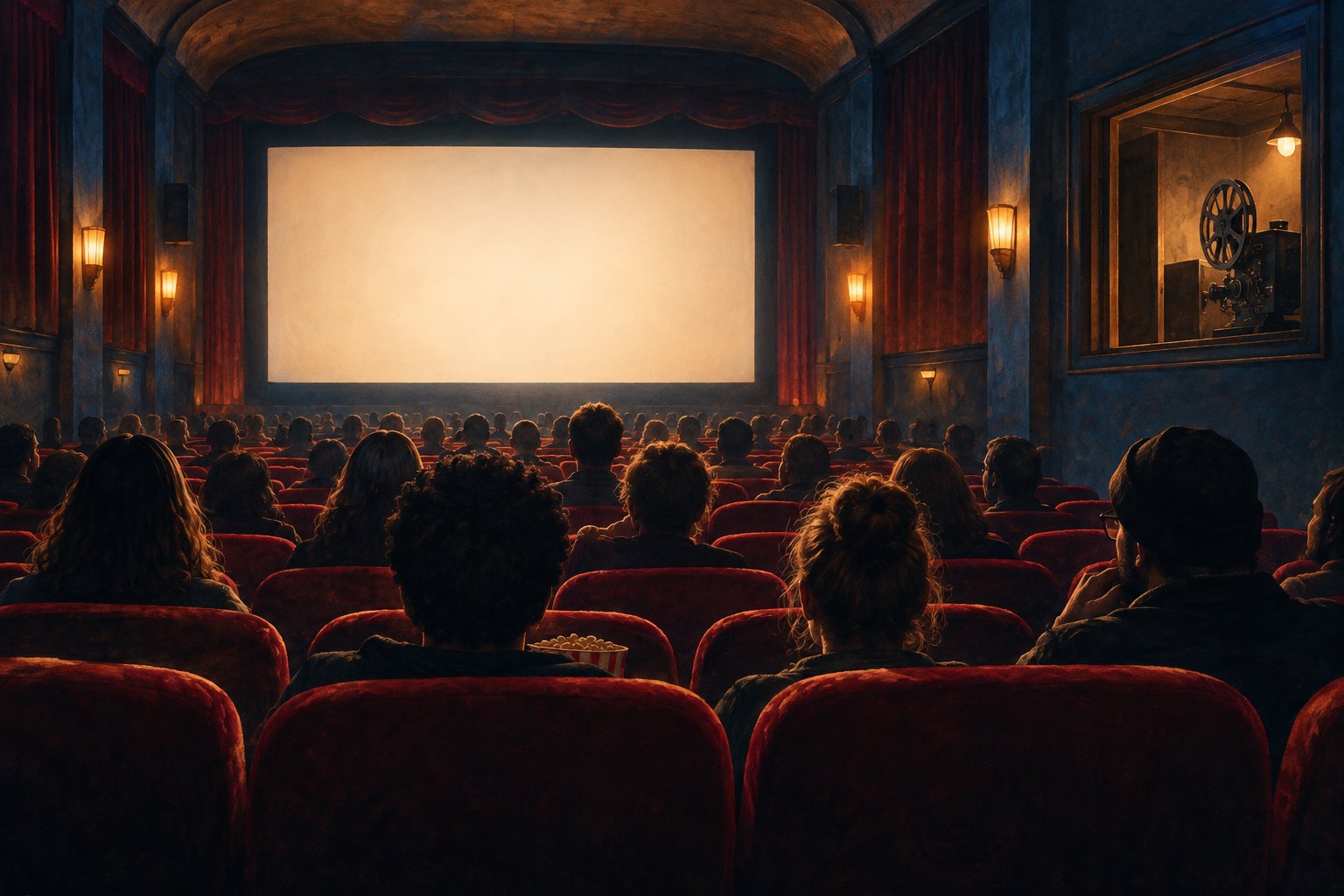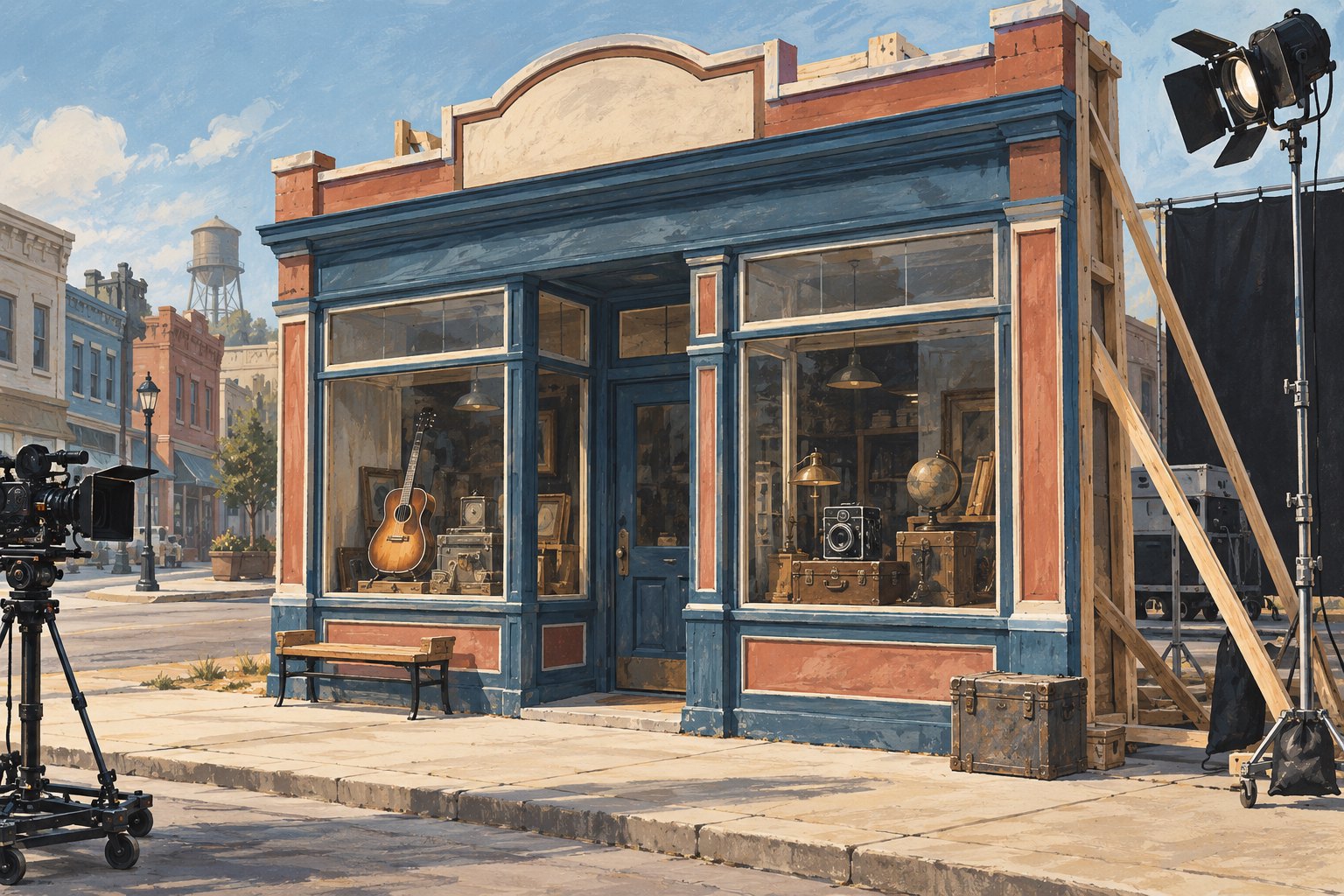
Livingston’s controversial film set brings together three attention-grabbing elements: a fake pawn shop, scenes involving ICE, and protests. Those are the central subjects identified in KBZK News’ coverage. For moviegoers, they raise an immediate question: what does seeing a politically charged production take shape actually tell us about the film being made?
It reveals something about the material the production is staging. It does not, by itself, establish how the finished movie will interpret that material. A storefront can be examined as scenery; an enforcement scene can be identified as subject matter. Neither supplies the character relationships, editing, or consequences that would support a complete film review.
This is spoiler-free commentary on the Livingston film-set controversy, not a review of a completed movie. The illustrations are conceptual images, not documentary views of the location.
Why the fake pawn shop matters
The pawn shop is the most concrete entry point into the story. It represents a basic act of filmmaking: turning a physical place into a setting that asks audiences to believe in another world. That transformation is ordinary production work, but its dramatic effect deserves attention.
A pawn shop carries possible associations with money, ownership, necessity, and bargaining. Those associations are interpretive possibilities, not confirmed plot details here. A filmmaker could emphasize any of them—or use the business simply as a recognizable location. We should resist deciding what the storefront symbolizes before seeing how the movie uses it.
Still, production design can begin shaping our response before a character speaks. A cramped counter might make an encounter feel restrictive. An open doorway might suggest escape or exposure. A display of possessions might imply histories the screenplay never explains. These are examples of how settings work, not descriptions of verified Livingston footage.
My critical preference is for a location that becomes more specific through the people occupying it. An impressive facade earns its dramatic purpose when we understand why someone works there, enters reluctantly, or wants to leave. Otherwise, visual detail risks becoming an inexpensive substitute for human detail.
ICE scenes need narrative context
The presence of ICE scenes makes perspective especially consequential. An image of enforcement can be presented as reassurance, intimidation, routine procedure, or a disruption whose meaning changes as new information emerges. Identifying the subject does not settle which interpretation a film supports.
That meaning depends partly on who knows what. If viewers receive information through an enforcement character, they may understand an encounter as the execution of a plan. If information arrives through someone being approached, uncertainty may become the scene’s dominant experience. A wider viewpoint could reveal a mismatch between the two.
None of those approaches automatically produces a thoughtful movie. Restricted perspective can create empathy, but it can also conceal facts conveniently. Multiple viewpoints can deepen a conflict, but they can become superficial gestures if only one character receives meaningful choices.
The useful question is therefore specific: does the film give viewers enough information to assess what its characters do? A persuasive scene should survive attention to its causes and consequences. Music, urgency, and an authoritative performance can generate an immediate reaction; they cannot independently establish that a character’s judgment is sound.
A set and a finished scene offer different evidence
Watching a production involves seeing fragments of work. A finished scene adds duration, sequence, sound, and context. These elements can change the apparent importance of an action without changing the action itself.
Consider a hypothetical shot of someone looking toward a doorway. Place it before an arrival, and it may suggest anticipation. Place it after a confrontation, and it may suggest fear or regret. The look remains the same; the relationship between images supplies much of its meaning. This is why a glimpse of staging cannot reliably reconstruct a character arc.
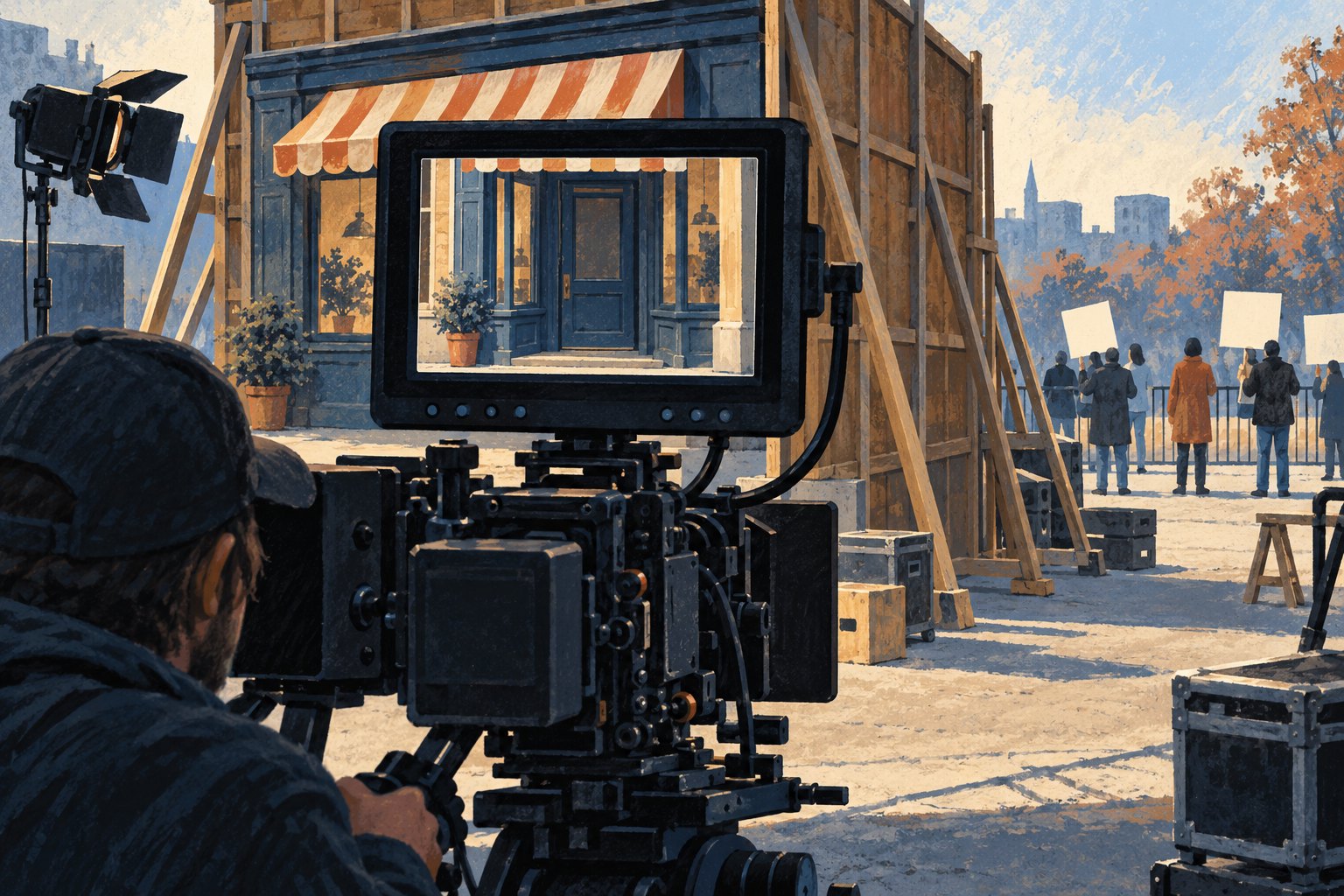
That distinction also helps separate production scrutiny from artistic judgment. Questions about what happens around a filming location deserve examination on their own evidence. Questions about whether the story is coherent, manipulative, moving, or shallow require attention to the work audiences eventually see.
Our discussion of how research claims should inform film criticism addresses a related issue: information about making a movie matters, but evaluating its argument also requires examining how that information becomes cinema.
Protests should not become a shortcut to a verdict
Protests belong to the Livingston story. Their presence alone, however, cannot establish either a film’s artistic failure or its importance. Treating opposition as proof of either conclusion would replace criticism with a reaction to the surrounding dispute.
It is equally unhelpful to treat protesters as a single dramatic character with one assumed motive. Specific objections need specific attribution. A person’s objection to an image, a production practice, or an anticipated political message would involve different claims and require different evidence.
For readers, the practical distinction is between what someone reports observing and what they believe that observation means. Both may be worth hearing. They should remain distinguishable, particularly when an interpretation begins circulating as though it were a verified synopsis.
Controversy can also become the lens through which audiences approach a film before its opening scene. Our analysis of Digger’s publicity debate and audience expectations considers that broader problem. Once the argument surrounding a movie becomes its main attraction, individual scenes can be reduced to evidence for positions viewers already hold.
What a meaningful review will need to examine
A character-focused assessment of the Livingston production should eventually move beyond identifying political symbols. The revealing details will be the connections between setting, action, and consequence:
- How the storefront functions: Does the pawn shop shape decisions and relationships, or provide atmosphere alone?
- Who receives interiority: Whose uncertainty, private concerns, and conflicting obligations become understandable?
- How enforcement is framed: What information supports a character’s actions, and what information challenges them?
- What follows confrontation: Does the story remain interested in its effects after the most dramatic moment ends?
Dialogue would also matter, particularly where a memorable line reveals a contradiction between a character’s self-image and behavior. No verified film dialogue is available for quotation here. Inventing a punchy line would create precisely the false impression of familiarity that responsible criticism should avoid.
The deeper issue is what the frame leaves out
The fake pawn shop offers a useful way to think about this controversy without pretending to know the movie’s ending. A facade is designed to look complete from a chosen angle. Cinema likewise selects what we can see, whose reactions we can read, and which consequences remain outside our view.
Selection is unavoidable. The artistic question is whether those choices reward scrutiny. My standard for the eventual film would be a story whose people remain intelligible beyond the immediate demands of a confrontation, and whose setting feels inhabited rather than merely arranged for an argument.
Livingston’s set invites attention because the construction is visible. The finished film will face a more demanding test: whether the world inside that construction can sustain believable human lives.
Original content by this site's editorial team. Published: October 1, 2026 at 15:35:54 PDT (Los Angeles time)