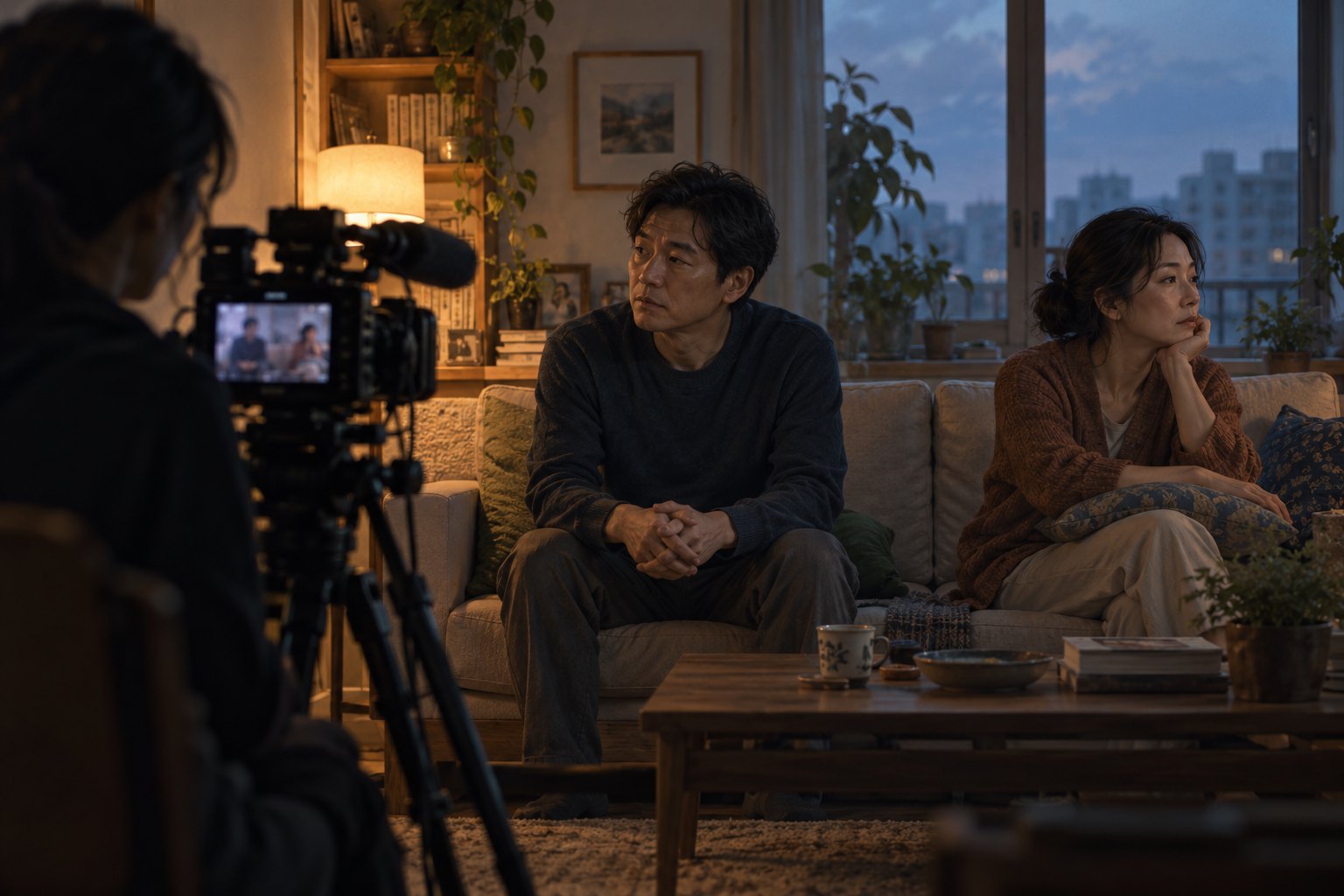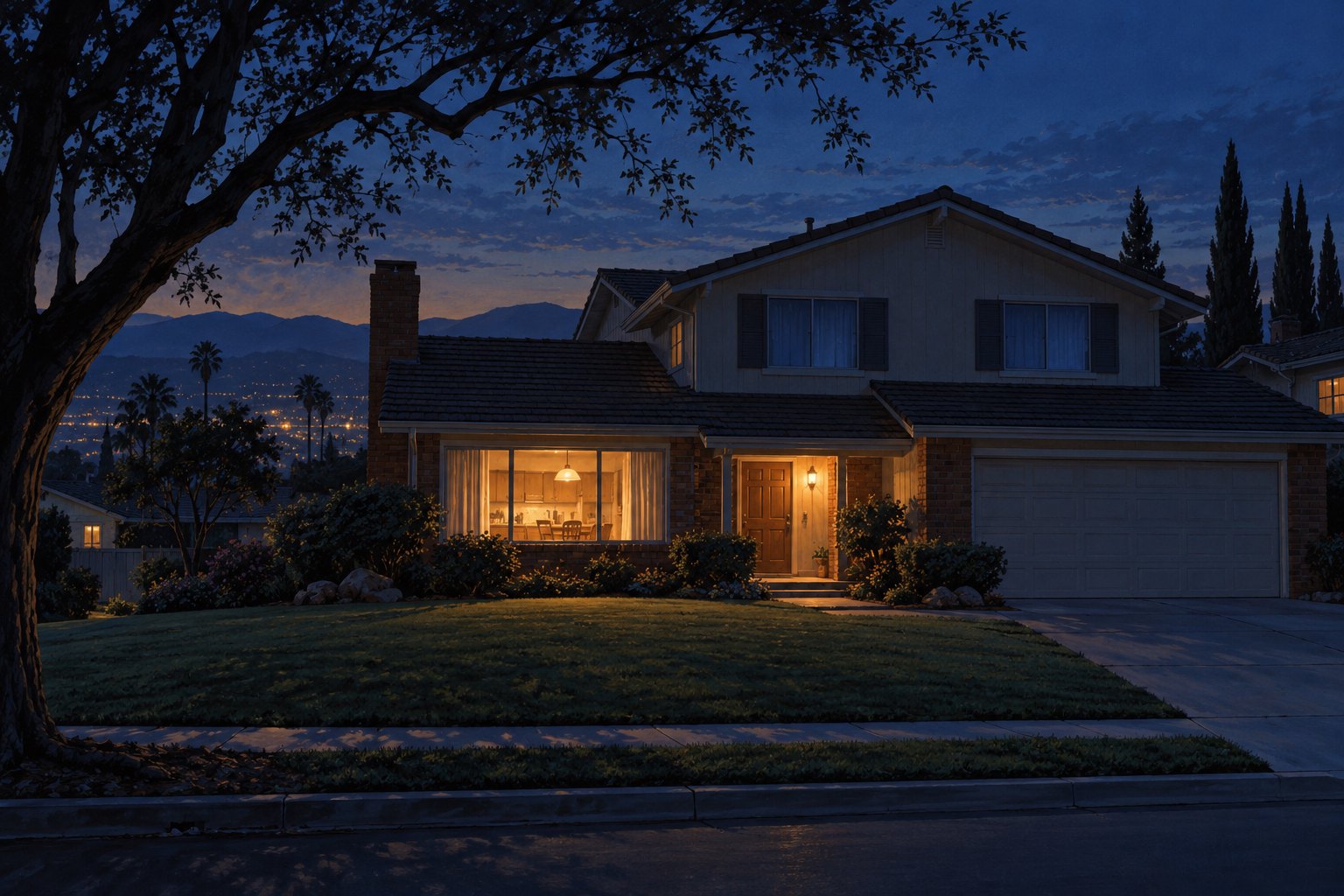
The house from Poltergeist is someone’s home. The Guardian’s account of a resident living there brings that simple, disorienting fact into focus. For viewers, the building belongs to a memory of domestic terror; for someone living in it, a house must also accommodate the ordinary business of daily life.
That tension makes an unusually good starting point for revisiting the 1982 film. Its lasting achievement is making familiar rooms feel capable of betraying the people who trust them. A frightening building is easy to imagine. A comfortable building that gradually stops behaving like one is harder to forget.
Spoiler warning: This review discusses the original film’s major scares, rescue sequence, and ending. The real residence and the supernatural events depicted in the movie are separate subjects; the illustrations here are imagined scenes.
Why this particular movie house stays with us
Directed by Tobe Hooper, with a screenplay by Steven Spielberg, Michael Grais, and Mark Victor, Poltergeist introduces the Freelings through domestic activity rather than ominous family mythology. Steve and Diane, played by Craig T. Nelson and JoBeth Williams, have children, distractions, and the easy familiarity of people accustomed to sharing space.
My favorite quality of the opening is its untidiness. The family does not seem assembled solely to receive a haunting. Their attention wanders. Adults have pleasures outside parenting. Children need reassurance at inconvenient moments. That ordinary friction makes the home feel inhabited before anything extraordinary happens.
It also explains the fascination of living in the recognizable house. The movie’s menace depends on a gap between appearance and experience. From outside, there is little reason to expect the impossible. Once you know the film, however, your imagination can supply it. Architecture becomes a surface onto which memory projects another story.
Carol Anne hears company where adults hear interference
Carol Anne’s announcement, “They’re here,” remains effective because she delivers information the adults cannot yet interpret. Heather O’Rourke does not need to perform elaborate terror. The unsettling element is her apparent ease with something the family has no language for.
The television makes that difference visible. To an adult, static marks a failed transmission. To Carol Anne, it becomes contact. The appliance already occupies a privileged place in the household: people gather around it, leave it running, and accept its voices as background company. The film turns that accepted intimacy into vulnerability.
From the child’s perspective, the boundary between welcome and danger is still being learned. From the parents’ perspective, an object they understand has acquired a function they cannot control. The same room holds two incompatible experiences, and neither generation can simply explain the other’s away.
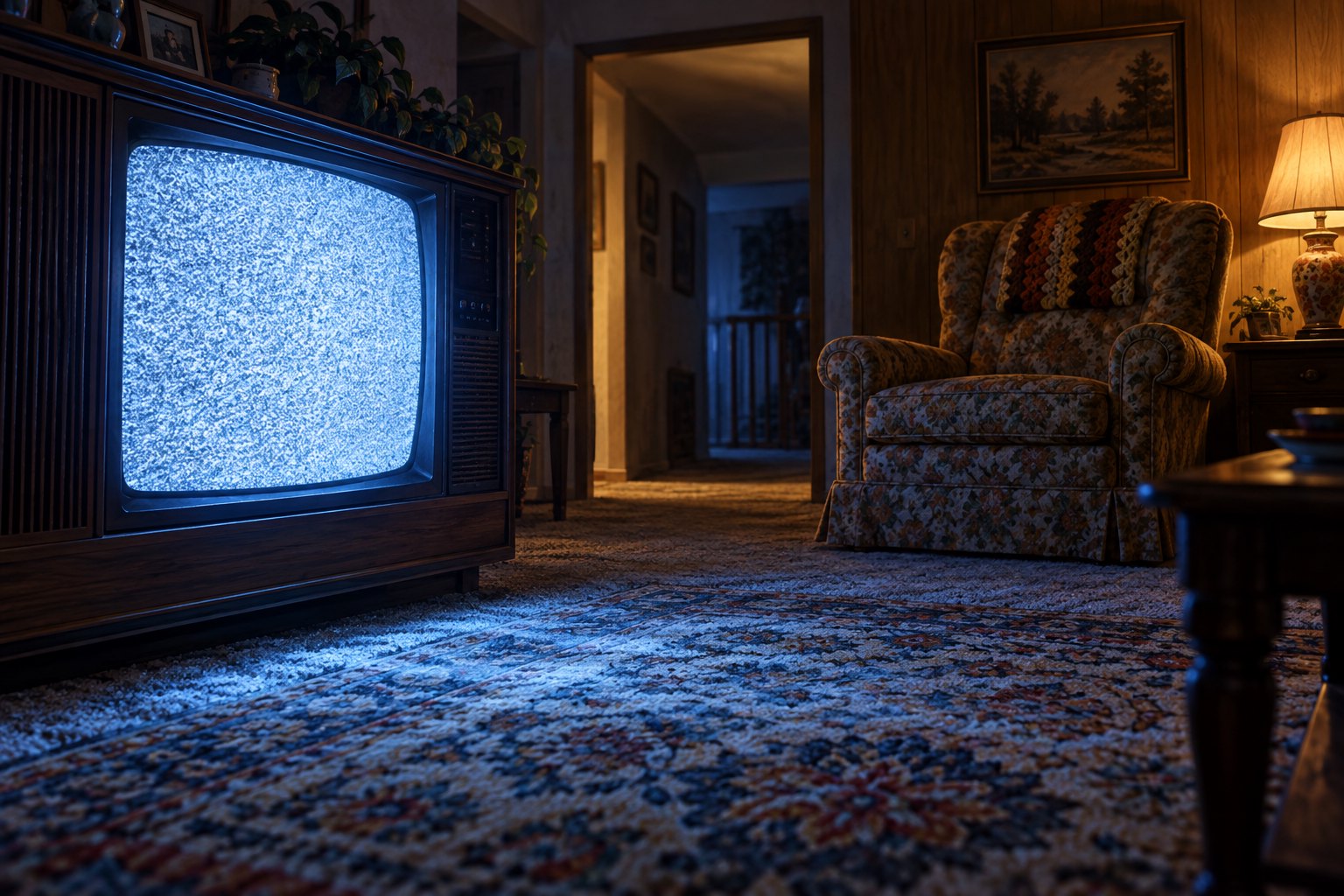
This is also why the premise travels beyond its period technology. The fear concerns familiar things becoming unreliable. Our discussion of recognition and danger in Mama Bear considers a related problem: what happens when an everyday signal no longer means what a character thinks it means?
Diane’s curiosity becomes the film’s emotional strength
Diane initially approaches the strange activity with curiosity and even delight. That response gives the escalation somewhere to go. If every unexplained movement produced instant panic, the haunting would have only one emotional register.
Williams makes the change in Diane’s priorities convincing. Once Carol Anne disappears, fascination gives way to concentrated effort. The question is no longer how an impossible event works, but how to reach her daughter. The supernatural machinery becomes meaningful because it obstructs a recognizable parental objective.
Diane’s eventual passage into the other realm is the film’s strongest expression of that commitment. The spectacle matters, but her decision gives it weight. She acts without possessing the reassuring knowledge that action films often grant their heroes. Love supplies a reason to proceed, not a guarantee of success.
For me, this is what keeps Poltergeist from becoming merely a collection of effects. Its emotional center is a mother trying to cross a distance that should not exist inside her own home. Familiarity makes the separation more painful: a child can be close enough to hear and still impossibly far away.
Robbie discovers the limits of reassurance
Robbie’s fears have a different rhythm. The tree outside his window and the clown doll transform the bedroom into a place where looking away feels dangerous. Oliver Robins gives those scenes an essential physical vulnerability: a child’s bed offers very little protection once imagination becomes action.
The tree attack is especially cruel because parental explanation has already tried to make the world manageable. Adults can offer a comforting account of an object, but the film lets that account fail. Robbie is left confronting something larger than his ability to reason with it.
The clown sequence works on a smaller scale. Waiting, checking, and discovering that a familiar object has moved create tension before the attack. The lesson for a rewatch is to notice how carefully the film organizes attention. A bedroom does not need to become visually unrecognizable to become unbearable.
Steve’s home is also his livelihood
Steve’s connection to the housing development gives the ending an anger that a generic haunting would lack. He participates in selling the reassuring environment his family inhabits. The eventual discovery that cemetery headstones were moved while bodies remained exposes a grotesque separation between an attractive surface and concealed reality.
That revelation changes how I read his earlier confidence. He is not simply a foolish father who should have believed sooner. His understanding of security has been shaped by a system whose promises he repeats. The betrayal is professional as well as personal.
The film’s moral accusation therefore extends beyond the house. Its buried dead make a literal return of what development has treated as disposable. This is an interpretation of the fictional story, not a claim about the history of the actual filming property.
A rescue does not repair the foundations
After Carol Anne’s rescue, Tangina declares, “This house is clean.” Zelda Rubinstein gives the assurance memorable finality. The later eruption of danger makes that certainty deeply uncomfortable: successfully retrieving a child has not resolved everything beneath the home.
I find the final stretch both exhilarating and somewhat exhausting. The concentrated anxiety of the earlier rooms gives way to an avalanche of threats. Yet the excess has a purpose. The family can no longer restore its old routine through one successful intervention.
The closing television gag offers a sharper release. At the motel, Steve removes the set from their room. After so much helplessness, the action is wonderfully modest: he cannot explain the universe, but he can decide what stays beside his family tonight.
What a real resident changes about the ending
Thinking about someone living in the Poltergeist house reveals how thoroughly cinema can alter our perception of ordinary space. A viewer carries imagined danger into a building; the person who lives there has a relationship with it that no film can fully describe.
That distinction also clarifies the movie’s deeper achievement. The Freelings’ home initially seems to guarantee their safety. By the end, safety depends on their willingness to protect one another and abandon that guarantee. The building loses its authority; the family’s obligations survive.
Readers interested in that emphasis on character can find a related argument in our commentary on why character and consequence matter in original movies. Here, every memorable room matters because someone we care about must enter it.
Poltergeist remains, in my judgment, an exceptionally effective domestic horror film. Its biggest images are spectacular, but its enduring question is intimate: when the place you trust stops protecting you, what still makes it home?
Original content by this site's editorial team. Published: October 29, 2026 at 23:18:15 PDT (Los Angeles time)