Little Shop of Horrors earns its place on a movie-night schedule by making temptation entertaining. The songs bounce, the plant steals scenes, and the romance has real tenderness. Yet Frank Oz’s 1986 musical keeps asking an uncomfortable question: how much harm will a sympathetic person excuse once doing the wrong thing finally makes life better?
My verdict: this is a wonderfully strange, emotionally persuasive horror comedy whose strongest special effect is the contrast between Rick Moranis’s anxious Seymour and Ellen Greene’s wounded, hopeful Audrey. The creature gets the biggest entrance. Their needs give it somewhere to take root.
Spoiler warning: This review discusses major deaths and both the theatrical ending and the alternate ending presented in the director’s cut.
Seymour wants recognition before he wants power
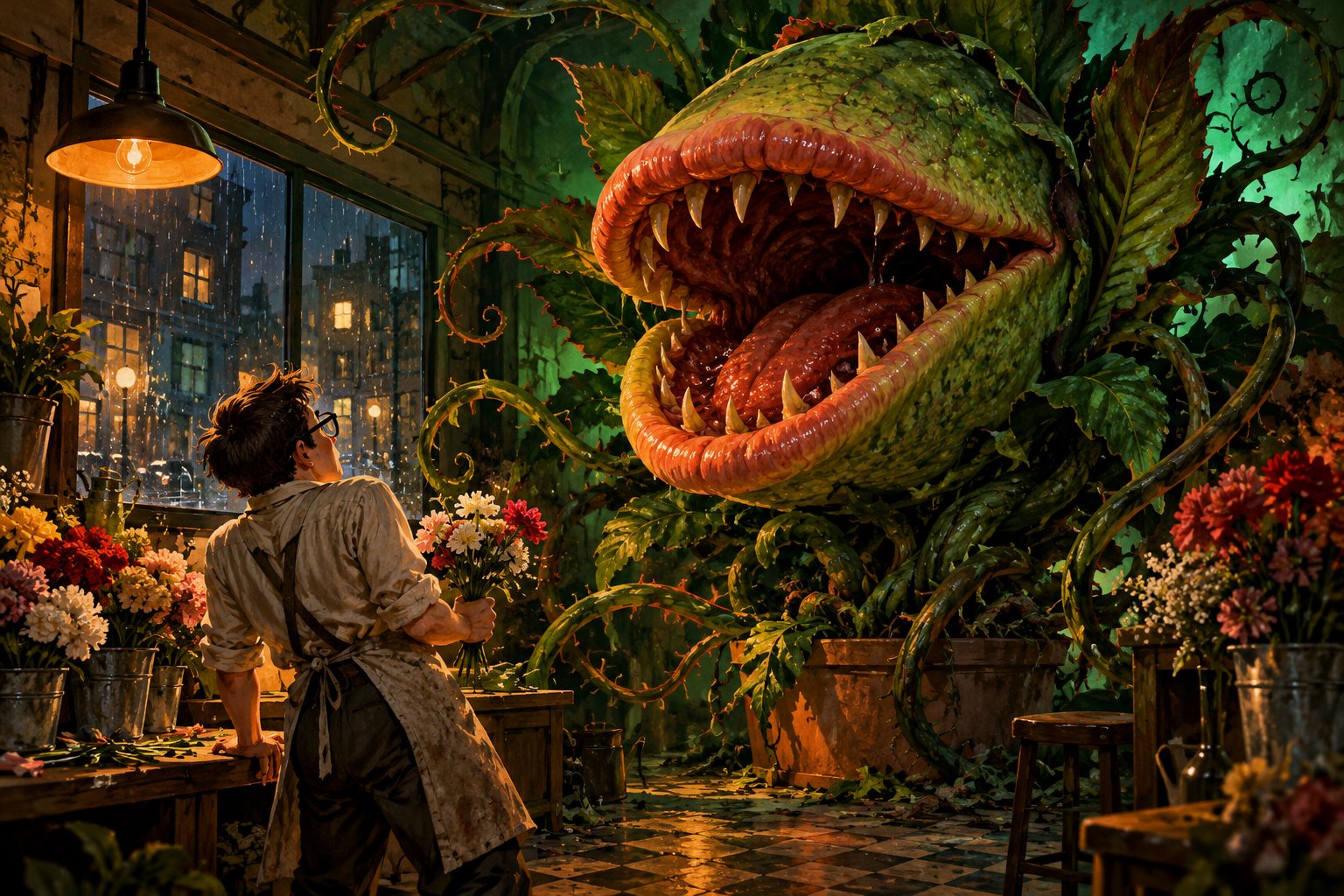
Seymour Krelborn works at a struggling flower shop on Skid Row, where his awkwardness seems to confirm everyone’s low expectations. When his unusual plant, Audrey II, attracts customers, it supplies something more intoxicating than income: evidence that he matters.
Moranis makes that distinction essential. His Seymour doesn’t initially carry himself like someone plotting a takeover. He looks like someone hoping to finish a sentence without being dismissed. The nervous posture and apologetic manner make his sudden importance feel enormous, even while the physical world around him remains shabby and cramped.
The discovery that Audrey II thrives on blood turns care into obligation. At first, Seymour pays with his own body. That arrangement lets him understand himself as devoted rather than dangerous. He is keeping something alive, saving the business, becoming useful. Each benefit supplies another reason to overlook the nature of the transaction.
Then comes the wonderfully blunt command, “Feed me, Seymour.” The plant can say exactly what it wants because Seymour is doing the complicated work of justifying it. Its appetite has no moral vocabulary. His does, and that makes him easier to manipulate.
The dentist gives Seymour a convenient excuse
Steve Martin’s Orin Scrivello is a dentist who treats cruelty as both profession and personality. His abuse of Audrey gives Seymour’s anger a legitimate object. The film makes him so extravagantly awful that viewers can feel the temptation to approve whatever removes him.
That is precisely where the comedy becomes morally slippery. Seymour goes to confront Orin with a gun but cannot bring himself to shoot. Orin dies after his gas apparatus malfunctions, with Seymour present. Seymour subsequently feeds his body to Audrey II. The distinction between causing a death, failing to prevent it, and exploiting it matters to the character’s self-image.
He can keep telling himself that he has not become the sort of person he fears. Meanwhile, the practical result is the same: the plant grows, and Seymour benefits.
Martin’s enormous performance is effective because it gives the audience an easy target. But the film becomes more interesting after that target disappears. Once Seymour has accepted a human body as the price of progress, the next demand no longer requires an entirely new moral argument. It requires an adjustment to the previous one.
Audrey’s dream is smaller—and more moving
Audrey wants a home, ordinary comforts, and a relationship in which affection does not arrive with punishment. Her wish for “somewhere that’s green” is funny in its domestic specificity, but Greene never treats the longing underneath it as foolish.
The performance moves between a fragile speaking voice and singing that seems to reveal a much larger emotional life. Audrey often sounds as though she expects to be interrupted. When she sings, the film briefly gives her enough room to exist without apology.
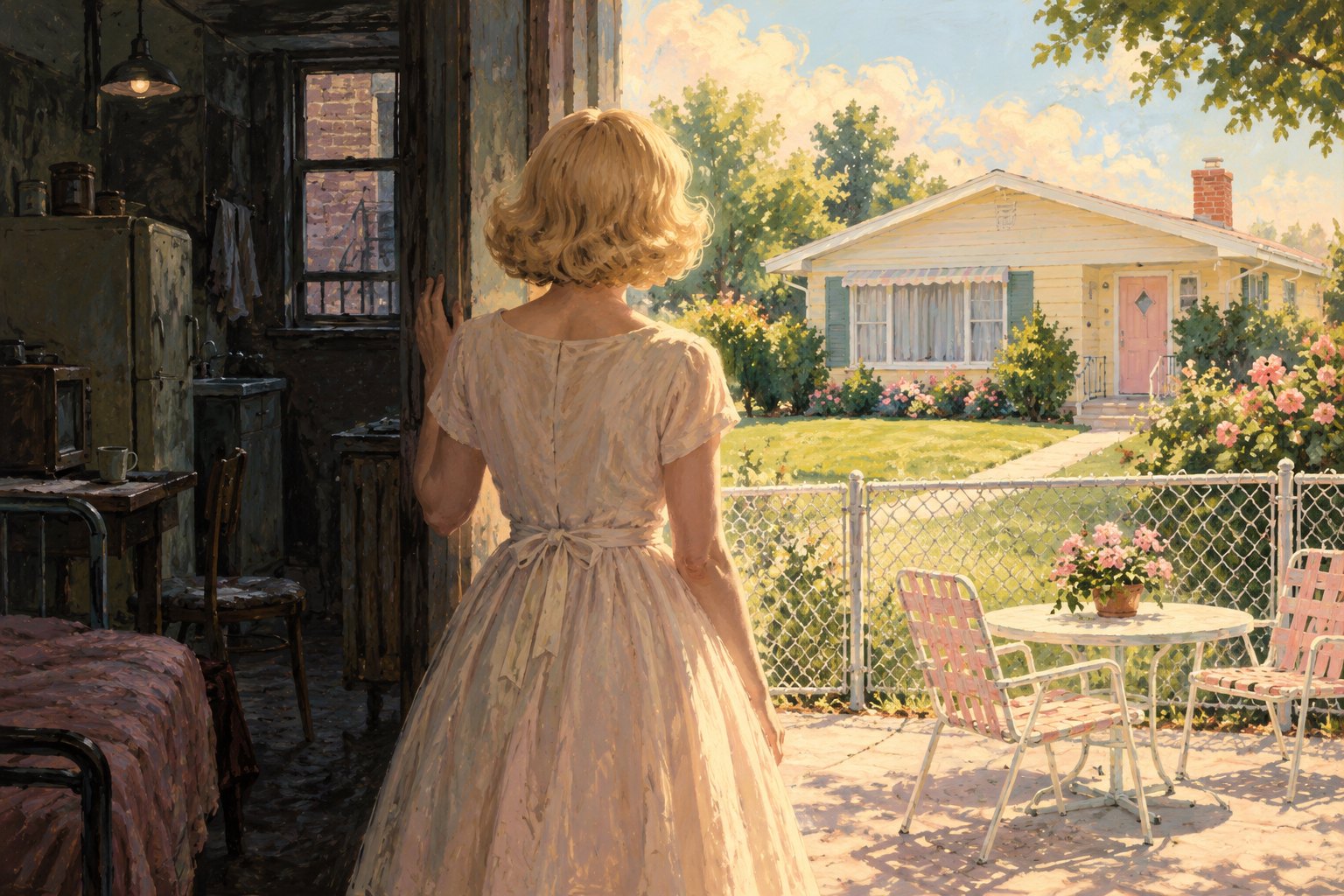
Her fantasy borrows the visual language of an idealized suburban household. It is possible to recognize the limitations of that picture while understanding why it represents freedom to her. Predictability would be extraordinary for someone accustomed to fear. An uneventful evening would count as a transformation.
This makes Seymour’s insecurity especially damaging. He worries that his importance depends on the plant, while Audrey’s affection points toward a different possibility: that he could be loved without maintaining the spectacle. He has trouble trusting the very person whose approval supposedly motivates him.
That tension connects with the questions about affection and usefulness in our analysis of Wicker’s made-to-order romance. Here, the tragedy begins when Seymour treats success as a prerequisite for love, even as Audrey offers evidence otherwise.
Audrey II sells the deal better than anyone
Voiced by Levi Stubbs, Audrey II has the confidence Seymour lacks. The creature negotiates, flatters, demands, and performs. Its musical authority makes obedience sound exciting.
The physical creature is equally important. Its expanding bulk changes the balance of the flower shop. What initially functions as a display becomes a dominant presence, crowding the people who imagine they are managing it. The relationship becomes visible before anyone fully acknowledges it: Seymour’s opportunity is taking up all the available space.
Howard Ashman’s lyrics and Alan Menken’s music make persuasion part of the entertainment. We enjoy the plant’s assurance even while recognizing the threat. That complicity gives the musical numbers dramatic purpose beyond their considerable pleasure as songs.
Vincent Gardenia’s Mushnik supplies a human variation on the same appetite. The shop owner recognizes Seymour’s commercial value, and his confrontation over Orin’s disappearance becomes entangled with control of the plant. Audrey II eventually consumes him, but the surrounding struggle has already shown how quickly concern can turn into bargaining.
The film’s broad comedy occasionally makes the damage feel too easily absorbed. Still, that tonal instability usually works in its favor. A laugh can arrive just before the realization that Seymour has accepted another intolerable situation.
The two endings ask different things of the audience
The theatrical ending offers escape
In the theatrical version, Seymour rescues Audrey from the plant, destroys Audrey II with electricity, and reaches the suburban future she imagined. The emotional reward is substantial because Greene and Moranis have made their happiness feel worth wanting.
My reservation is that this ending resolves the immediate danger more thoroughly than it resolves Seymour’s responsibility. Defeating the monster does not undo his participation. The romance provides release, but the moral accounting remains incomplete.
That tension resembles the distinction between care and possession explored in our Wildwood character analysis: loving someone does not automatically justify the choices made in their name.
The director’s cut turns private compromise into public disaster
The alternate ending is harsher. Audrey dies after the attack and asks Seymour to give her body to the plant. Seymour is subsequently devoured, and the proliferation of Audrey II plants leads to destruction on a much larger scale.
Audrey’s fate makes her generosity agonizing. She still imagines her value in terms of what she can give Seymour. The plant exploits that selflessness just as effectively as it exploits his ambition.
I find this ending more coherent as a cautionary tale, though less satisfying as a romance. Its expanding spectacle shows the consequences of treating a predatory thing as a marketable miracle. The danger outgrows the people who thought their arrangement was personal.
The final garden detail—and the deeper horror
Watch the garden at the end of the theatrical cut: a small Audrey II-like bud complicates the apparent happy ending. It is a visual sting rather than proof of a particular future, but it prevents the suburban image from becoming completely innocent.
That detail captures the film’s deepest anxiety. Seymour and Audrey deserve lives beyond deprivation and humiliation. Their desires are understandable. The horror lies in how readily a promise of escape can turn those desires into instruments of control.
Little Shop of Horrors remains such rewarding entertainment because it lets us feel the attraction before examining the cost. The plant offers Seymour recognition immediately and sends the bill later. By then, he has begun confusing everything it gives him with everything he is.
Original content by this site's editorial team. Published: October 30, 2026 at 17:42:48 PDT (Los Angeles time)