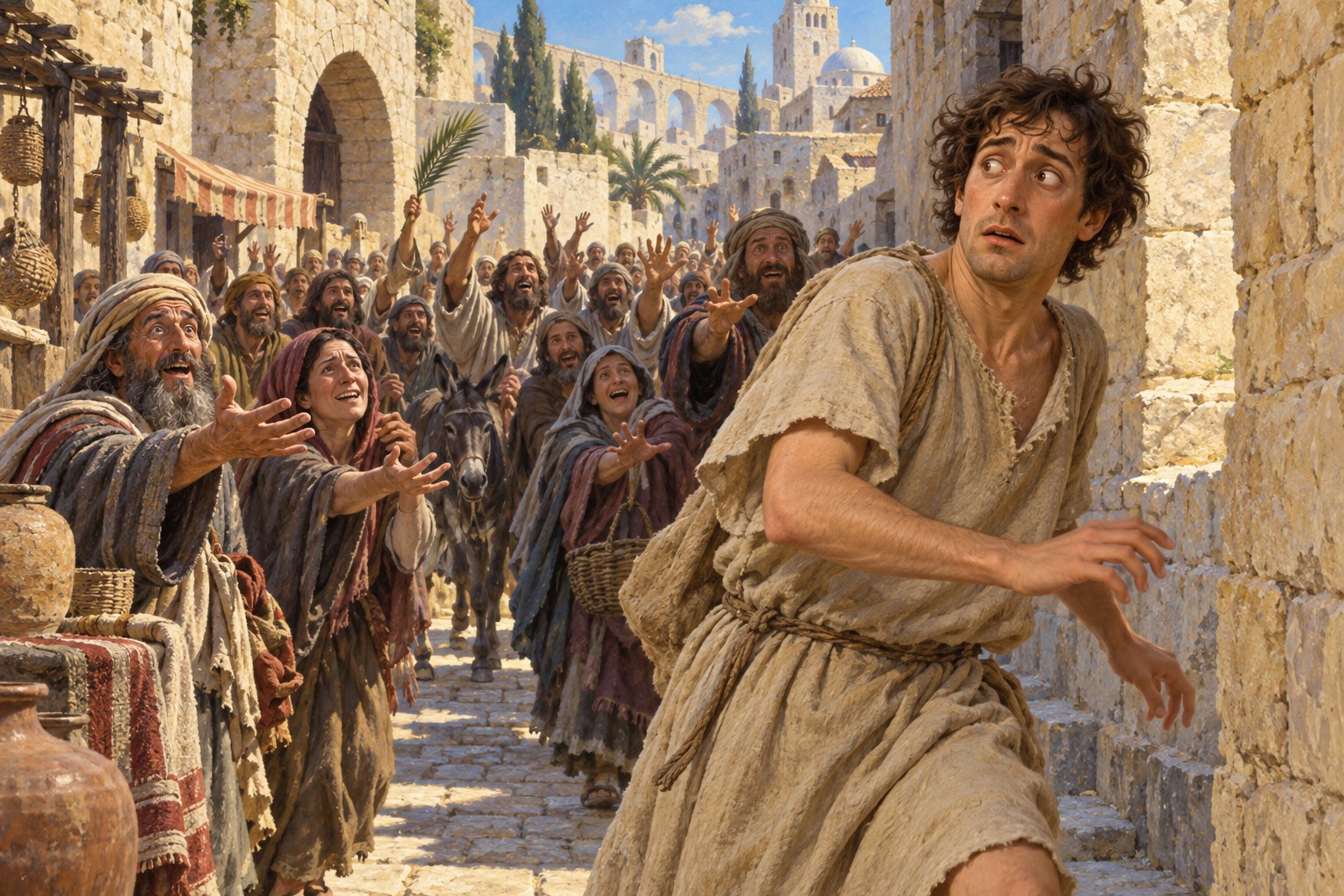
Monty Python’s Life of Brian began filming in Tunisia on September 16, 1978—48 years ago this September. HandMade Films’ production history confirms that starting date. The anniversary invites a fresh look at Terry Jones’s 1979 comedy and its remarkable central joke: a man becomes the object of universal attention without gaining the basic privilege of being heard. [HandMade Films’ production history](https://www.handmadefilms.com/about/)
Calling it the greatest comedy ever made is a matter of taste. My argument for its greatness rests on something more specific than its supply of quotable scenes. Its jokes keep tightening the same trap around Brian Cohen. Family, politics, religion, and government all assign him a role; his attempts to explain himself only make escape harder.
Spoilers follow, including the ending.
Brian wants a life; everyone else wants a symbol
Graham Chapman plays Brian with the anxious seriousness that makes the surrounding nonsense work. Born next door to Jesus, Brian grows into an ordinary young man living under Roman occupation. His attraction to Judith and his resentment of Roman rule draw him toward the People’s Front of Judea. His motives are recognizable: desire, anger, and the hope that joining something will make him matter.
Chapman gives those motives enough weight to prevent Brian from becoming a walking setup. Watch how often his face seems to ask whether an interaction can simply end. Around him, people relish their opportunities to argue, instruct, or pronounce judgment. He wants to get through the conversation and continue living.
That difference supplies the film’s emotional rhythm. Brian can be foolish, reactive, and easily impressed, but his embarrassment feels proportionate to his circumstances. He is the person who has to experience what everyone else treats as an occasion for performance. The value of such vulnerability also runs through our look at Will Poulter’s awkward, emotionally exposed comic characters.
Reg turns revolution into a meeting that never ends
For Brian, joining the resistance promises agency. For Reg, played by John Cleese, it offers a platform from which to supervise other people’s convictions. The People’s Front of Judea spends extraordinary energy distinguishing itself from rival factions. Membership depends on knowing whom to despise, including people with almost identical objectives.
The famous question, “What have the Romans ever done for us?”, works because Reg expects a ritual response. Instead, his listeners begin supplying inconvenient examples of public infrastructure and services. Each answer forces him to narrow his claim while trying to preserve his commanding tone.
The scene does not establish that occupation is justified by decent plumbing. Its sharper observation concerns a leader who needs agreement more than information. Reg cannot allow a complicated answer to interrupt the emotional usefulness of his question. Cleese’s mounting irritation makes intellectual dishonesty visible as a struggle to keep control of the room.
Brian’s Latin graffiti assignment turns political action into another humiliating lesson. A Roman centurion catches him painting an anti-Roman message and concentrates on his grammar. The authority figure’s professional habits temporarily overpower the meaning of the protest. Brian finally gets to act, only to find himself treated like a schoolboy.
Mandy knows her son—and still defines him for him
Terry Jones gives Brian’s mother, Mandy, a wonderfully unromantic certainty. Where others see spiritual significance, she sees domestic inconvenience. Her dismissal of Brian as “a very naughty boy” punctures the crowd’s elevated expectations with the vocabulary of parental discipline.
Yet Mandy’s skepticism does not automatically make her Brian’s ally. She rejects the identity his followers have invented while insisting on her own familiar version of him. Brian cannot grow into an autonomous adult if every claim he makes must pass through his mother’s authority.
That is why the scene remains funnier than a simple collision between faith and common sense. Two groups compete to explain Brian, and both regard his participation as optional. Jones’s brisk delivery leaves almost no room for negotiation. From Mandy’s perspective, the crowd is absurd because she already knows everything necessary about her son.
The crowd makes disagreement impossible
Brian acquires followers after pretending to preach while trying to evade capture. His audience invests his interrupted speech with significance, then treats his efforts to leave as further evidence that he possesses extraordinary knowledge. Soon, a discarded sandal and a gourd become objects around which competing interpretations gather.
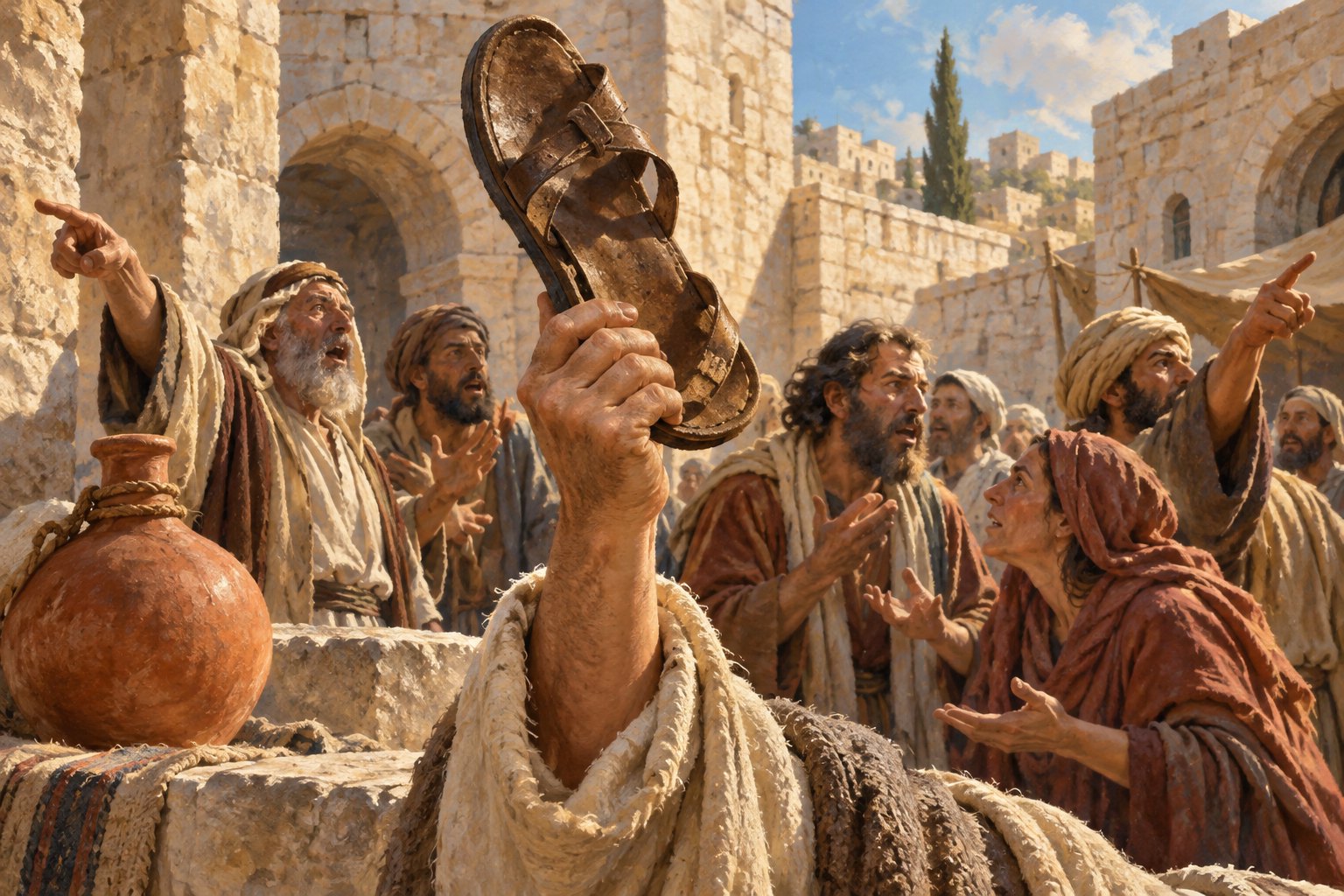
The physical objects matter because they expose how little Brian’s intentions count. Something he loses becomes something others believe he has bestowed. A practical accident becomes a message. The followers need no deliberate deception from their supposed leader; their appetite for significance does the work.
“You are all individuals!” is therefore a desperate attempt to restore responsibility to the audience. Their collective agreement defeats his purpose. They can repeat the language of independent thought without practicing it.
Jones stages the crowd as an active comic force. Reactions pass from one person to another, gathering confidence through repetition. Brian’s isolation increases as his audience grows. The scene also demonstrates the principle explored in our discussion of how ensembles generate comic friction: supporting characters become most useful when their wants interfere with the lead’s.
Why the silliness sometimes cuts deeper than the satire
The film is not uniformly elegant. Some routines depend on prolonged repetition, and the laughter directed at speech impediments can feel easier and less searching than the comedy of ideological certainty. Viewers who prefer a tightly controlled narrative may also find the sudden spaceship episode a disruptive detour.
For me, that instability is usually productive. Brian cannot trust the rules of the world any more than he can trust its institutions. A scene can begin as political intrigue, become a classroom exercise, and end as a chase. Chapman maintains continuity by treating each new indignity as something that is actually happening to him.
The substantial stone settings help, too. These people inhabit a world that looks solid enough to support a historical epic. Their petty disputes do not float in an abstract sketch environment; they occupy streets, rooms, and public spaces. The distance between that visual seriousness and their behavior gives the jokes extra force.
The ending asks what solidarity is worth
Brian’s crucifixion brings the film’s pattern to its harshest conclusion. People can celebrate what he represents while failing to respond to what he needs. Admiration becomes another way of abandoning him. Political meaning offers little comfort to the person expected to supply the sacrifice.
Eric Idle’s “Always Look on the Bright Side of Life” changes the atmosphere without changing the situation. The melody offers communal pleasure, but no rescue. The film leaves us with the uncomfortable experience of enjoying a number performed by people whose suffering remains unresolved.
I read that ending as both generous and merciless. Humor can give people a small measure of freedom inside circumstances they cannot control. It can also make those circumstances easier for spectators to accept. The song holds both possibilities at once, which is why its cheerfulness never entirely cancels the cruelty surrounding it.
The deeper achievement of Life of Brian is its attention to the difference between loving an idea and attending to a person. Brian is surrounded by conviction and starved of consideration. Forty-eight years after filming began, that remains an exceptionally strong foundation for comedy: everyone has an answer, while the man at the center can barely finish a sentence.
A cameo to catch on a rewatch
George Harrison, whose financial backing helped get the production made, also appears briefly in the film. Monty Python’s official production account confirms both his support and the cameo. It is a fitting small detail in a movie about misplaced attention: an essential contributor passes through the picture without becoming its center. [Monty Python’s official film history](https://www.montypython.com/film_Monty%20Python%27s%20Life%20of%20Brian/14)
Original content by this site's editorial team. Published: September 17, 2026 at 16:03:03 PDT (Los Angeles time)