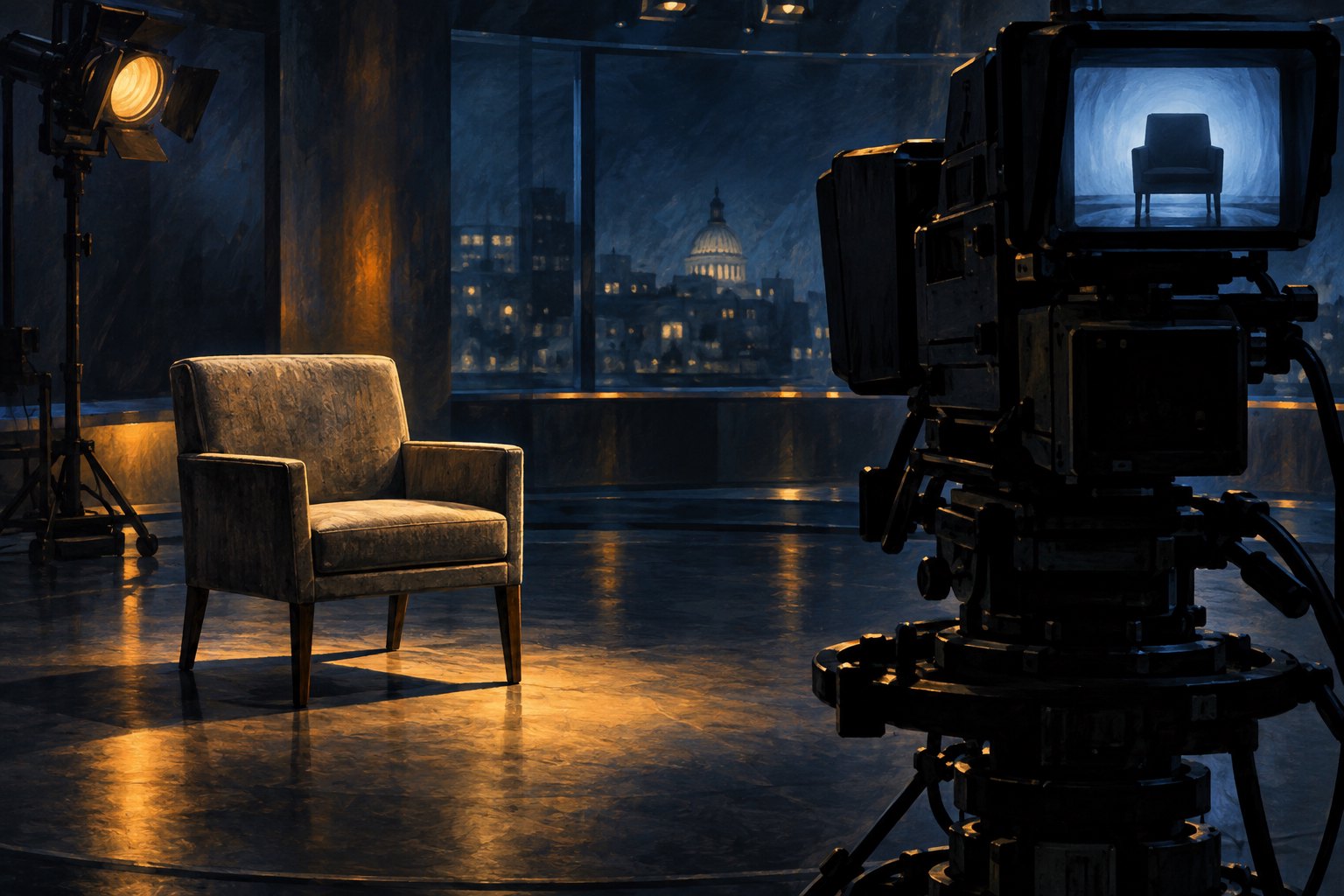
Lance Oppenheim’s Primetime and You Can See Everything invite a compelling comparison: what happens when someone accustomed to managing a public image becomes the subject of someone else’s camera? His discussion of the films and Chris Hansen brings that question into focus. The richest connection between these projects concerns the authority an image appears to possess—and the decisions that give it that authority.
Spoiler-light critical commentary: This essay examines the projects through Oppenheim’s reported creative approach. It does not offer a firsthand performance verdict or reveal either film’s ending.
Chris Hansen and the authority of an entrance
In his interview with The Playlist, Oppenheim describes his childhood fascination with Hansen’s ability to command a televised encounter. He recalls the host’s familiar instruction: “Sit down, have a seat.” Those words belong to the television persona discussed in the interview; they should not automatically be treated as verified dialogue from Primetime.
The phrase offers a useful starting point for character analysis. On the page, it could sound hospitable. Within a confrontation, it establishes who controls the room. One person gives directions; another must decide whether to comply. The audience receives an immediate map of power before anyone has explained the evidence.
That structure creates an unusual dramatic problem for a filmmaker depicting Hansen. A commanding presence can look entirely self-sufficient, as though authority originates in the host’s voice. Yet television authority also depends on people and equipment beyond the frame. Someone arranged the space, anticipated the encounter, positioned the cameras, and selected what viewers would eventually see.
My critical interest lies in the friction between those two perspectives. From the central character’s position, the camera can feel like confirmation of personal importance. From a wider production perspective, that same person is one component of a carefully maintained system. A revealing character portrait would let us understand why the first perspective feels persuasive while making the second impossible to ignore.
A public persona can become a role with no exit
Oppenheim’s Variety interview connects his interest in Primetime to a personalized Cameo video from Hansen. The creative significance is more interesting than the novelty of the purchase: a recognizable manner can become something audiences request on demand.
Once a public figure has a familiar delivery, gesture, or catchphrase, recognition itself becomes part of the performance. Viewers know what they expect. The performer knows what will satisfy them. Repetition strengthens that relationship, but it can also narrow the space available for uncertainty or change.
For an actor interpreting such a figure, imitation is only the beginning. The more revealing question concerns what maintaining the recognizable surface costs the character. Does confidence require constant reinforcement? Can the person admit confusion without feeling that the entire role is slipping away? These are interpretive questions, not claims about Hansen’s private thoughts.
They also help distinguish a character study from a collection of impersonations. A familiar voice can produce instant recognition. Drama requires competing needs: the desire to remain authoritative, the need for other people’s cooperation, and the possibility that those demands will collide.
Our examination of the questions surrounding Robert Pattinson’s portrayal considers the expectations attached to playing a recognizable person. Here, the additional issue is how the filmmaking itself distributes power around that performance.
You Can See Everything changes the relationship to observation
Variety identifies You Can See Everything as Oppenheim’s nonfiction collaboration with Nathan Fielder centered on Elizabeth Holmes. Putting it beside Primetime creates an illuminating formal comparison without requiring us to treat their subjects as morally equivalent.
A scripted portrayal and a documentary encounter make different promises. In a dramatic film, an actor’s hesitation is part of a constructed performance. In nonfiction, a recorded hesitation happened in front of a camera, but its meaning still requires interpretation. Embarrassment, calculation, fatigue, distraction, and uncertainty can produce similar visible behavior.
That distinction matters whenever viewers feel they have understood someone from a glance. A camera records an expression more readily than it establishes a motive. Editing can make that expression feel like an answer even when the person has said nothing.

In his conversation with Letterboxd Journal, Oppenheim describes adapting his methods for You Can See Everything, including filming with multiple cameras. He also describes disagreement among the filmmakers about how to interpret what they witnessed. That account supports a particularly useful distinction: more coverage can reveal more behavior without producing agreement about its meaning.
One angle may privilege the speaker’s composure. Another may reveal the listener’s discomfort. A wider view may show the physical relationship between them. None automatically settles what either person intends. For viewers, the productive question becomes how these perspectives complicate one another.
The filmmaker belongs inside the ethical question
Oppenheim’s interest in mediated identity also places demands on his own work. A film can expose the ways television manufactures authority while using music, framing, and editing to make its own interpretation feel inevitable.
Those tools are central to cinema. The critical issue is whether their force remains open to examination. An ominous sound can encourage suspicion before a character acts. A lingering close-up can make ordinary silence feel incriminating. A cut to another person’s reaction can suggest that a remark has exposed something decisive.
My view is that the strongest work in this territory leaves enough room for us to question that persuasion. It allows a person’s explanation to register, even when the surrounding material challenges it. It also gives supporting people a presence beyond their usefulness as witnesses to the central figure’s flaws.
That standard applies independently of whether a subject welcomes the finished portrait. Our discussion of what Hansen’s reaction can establish addresses that separate question. Approval and objection are evidence about a subject’s response; neither replaces close attention to how a film makes its case.
Seeing more can mean becoming less certain
The most useful deeper reading of this pairing concerns the temptation to confuse visibility with understanding. A recognizable public persona feels legible because we have encountered it before. Extended documentary access feels authoritative because we have been allowed to observe. Both experiences can encourage confidence that exceeds what the images establish.
Seen through that lens, You Can See Everything becomes a provocative title to place beside Primetime. Seeing everything would still leave the difficult work of deciding what matters, what connects, and what remains unknowable. A crowded archive of images cannot perform that judgment for us.
Oppenheim’s projects therefore offer a worthwhile question to carry into the theater: whose interpretation feels natural at this moment, and how did the film make it feel that way? Following that question preserves the pleasure of watching while making us more attentive to the people on screen—and to the filmmaker arranging our encounter with them.
Original content by this site's editorial team. Published: September 25, 2026 at 21:22:23 PDT (Los Angeles time)