Kid Cudi plans to write, direct, and star in a movie about Jean-Michel Basquiat, according to Deadline. His description of the project as “a love letter to Jean, the 80s & NY City” gives the announcement an intriguing emphasis: the ambition extends beyond portraying one artist to evoking the place and period around him.
That is the most interesting creative promise to examine here. A film can assemble convincing clothes, interiors, and street scenes while leaving its setting dramatically empty. For Cudi’s Basquiat movie, the challenge will be making New York matter to what the central character notices, wants, and does.
This is commentary on the announced project, not a review of a completed film. The discussion below concerns possible filmmaking approaches; it does not describe confirmed scenes, dialogue, or plot developments.
What the announcement establishes
The reported news identifies Cudi’s three intended roles and the broad subject of the film. The quoted description establishes an affectionate creative intention toward Basquiat, the decade, and the city. It does not, by itself, establish the screenplay’s time span, narrative structure, supporting characters, or visual approach. Nor does an announcement provide a basis for judging the eventual performance.
Our earlier discussion of the challenge of bringing Basquiat to life beyond his familiar image considered the relationship between admiration and characterization. The city offers a different way into the project: how can the surroundings make a screen portrait more specific?
My view is that Cudi’s stated affection for New York becomes cinematically valuable when it produces attention to ordinary experience. A room’s layout, the distance between people, or the noise outside a window can tell us something that an explanatory speech cannot.
New York needs geography, not just atmosphere
Period atmosphere is immediately legible. A street full of convincing details can tell an audience that it has entered another era within seconds. Geography takes more work. It asks viewers to understand how places relate to one another and why moving between them matters.
Consider a general filmmaking choice, not a proposed scene from this movie: cutting directly from a crowded gathering to a quiet workspace creates a contrast. Staying with a character during the journey between those spaces can create a transition in mood, attention, or confidence. The destination is identical; the experience is different.
A Basquiat film could use that distinction to keep its city connected to its protagonist’s perspective. What does he look at while moving through it? When does the camera follow his attention, and when does the environment overwhelm the frame? Those decisions would determine whether viewers encounter a lived place or a succession of attractive locations.
This does not require constant movement or expensive panoramic shots. A repeated doorway can become meaningful if entering it carries a different emotional weight later. Spatial clarity lets audiences feel change without needing dialogue to explain every shift.
The 1980s should emerge through behavior
The phrase “the 80s” invites a ready-made visual vocabulary. The danger is allowing recognition to become the main pleasure: a familiar object appears, the audience identifies the decade, and the film moves on.
Useful production design gives objects a practical role. A telephone affects when a conversation can happen. A cramped table changes how people share space. A room arranged for work creates different possibilities from one arranged for display. These are general dramatic principles, not claims about what Cudi’s screenplay contains.
For this project, the strongest period details would be those that affect a decision or an interaction. Viewers should not have to pause the movie to appreciate the research. Ideally, they would understand the environment through the way people use it.
There is also a question of visual emphasis. A camera can admire a room so insistently that the person inside it becomes secondary. Holding on a face while the surroundings remain partly unseen may reveal more about the experience of being there. Historical texture and emotional proximity need different kinds of attention.
Sound can make the city feel inhabited
Cudi’s description also invites questions about the film’s sonic world. There is no basis here for predicting soundtrack selections or musical collaborators. What can be discussed is the difference between music that identifies a period and sound that establishes a point of view.
A song can make a sequence feel energetic before anything meaningful happens within it. Environmental sound can work more quietly: traffic heard through glass, overlapping conversation, or a radio competing with activity in a room establishes relationships between people and space.

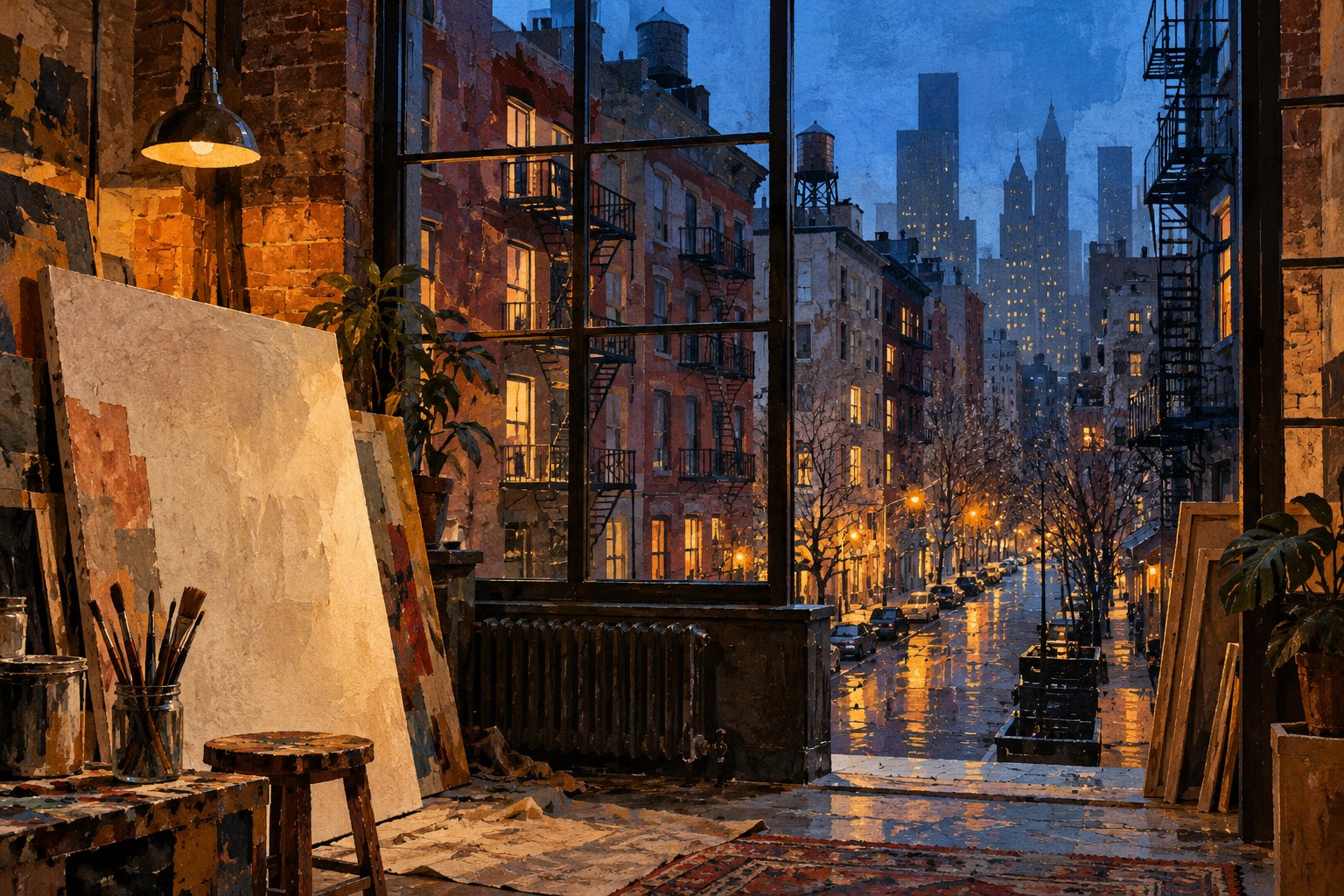
The illustration above is a conceptual accompaniment, not a production image. Its combination of working materials and a radio points toward a useful critical question: does sound belong to the character’s environment, or does it primarily tell the audience what to feel?
Either approach can succeed. The distinction matters because a film about a creative person needs room for concentration as well as stimulation. Silence, interruption, and repetition can make work perceptible without turning every moment of creation into a triumphant montage.
That concern connects with our discussion of how music can change a story rather than merely accompany it. Here, the corresponding test would be whether a musical choice changes our understanding of an encounter, a space, or a moment of attention.
A love letter can contain friction
Affection is a useful starting point for a period film, but affection alone does not determine its depth. A filmmaker can love a place while remaining attentive to discomfort, inconvenience, exclusion, and conflicting experiences within it.
For Cudi’s movie, the phrase “love letter” leaves open whose New York the audience will experience. The most coherent answer would come through the film’s choices of perspective. A place can feel welcoming in one encounter and alienating in another without the movie needing to announce a grand statement about the city.
My hope is for that kind of specificity. Weathered walls and crowded interiors should carry consequences for the people occupying them. Beauty can remain, but it becomes more affecting when the film also understands the effort involved in living and working within its frame.
The deeper promise of the setting
The most promising interpretation of Cudi’s announcement is that artist, city, and period could become inseparable parts of the film’s storytelling. That remains a possibility, not an achievement we can credit in advance.
A convincing screen world would give Basquiat more than a historically recognizable backdrop. It would establish what reaches him, what distracts him, where he can withdraw, and how his attention organizes what viewers see. Setting would then help express an individual perspective rather than stand in for one.
That is the standard I would bring to the eventual film: whether its affection produces close observation. The lasting value of this New York story will depend on how fully it lets an audience experience a person moving through a particular world, moment by moment.
Original content by this site's editorial team. Published: October 21, 2026 at 16:44:43 PDT (Los Angeles time)