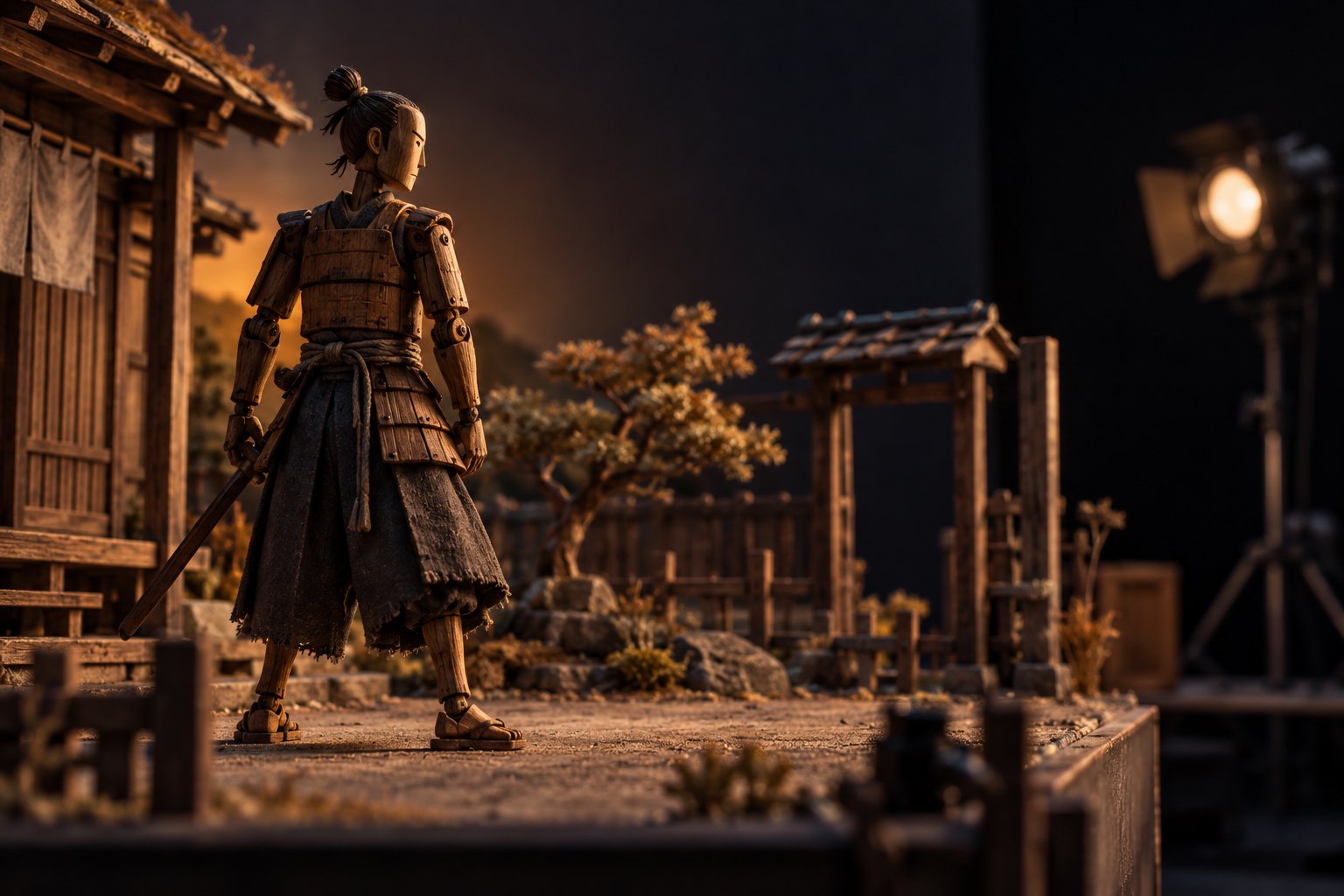
Hidari, the stop-motion samurai film featuring Keanu Reeves’ voice, is looking for a new partner after talks in the United States stalled, according to Variety. For viewers following the project, the immediate takeaway is that its search for a partner continues. The development does not, by itself, establish cancellation, a release delay, or any change to Reeves’ involvement.
The combination remains intriguing: a recognizable performer, a genre built around physical confrontation, and animation that constructs movement through individual adjustments. My interest lies in how those elements might produce a character whose decisions matter as much as the spectacle surrounding him. That possibility deserves attention, although the business update cannot tell us whether the film realizes it.
This is a spoiler-free critical preview and production commentary, not a review of a completed feature. A scene-by-scene verdict, dialogue analysis, or account of the ending would require evidence beyond this development news.
What the stalled U.S. talks actually tell viewers
The essential distinction is between the outcome of a particular negotiation and the fate of the film. Seeking another partner indicates an unresolved business relationship. It does not establish that nobody wants the project, that the filmmaking has failed, or that audiences will reject it. Those are much larger conclusions than the reported development supports.
Likewise, the word “partner” should not automatically be translated into a specific viewing destination. Financing, production support, distribution, and marketing describe different responsibilities. Without a confirmed agreement spelling out those responsibilities, readers should resist treating this news as an announcement about where or when they can watch Hidari.
Celebrity casting and a completed commercial arrangement also answer different questions. Reeves’ involvement gives readers an immediate point of recognition. A partnership still needs to work on its own terms. Neither the presence of a star nor the interruption of negotiations supplies a reliable shortcut to assessing the finished movie.
That separation between commercial developments and artistic judgment also informs our examination of what an opening-weekend result can reveal about a film. Business outcomes matter, but they cannot substitute for looking closely at what happens on screen.
The creative promise is in the meeting of voice and body
For an animated character, a recognizable voice is only one part of a performance. Timing, posture, framing, and reaction all help determine what a spoken sentence means. A line delivered over an unwavering stance can suggest certainty; paired with a withdrawn gesture, the same words might suggest someone trying to conceal doubt.
These are illustrative possibilities, not descriptions of scenes in Hidari. They explain why Reeves’ participation is an invitation to listen closely rather than grounds for an advance verdict. The meaningful question will be how the voice interacts with the character’s physical behavior.
From the character’s perspective, the most revealing moment may be the one before speaking. Does he seem to register another person’s presence? Does his body anticipate a confrontation before his voice acknowledges it? Does a pause belong to a thought, or merely create a dramatic effect? Such distinctions help a figure feel like someone experiencing events instead of simply presenting them.
My preference is for animation that allows a vocal performance and a physical performance to complicate each other. Perfect agreement can communicate an emotion clearly. A small disagreement can make that emotion interesting: confidence in the voice, uncertainty in the hand. Whether Hidari pursues anything like that remains an open critical question.
Why stop-motion makes gesture worth watching
Stop-motion gives filmmakers unusually direct control over the progression of a gesture. A figure can be repositioned between exposures so that a turn, reach, or recoil develops through carefully chosen increments. The technique’s appeal is not exhausted by how difficult or patient that work may be. What matters to a viewer is the expressive result.

A small movement can establish a relationship to the surrounding world. A hand that approaches an object slowly suggests a different intention from one that grabs it. A body that settles after moving suggests weight. Held stillness can draw attention to anticipation, although stillness without dramatic purpose can also leave a scene feeling inert.
For a samurai film, these choices offer an especially interesting way to examine readiness and restraint. Movement can make skill visible, but hesitation can reveal the cost of using it. That is a potential strength of the combination, not a claim about the film’s actual choreography or themes.
The setting participates in the performance, too. Distance, obstacles, and the arrangement of a space can determine whether a character appears secure or exposed. As our commentary on how an ordinary location becomes a meaningful movie setting explores, a place gains dramatic value through the way characters inhabit it. A miniature deserves the same scrutiny.
The character test for a samurai story
When the film can be assessed fully, a useful starting point will be the protagonist’s choices. What does he believe an action will accomplish? What does that action cost someone else? Does experience alter his understanding, or does the story merely present increasingly elaborate obstacles? These questions make room for excitement while asking whether it accumulates emotional significance.
Supporting characters matter to that assessment. An opponent becomes more compelling when the audience can understand the pressure they exert on the protagonist’s beliefs. A companion becomes more than decoration when their needs affect his decisions. Those principles do not prescribe a plot; they identify what a character-centered review would need to examine.
Memorable dialogue would belong in that eventual discussion when its wording and context can be verified. Quoting an invented declaration about honor or revenge would impose a generic samurai story on Hidari. The project deserves the chance to establish its own language.
What would make the next update meaningful
For readers tracking the production, the most useful next announcement would identify a confirmed partner and explain that partner’s role. A release date would be a separate development requiring its own confirmation. For readers tracking the art, substantial footage would offer a different kind of evidence: the relationship between speech and movement, the rhythm of a scene, and the clarity of a character’s intention.
The deeper appeal of Hidari is the possibility of a physical object becoming a persuasive emotional presence. A famous voice may draw attention to that transformation, but the transformation itself has to happen through filmmaking. The search for a new partner matters because it concerns the conditions under which that work can reach viewers. The eventual artistic judgment should turn on whether we come to care about the person the animation asks us to see.
Original content by this site's editorial team. Published: October 11, 2026 at 10:46:24 PDT (Los Angeles time)