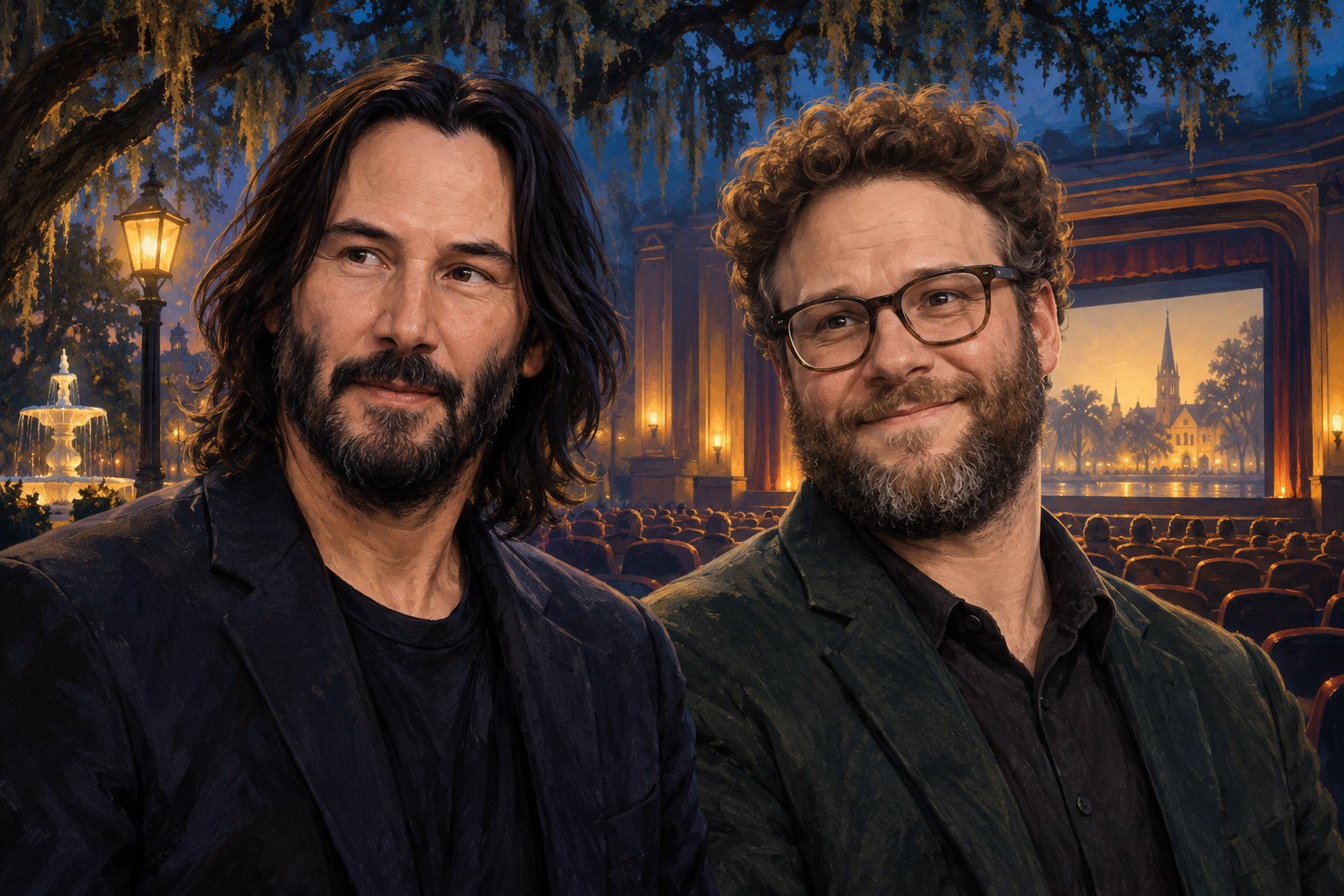
Keanu Reeves and Seth Rogen are set to receive honors at the SCAD Savannah Film Festival, according to The Hollywood Reporter. The announcement offers a welcome reason to look past their instantly recognizable screen personalities and examine the choices that make their performances work.
For a revealing comparison, revisit Reeves in John Wick and Rogen in Steve Jobs. These are editorial selections for exploring their craft, rather than a claim about the festival’s screening program. One performance centers on a bereaved killer; the other belongs to an engineer seeking acknowledgment from an old collaborator. Both actors make injured pride and emotional need visible without asking the audience to confuse those feelings with moral innocence.
Spoiler warning: The following review discusses major developments and the ending of John Wick, along with key confrontations in Steve Jobs.
Reeves in John Wick: Grief Before the Gunfire
The original John Wick, released in 2014, establishes its emotional stakes through the relationship between a widower and a puppy. Daisy is a final gift from John’s late wife, Helen. When intruders kill the dog and steal his car, the assault destroys an emerging daily routine as well as a living connection to his marriage.
From John’s perspective, caring for Daisy briefly provides something grief has taken away: a reason to attend to the present. Feeding and protecting another creature requires participation in a world he seems ready to withdraw from. Reeves gives these early scenes a subdued attentiveness. His quietness allows that fragile connection to register without an explanatory speech.
That groundwork is essential because the revenge plot would otherwise reduce the dog to a mechanical trigger. The film still uses her death to unleash its action fantasy, and viewers who dislike that manipulation have a fair objection. What makes the device emotionally effective, in my reading, is Reeves’s suggestion that John had barely begun learning how to live alone.
Being Recognized Becomes a Trap
Once John returns to the criminal underworld, other people recognize him with a mixture of familiarity and fear. Reeves lets those reactions carry much of the exposition. He does not need to keep announcing his character’s reputation when everyone around him behaves as though a disaster has arrived.
His physical performance then gives that reputation substance. The controlled movements and abrupt bursts of effort suggest practiced habits becoming available again. There is satisfaction in watching his competence, but also something bleak: the work John knows best is the work from which he had escaped.
“Yeah, I’m thinking I’m back” lands as an action-movie declaration. Within the character’s story, it also sounds like surrender to an identity that other people understand more readily than his grief. The underworld knows what to do with John the killer. It has little use for John the husband who has lost his wife.
That tension is why I find Reeves more compelling here than the simple description “stoic action hero” suggests. His restraint gives the eruptions somewhere to come from. The action does not replace the performance; it expresses a character reaching for the only form of control he can still exercise.
Rogen in Steve Jobs: Asking to Be Seen
In Danny Boyle’s 2015 film Steve Jobs, written by Aaron Sorkin, Seth Rogen plays Steve Wozniak opposite Michael Fassbender’s Jobs. The film organizes its central drama around the preparations for three product launches, repeatedly placing professional triumph beside unresolved personal conflict. Its conversations are dramatized scenes, not transcripts of the historical participants’ private exchanges.
Wozniak’s recurring concern is acknowledgment of the Apple II team. Seen from his position, this is a question about who gets included in the company’s account of itself. Work that helped build the organization risks becoming inconvenient background material for the next presentation.
Rogen gives that grievance a valuable mixture of directness and discomfort. His Wozniak can identify an injustice, but he remains emotionally invested in the person whose recognition he wants. That investment makes the encounters hurt. Winning an argument cannot supply the affection or generosity that prompted the argument in the first place.

The Supporting Actor Changes the Standard of Success
“What do you do?” is a particularly sharp challenge from Wozniak to Jobs. The question interrupts the assumption that commanding attention proves authorship. It asks the film’s central figure to explain his contribution in terms that another worker might recognize.
Rogen’s delivery matters because the exchange could become a tidy debate between rival definitions of genius. Instead, his presence gives the question a personal cost. Wozniak is speaking to someone with whom he shares a history, and his frustration carries the disappointment of a relationship that cannot settle into mutual respect.
Later, “You can be decent and gifted at the same time” states his objection with devastating economy. Rogen does not have to make Wozniak more dazzling than Jobs. He makes decency sound like a reasonable expectation, which exposes how far the surrounding conversation has traveled from ordinary human obligations.
My reservation about Steve Jobs is that its tightly arranged confrontations sometimes make supporting characters feel scheduled to deliver the next challenge. Wozniak risks becoming the designated conscience. Rogen pushes against that neatness by preserving the character’s need for a response. He is not simply there to pronounce judgment and leave.
What the Two Performances Reveal Together
Reeves and Rogen create different relationships with silence. John often allows silence to close an exchange; Wozniak keeps speaking because the exchange has failed to resolve anything. Watching them together makes timing especially noticeable: when an actor waits, when he presses forward, and when a familiar manner suddenly exposes vulnerability.
Both films also ask viewers to examine the authority of a central figure. John Wick makes extraordinary competence thrilling while showing its destructive purpose. Steve Jobs gives its protagonist verbal command while allowing another character to question what that command excuses. The relationship between star presence and moral judgment also informs our analysis of how Digger puts Tom Cruise’s hero image on trial.
This is a useful way to approach festival recognition: return to a scene and identify the work beneath the celebrity. Our discussion of SCAD’s television sidebar and the value of close performance viewing extends that approach to episodic storytelling.
The Deeper Connection: Talent Cannot Repair Everything
The ending of John Wick offers a modest counterweight to its violence. John treats his injuries and takes a dog from an animal clinic. Revenge has demonstrated his abilities without restoring what he lost. Caring for another vulnerable creature suggests a possible future that killing could never provide.
Wozniak’s challenge in Steve Jobs points toward a related limitation. Accomplishment cannot automatically repair a relationship, and admiration cannot substitute for acknowledgment. Rogen makes that argument tangible by playing someone who wants a basic human response from a man preparing to command an audience.
For viewers considering what Reeves and Rogen bring to the screen as their SCAD honors approach, these performances offer a strong answer. Each makes a character’s unmet need legible beneath an impressive public identity. John can defeat enemies; Wozniak can articulate the problem. Neither ability guarantees the connection he actually wants.
Original content by this site's editorial team. Published: October 2, 2026 at 13:13:27 PDT (Los Angeles time)