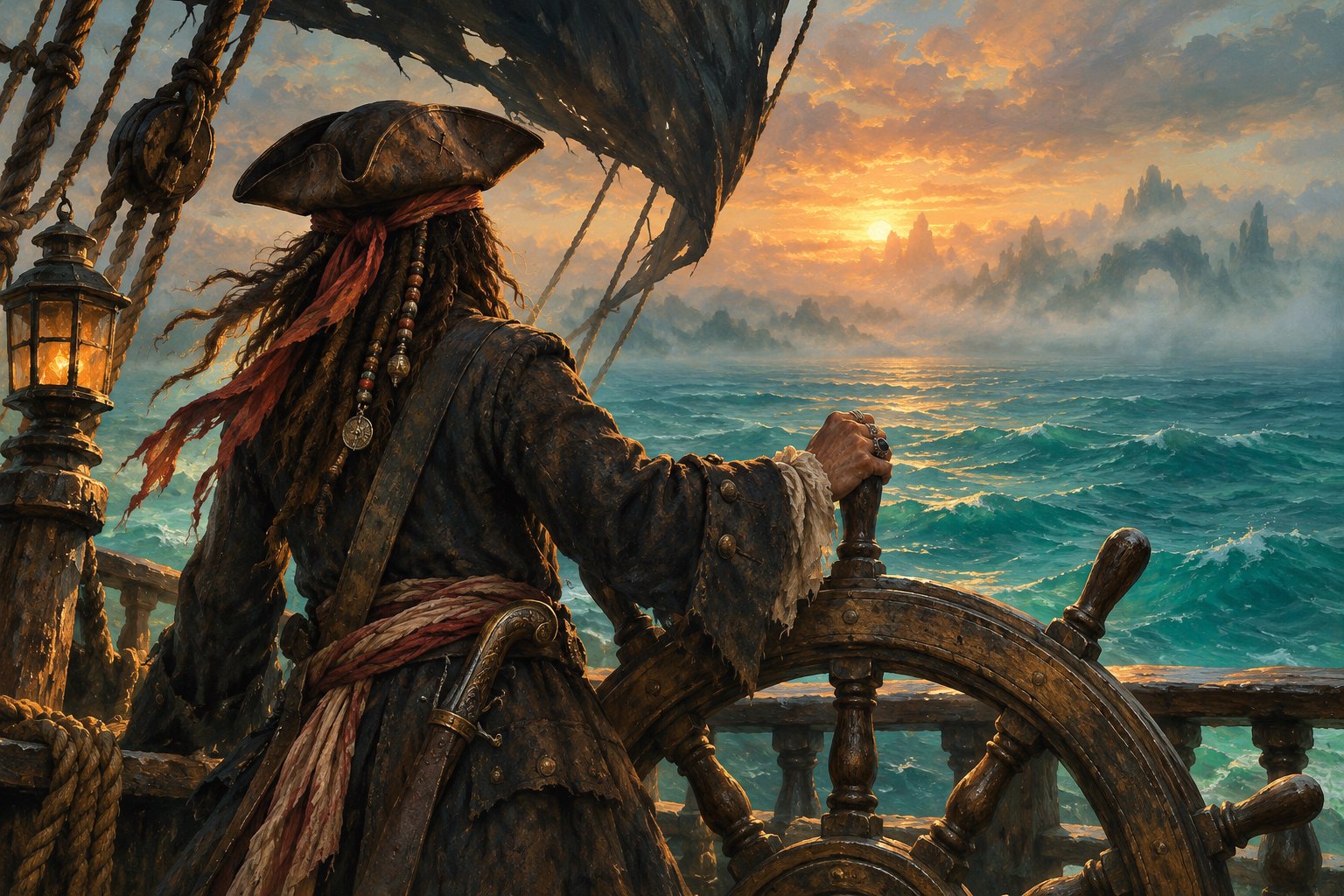
Johnny Depp has addressed the possibility of returning for Pirates of the Caribbean 6, according to Variety. That makes another appearance by Captain Jack Sparrow a subject of discussion, not something readers should mistake for confirmed casting. For viewers, the more interesting question follows immediately: what would make his return worth watching? [Variety’s report](https://au.variety.com/2026/film/news/johnny-depp-explains-pirates-of-the-caribbean-6-return-jack-sparrow-42215/)
The strongest answer remains Pirates of the Caribbean: The Curse of the Black Pearl. Its appeal extends beyond Depp’s eccentric performance. Jack operates inside a story whose other characters have urgent desires, conflicting loyalties, and the ability to frustrate him. A worthwhile return would need to recover that dramatic friction.
Spoiler warning: The following retrospective discusses the story and ending of The Curse of the Black Pearl. Suggestions about a sixth film are critical judgments, not claims about its screenplay.
What the original film gives Jack besides an entrance
Directed by Gore Verbinski, the 2003 film builds its adventure around several overlapping objectives. Jack wants to recover the Black Pearl from Barbossa. Will Turner joins him to rescue Elizabeth Swann. Barbossa and his crew are seeking release from the curse attached to stolen treasure. Their destinations overlap; their reasons for getting there do not. [Disney’s film synopsis and credits](https://movies.disney.com/pirates-of-the-caribbean-the-curse-of-the-black-pearl)
That distinction is the engine of the movie. An alliance can solve one character’s problem while worsening another’s. Information becomes currency. Jack’s talent lies in recognizing what someone else needs and making himself temporarily indispensable.
From his perspective, much of the action is negotiation conducted under terrible conditions. Depp’s pauses, sideways glances, and unstable-looking posture encourage us to underestimate the calculation beneath the performance. The comedy comes from the gap between how little control Jack appears to have and how quickly he identifies an opening.
My judgment is that this remains the character’s most satisfying dramatic setting. Jack can dominate a scene without owning every emotional stake. We watch him closely because we cannot immediately tell whether he is improvising, manipulating someone, or disguising a failure.
Will and Elizabeth make his unpredictability matter
Will’s directness is essential. His desire to rescue Elizabeth gives the film a comprehensible emotional objective while Jack complicates the route toward it. Without that contrast, a succession of evasions and double-crosses could become exhausting. Will supplies the question that keeps the spectacle grounded: will this actually help her?
Their partnership also turns trust into an action problem. Will cannot simply decide whether Jack is a good person and proceed accordingly. He has to judge particular choices under pressure. That makes their relationship more engaging than a straightforward pairing of an innocent apprentice and a secretly benevolent mentor.
Elizabeth brings a different kind of resistance. When she and Jack are stranded together, she refuses to accept his preferred way of handling the situation. Her decision to burn the rum creates a signal for rescue. It also punctures his authority: being the experienced pirate does not mean he has the best answer. [The film’s plot account](https://www.imdb.com/title/tt0325980/plotsummary/)
The scene works because Elizabeth changes their circumstances. She is not merely present to react to Jack’s eccentricities. Her practical intervention forces the adventure forward, turning a comic disagreement into a consequential choice.
This is why a potential sixth film needs characters who can disrupt Jack’s plans. Familiar companions would not automatically accomplish that, and new characters would not automatically fail. The test is whether they possess independent motives. As our discussion of why franchise confidence needs stronger character relationships argues, recognition alone cannot do the work of a story.
Barbossa gives the adventure a darker appetite
Barbossa’s curse makes possession grotesquely inadequate. He commands a formidable ship and holds treasure, yet his existence is defined by deprivation. Geoffrey Rush’s performance gives his authority an undertow of desperation: power has failed to deliver the life he wants.
Viewed beside Jack, Barbossa becomes more than an obstacle. Both men attach enormous significance to the Pearl, but control of the vessel does not produce the same freedom for each. The film allows their rivalry to carry a question that reaches beyond ownership: what is the use of obtaining something if you cannot enjoy what it promises?

Jack’s line, “Not all treasure is silver and gold, mate,” supplies a compact statement of that distinction. Its force comes from a movie in which treasure generates misery as readily as opportunity. The joke-filled adventure contains a serious suspicion of getting exactly what you thought you wanted. [Disney’s collection of Jack Sparrow dialogue](https://news.disney.com/the-definitive-ranking-of-jack-sparrow-quotes/)
For a new installment, the lesson is structural. A threatening antagonist needs an intelligible desire that pushes against Jack’s own. Increasing the scale of supernatural danger would matter less than establishing why these particular people cannot simply leave one another alone.
What a return would need to earn
A successful comeback would give Jack something specific to pursue and something meaningful to lose. Those stakes need not require an elaborate explanation of his past. They need to produce choices whose consequences survive the next punch line.
It would also allow other performers to command the frame. Depp’s characterization gains definition through resistance: another person’s impatience, suspicion, courage, or refusal. That is a useful extension of the distinction explored in our commentary on keeping character and performance central to acting coverage. A recognizable star still needs a role with relationships to play.
The screenplay should preserve uncertainty without making behavior arbitrary. Audiences can enjoy discovering that Jack anticipated a problem. They also need enough information to understand why his solution works. Otherwise, resourcefulness becomes a convenient escape hatch rather than a character trait.
And the humor should arise from circumstances. Repeating a familiar gesture may earn recognition, but a joke becomes dramatically useful when it reveals an appetite, damages a negotiation, or exposes the limits of Jack’s confidence.
The deeper question is what freedom costs
“Wherever we want to go, we’ll go” expresses Jack’s attractive promise of possibility. But the original film keeps placing that promise beside other people’s obligations. Will’s devotion and Elizabeth’s determination complicate the fantasy of answering to nobody. Jack’s freedom becomes interesting because he must repeatedly maneuver through relationships he cannot entirely control.
That tension offers a stronger foundation for another appearance than nostalgia alone. The film does not require us to resolve Jack into either a dependable hero or a fraud. Its pleasure comes from watching someone fiercely protective of his independence become entangled with people whose choices matter.
A small post-credits sting
The original film’s post-credits scene returns to the treasure cave, where Barbossa’s monkey takes a coin and becomes undead again. It is a compact supernatural joke that reuses an established rule rather than introducing a new mythology. [The original film’s ending and post-credits scene](https://en.wikipedia.org/wiki/Pirates_of_the_Caribbean%3A_The_Curse_of_the_Black_Pearl)
A possible Depp return deserves a similarly disciplined instinct: understand what made the machinery work before adding more machinery. Give Jack people he cannot easily outwit, a desire worth pursuing, and a choice that costs him something. Then his arrival could begin an adventure instead of merely announcing a reunion.
Original content by this site's editorial team. Published: November 3, 2026 at 04:55:03 PST (Los Angeles time)