James McAvoy’s answer is Split. Discussing his earnings on Josh Horowitz’s Happy Sad Confused podcast, the actor identified M. Night Shyamalan’s thriller as the film that consistently sends money his way. “The only one that really consistently pays me is Split,” he said, describing the first payment as “bonkers.” His comments were reported by [TheWrap](https://www.thewrap.com/creative-content/movies/james-mcavoy-only-movie-good-residuals-split/).
The financial anecdote supplies a timely reason to revisit a performance that makes a confined space feel crowded with competing intentions. Yet Split works best when we watch McAvoy through the eyes of the person trying to survive him. Anya Taylor-Joy’s Casey gives his transformations their stakes: every altered expression might mean an opportunity, a deception, or another threat.
Major spoilers follow for Split, including its ending and connection to Unbreakable. The discussion also addresses childhood abuse.
What McAvoy’s Earnings Story Actually Establishes
McAvoy’s account establishes his experience of receiving unusually rewarding payments from this particular project. It does not disclose the amount of an individual check, his complete compensation, or the precise contractual mechanism behind the payments. His recollections about costs and early profitability should remain attributed recollections, rather than become an independently audited financial history.
That distinction matters because a successful theatrical run and an actor’s eventual income answer different questions. McAvoy’s experience cannot tell us what every participant earned. Nor does the size of a payment establish whether a performance works. As our discussion of what opening-day box office can actually tell us explains, commercial evidence becomes useful when its limits remain visible.
For a viewer, the more interesting question is what makes this particular role worth returning to. My answer is the relationship between McAvoy’s expressive range and the film’s restricted setting. A doorway stays in the same place; the person entering through it can change the entire scene.
Casey Turns Watching Into a Survival Skill
The premise places Casey and fellow captives Claire and Marcia at the mercy of a man whose identities compete for control. Dennis, Patricia, and the childlike Hedwig present different possibilities for interaction. Casey’s task becomes identifying who is present, what that identity wants, and whether an apparent opening is real.
Her watchfulness is easy to mistake for inactivity. Taylor-Joy makes it feel like calculation. Casey studies pauses and changes in tone before committing herself. Claire’s more immediate resistance has its own understandable logic: waiting can look intolerable when the danger is obvious. The tension comes from watching people with incomplete information choose incompatible ways to stay alive.
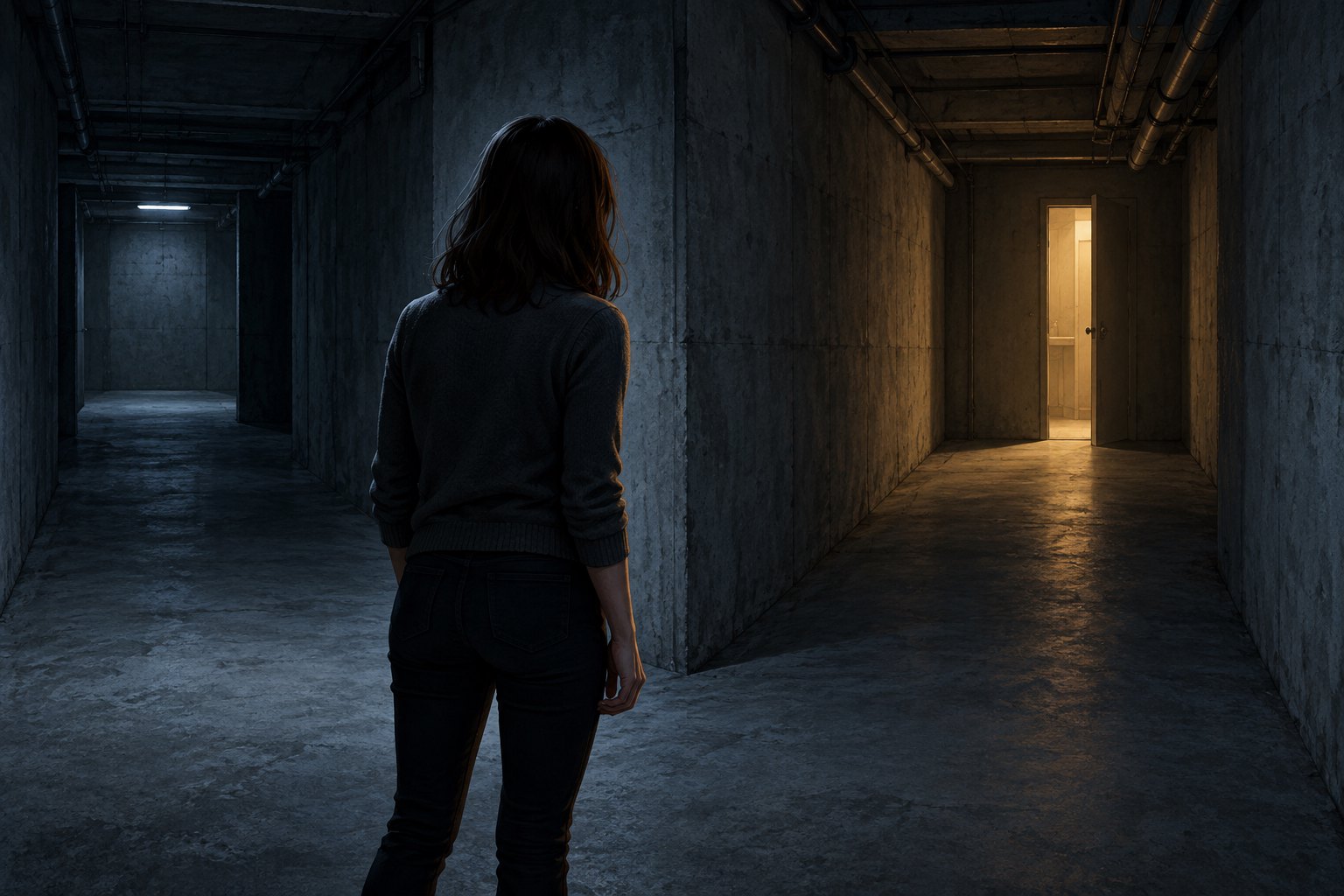
Casey’s exchanges with Hedwig are especially effective because friendliness becomes a precarious tool. His desire for attention creates room for negotiation, but his childish manner does not make the situation safe. She must sustain his interest while looking for an escape. The audience watches a conversation and an emergency unfold simultaneously.
The flashbacks to Casey’s abuse complicate that vigilance. They suggest that she has already learned to read dangerous people. The strongest interpretation is that she brings hard-earned knowledge into captivity. The troubling alternative—that abuse somehow prepared her beneficially for this ordeal—requires resistance. Her resourcefulness belongs to her; the person who harmed her deserves no credit for it.
McAvoy Makes Control Visible
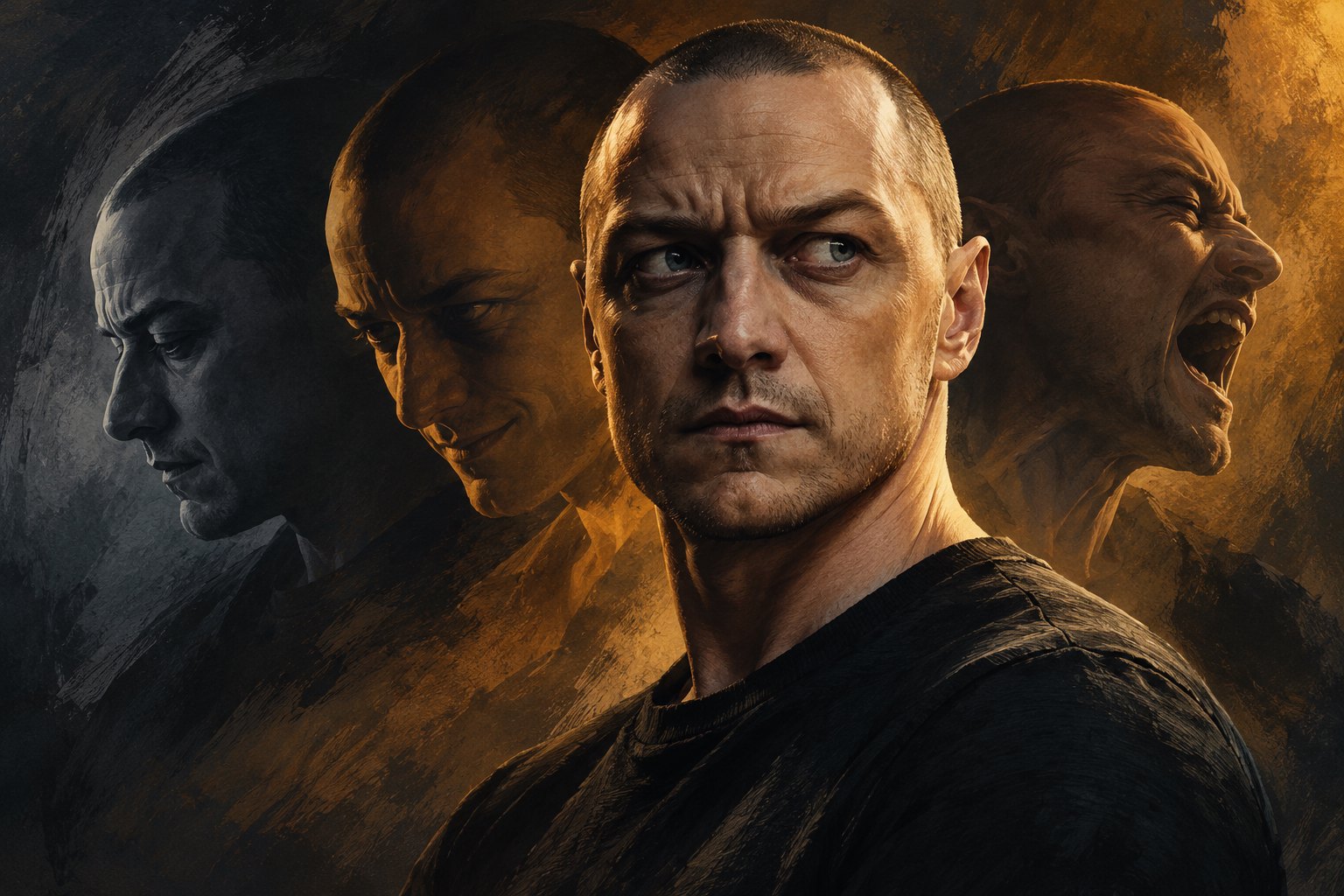
McAvoy’s achievement is more specific than playing several recognizable personalities. He makes each encounter reorganize the balance of power. Dennis brings physical rigidity and scrutiny. Patricia’s composed delivery turns ordinary reassurance into something coercive. Hedwig introduces unpredictable shifts between vulnerability and authority.
Those contrasts give Casey something to interpret, which gives the audience something to do. We are not simply waiting for a transformation. We are assessing whether the new behavior changes the odds of escape. McAvoy’s face becomes part of the film’s suspense mechanism.
The danger of such a role is that virtuosity can become its own attraction, drawing attention away from the captives. Split occasionally approaches that imbalance. Some behavioral flourishes invite us to admire the actor at precisely the moment we should be fearing what his character might do. Taylor-Joy’s restrained reactions provide a necessary counterweight.
Betty Buckley’s Dr. Fletcher introduces another kind of watching: professional attention shaped by investment in her patient. Her scenes make interpretation itself suspenseful. How much can she infer from an apparently familiar interaction? When does confidence in understanding someone prevent recognition of an immediate danger? These questions are more compelling than exposition about the film’s extraordinary premise.
The Beast’s Philosophy Is the Film’s Hardest Problem
The final confrontation turns the thriller’s suggestions of extraordinary physical change into overt fantasy. The Beast spares Casey after recognizing evidence of her suffering. The ending’s events and the transition from captivity thriller to supernatural mythology are detailed in [CinemaBlend’s ending analysis](https://www.cinemablend.com/movies/split-ending-explained-what-the-bizarre-twist-ending-means).
“The broken are the more evolved” expresses the hierarchy behind that decision. Another declaration, “We are what we believe we are,” gives self-belief a frighteningly literal dimension. Both lines appear in the film’s [dialogue transcript](https://www.springfieldspringfield.co.uk/movie_script.php?movie=split).
As villainous reasoning, this is chilling: pain becomes a qualification for superiority, and people judged insufficiently wounded become expendable. As the mechanism that saves Casey, it is harder to accept without qualification. The plot grants practical force to a worldview that deserves rejection.
My reservation is not that a villain holds a monstrous belief. It is that the movie makes that belief determine who survives. Claire and Marcia should not become less worthy of sympathy because the narrative gives us less access to their histories. Casey’s survival is welcome; the Beast’s explanation for it remains abhorrent.
This is where Split becomes more provocative than reassuring. Its supernatural treatment of identity should be understood as horror invention, not a clinical explanation. The performance can be admired while the film’s association of psychological fragmentation with monstrous violence remains open to criticism.
The Unbreakable Connection Changes the Scale
The closing diner scene reveals Bruce Willis as David Dunn, connecting the story to Unbreakable. His identification of “Mr. Glass” transforms what seemed like a self-contained nightmare into part of a larger fictional world. The connection is documented in [Time’s account of the films’ shared mythology](https://time.com/5503796/glass-unbreakable-split-reference/).
That reveal rewards recognition, but it also redirects attention. Casey’s intimate survival story suddenly shares space with franchise anticipation. This is the same critical tension raised by why a returning thriller protagonist’s perspective matters: a larger story remains compelling only when it preserves the person at its center.
A Performance Worth Revisiting, an Ending Worth Challenging
McAvoy’s residuals story concerns a role that continues to reward him financially. Artistically, its lasting value lies in how much suspense he and Taylor-Joy create through observation. He changes the terms of an encounter; she measures the consequences.
For me, Split is strongest as a contest over who gets to interpret another person. Casey must understand her captor to survive, while the Beast claims the authority to define her worth. The deeper reading rejects his verdict: she deserves life and safety regardless of what she has endured. That distinction makes the film worth debating long after its final surprise.
Original content by this site's editorial team. Published: October 17, 2026 at 13:44:50 PDT (Los Angeles time)