
The house in Verity is central to the story’s most unsettling proposition: entering someone’s private world can make that person harder to understand. Its promise of comfort and creative opportunity gives Lowen Ashleigh reasons to stay, while the uncertainty surrounding its inhabitants makes staying increasingly difficult to separate from surrendering her judgment.
The Hollywood Reporter’s focus on the house as a “fever dream” identifies a productive way to approach this psychological thriller. The interesting question is how architecture can make suspicion feel personal. A beautiful room can invite a visitor inside while quietly reminding her that everything belongs to someone else.
Spoiler note: This critical analysis discusses the official premise, publicly reported production design, and trailer dialogue. It does not reveal the ending or offer a firsthand assessment of the complete film. The illustrations are conceptual architectural images, not movie stills.
Lowen enters a home where her work and judgment overlap
Michael Showalter’s adaptation of Colleen Hoover’s novel casts Dakota Johnson as Lowen, a struggling writer who moves into the remote Crawford estate to ghostwrite for celebrated author Verity Crawford, played by Anne Hathaway. There, she discovers apparently autobiographical notes involving Verity’s husband, Jeremy, played by Josh Hartnett. The official synopsis emphasizes her difficulty distinguishing invention, attraction, and manipulation. [Amazon MGM Studios’ official story overview](https://www.aboutamazon.com/news/entertainment/verity-colleen-hoover-amazon-mgm-studios)
That arrangement gives the house an unusually complicated function. Lowen enters as a professional, but her workplace is somebody else’s intimate territory. Reading becomes both an assignment and an intrusion. The more personally revealing the material appears, the less straightforward her position becomes: is she understanding the household, or adopting the interpretation its most powerful storyteller has prepared?
My reading is that this overlap supplies the setting’s strongest psychological pressure. A conventional office allows some distance between professional responsibility and private curiosity. A residential assignment erodes that distance. Leaving the desk does not necessarily mean leaving the people, possessions, and relationships described in the pages.
It also makes the usual thriller question—why does the outsider stay?—more interesting. Opportunity itself can create attachment. Lowen has entered a space associated with the success she lacks, so unease competes with a plausible reason to keep working.
The design makes a guest’s uncertainty physical
Production designer Amy Williams described a striking approach to Verity’s office in an interview with Galerie. Most interiors were constructed on soundstages; the office combines pink tones, a conversation pit, an octagonal skylight, and mirrors around the desk. Williams connected its atmosphere to both enclosure and the novelist’s glamorous reputation. [Galerie’s interview with Amy Williams](https://galeriemagazine.com/how-verity-turned-jens-quistgaard-designed-gem-into-dream-home/)
Those details invite a more specific interpretation than simply calling the house creepy. A conversation pit lowers its occupants into a defined social space. Mirrors expand what seems visible while complicating where a glance originates. A distinctive skylight draws attention upward. Each feature can make a room pleasurable to inhabit, yet each also organizes the body and directs attention.
For an established resident, that organization may feel familiar. For a visitor, familiarity must be learned. The same interior can therefore express ownership for one character and uncertainty for another, without changing a single piece of furniture.
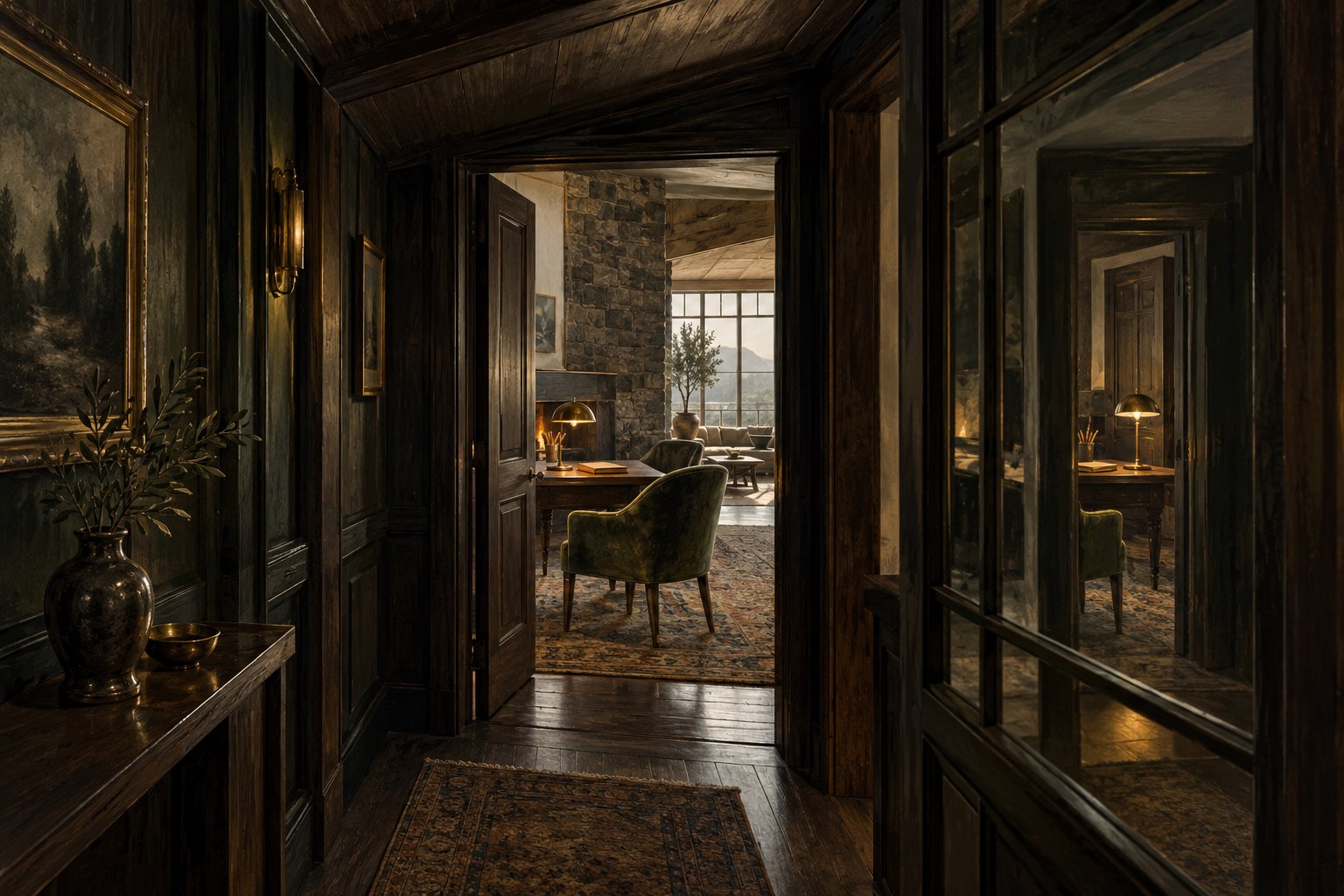
This is where the fever-dream idea becomes useful. Dreamlike space does not require impossible staircases or visibly supernatural events. It can emerge from a mismatch between how welcoming a room looks and how little control someone feels inside it. A visitor can see the next doorway without knowing whether crossing it is permitted.
Our discussion of how background details make a fictional place feel inhabited considers a related principle: surroundings carry social information. Here, the crucial information concerns who belongs, who is visiting, and who gets to establish the rules.
Verity’s room extends the authority of her words
Verity’s position is especially interesting because the assignment requires another writer to enter her professional identity. Lowen must engage with the work of an established novelist while encountering material that seems to expose the person behind that work.
The office’s glamour matters in that context. Success has a physical presence: a dedicated room, a distinctive aesthetic, a world arranged around writing. My interpretation is that such a space can make its owner’s voice feel authoritative before the visitor has established whether that voice deserves belief.
There is a trap in confusing access with understanding. Finding private pages may feel like moving closer to the truth, but privacy does not guarantee accuracy. A manuscript is still an arrangement of language. Someone has selected the details, controlled their sequence, and decided what the reader gets to know.
That makes the relationship between room and manuscript particularly rich. Both can offer the sensation of intimacy while leaving their organizing intelligence concealed. Lowen’s challenge is not simply to read carefully; it is to recognize how strongly the circumstances of reading influence her conclusions.
Jeremy belongs to the world Lowen is trying to interpret
Jeremy occupies a different position within this arrangement. He is part of the household whose history Lowen encounters through Verity’s writing, and the official premise places attraction alongside her uncertainty. That combination complicates the apparent reassurance of another person’s presence.
From Lowen’s perspective, someone familiar with the house could provide orientation. Yet emotional investment can also make an explanation appealing before it becomes convincing. The distinction matters: wanting to trust somebody is an experience, while having grounds to trust them is a judgment.
This does not establish Jeremy’s guilt, innocence, or intentions. It identifies the tension built into Lowen’s position. Her reading of the household cannot remain detached if she starts imagining a place for herself within it.
As in our examination of how private relationships shape thriller suspense, the revealing question concerns what an attachment encourages a character to overlook. Architecture gives that attachment a setting with boundaries, habits, and an existing owner.
The trailer’s warnings describe two different kinds of confinement
Two brief trailer lines sharpen this interpretation. Lowen says, “I feel like I’m losing my mind.” Verity warns, “This is your final warning, only darkness ahead.” Both lines were documented in PA’s coverage of the trailer. [PA’s account of the trailer dialogue](https://www.standard.co.uk/culture/film/anne-hathaway-verity-dakota-johnson-josh-hartnett-oscar-b1293072.html)
Lowen’s statement locates the crisis inside her own perception. Verity’s warning claims knowledge of the destination. Taken together, they establish an imbalance between a reader who doubts her bearings and a storyteller who appears to know where the journey leads. Their use in promotional footage supports that thematic reading; it does not establish how the complete film resolves it.
For viewers, three questions offer a useful way to examine the house: who understands the space, who controls access to it, and whose account makes its ordinary details seem threatening? These questions connect design to character decisions instead of treating every shadow as a hidden clue.
The deepest trap is wanting the house to make sense
My strongest reading of the Verity house is that it gives uncertainty something desirable to inhabit. Lowen’s professional opportunity, Verity’s literary identity, and Jeremy’s intimate history occupy the same address. Understanding one promises access to the others, but that promise may encourage premature conclusions.
The resulting danger is interpretive: an attractive explanation can become somewhere a person settles. Once a character has emotionally moved into a version of events, contradictory evidence threatens more than an opinion. It threatens the future she has begun to imagine.
That is the most compelling meaning of a house one cannot escape. The threshold may be visible. The harder departure is from the story that made entering feel worthwhile.
Original content by this site's editorial team. Published: October 8, 2026 at 23:40:27 PDT (Los Angeles time)