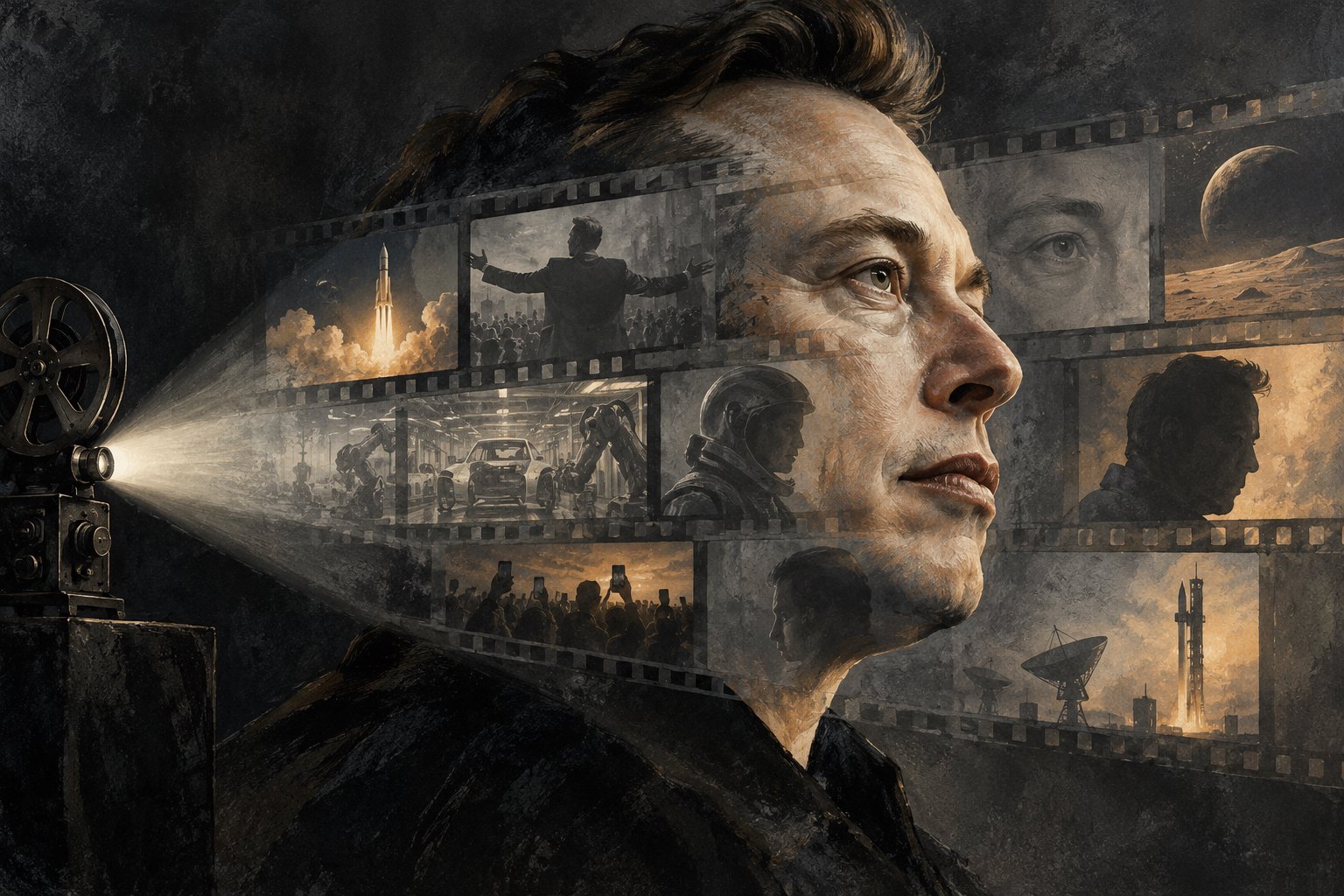
Elon Musk presents an unusually difficult documentary subject: a person whose public image is already an elaborate, constantly revised story. Alex Gibney’s Musk approaches that problem through biography, testimony, archival material, and a digital representation of its central figure. Its most interesting question concerns authorship: who gets to explain Musk when Musk has spent so much time explaining himself?
The appeal of journeying inside his mind is obvious. The limitation is equally important. A documentary can examine statements, decisions, relationships, and consequences; it cannot establish private thoughts simply by arranging those materials persuasively. That distinction is central to assessing Gibney’s approach.
Scope and spoilers: This is a critical analysis of the film’s publicly documented content and methods, rather than a firsthand screening review. It discusses the biographical trajectory and digital-avatar device without claiming access to unverified scenes or dialogue.
A biography organized around control of the story
The film’s published descriptions trace Musk’s progress through Silicon Valley, Tesla, and SpaceX before reaching his alliance with Donald Trump and involvement in the Department of Government Efficiency. That progression supplies a recognizable biographical structure: increasing success brings increasing influence, and the subject’s decisions eventually affect people far beyond his companies.
Gibney’s stated approach is more confrontational than a conventional career retrospective. In his Venice director’s statement, he describes reconsidering Musk’s familiar story through perspectives that challenge its dominant framing. That is a declaration of the filmmaker’s argument, not independent proof of every conclusion the documentary reaches.
As a critical proposition, the approach has force. A biography becomes more revealing when it asks how a reputation was constructed. Who receives credit? Whose labor disappears into a founder’s identity? Which achievements become evidence for trusting that person in an entirely different field? Those questions turn a résumé into a story about authority.
They also demand precision. Investment, technical invention, management, and publicity are different contributions. The strongest assessment of an entrepreneur distinguishes them instead of assuming either that one person accomplished everything or that personal shortcomings erase every accomplishment.
The people around Musk are more than supporting characters
The Venice listing identifies participants including Justine Musk, Ashley St. Clair, Kara Swisher, Martin Eberhard, Zoë Schiffer, and Geoffrey Hinton. Their presence establishes a range of personal, journalistic, business, and technological perspectives. It does not make their testimony interchangeable.
For a character-centered reading, that difference matters enormously. Someone describing a personal relationship is answering a different question from someone reconstructing a corporate decision. Expertise about technology does not automatically confer insight into a marriage; personal proximity does not establish every fact about a company. A viewer should listen for what each speaker actually knows.
There is also an ethical challenge in the very idea of supporting characters. These are real people whose significance extends beyond what they reveal about a famous man. Criticism should ask whether the film gives their experiences weight in their own right, rather than treating pain, disagreement, or disappointment merely as clues to Musk’s personality.
This concern connects with our discussion of how documentary access changes the relationships being filmed. Intimacy can produce valuable evidence, but the feeling of proximity is never a substitute for examining it.
The digital Musk creates a second problem of authorship
Apple TV’s description confirms that the documentary combines interviews and archival footage with an AI avatar of Musk, who did not sit for an interview for the film. The device makes the question of representation unusually concrete: the filmmaker can put a version of his subject on screen without securing that subject’s participation.
My reservation is that a simulated presence can carry the emotional authority of an encounter it never records. Facial expression, vocal delivery, and timing influence how an audience interprets language. Even when words originate in documented statements, a new presentation can alter their apparent meaning.

The useful distinction is between illustration and evidence. An avatar may illustrate how a public persona functions. It cannot provide the evidentiary value of a fresh answer, a spontaneous hesitation, or an exchange in which a subject can challenge the question. Those differences remain significant even when the simulation is openly identified.
The device is therefore worth considering both aesthetically and critically. It may expose the artificial construction of celebrity while asking viewers to accept another constructed image. That tension is a meaningful subject for analysis; it should not disappear simply because an audience agrees with the film’s politics.
What changes when life becomes a game?
The Mill Valley Film Festival’s account identifies Musk’s interest in simulated reality as an inspiration for Gibney’s approach. It also describes a movement from business history toward political power. Taken together, those elements suggest a troubling interpretive possibility: institutions and relationships can appear as systems to manipulate rather than obligations to other people.
That is an interpretation of the documentary’s framing, not a diagnosis of Musk. The distinction protects the analysis from becoming the same kind of grand explanation it should scrutinize. A metaphor can clarify a pattern without explaining every action.
Games usually offer bounded objectives, visible progress, and the possibility of starting again. Public decisions rarely provide those comforts. Their consequences can outlast the person making them, and the people affected do not necessarily consent to the rules. The film’s game imagery is most useful when it directs attention toward that imbalance.
There is a related dramatic problem in portrayals of brilliant, competitive founders. As our examination of Jesse Eisenberg’s performances, including The Social Network, explores, intelligence becomes dramatically interesting through relationships and behavior. Calling someone a genius supplies a label; showing how that identity affects others supplies a story.
The deeper question is about the audience
The film’s Apple TV description crystallizes its inquiry in a memorable question: “How had Elon Musk acquired so much power, and how had we given it to him?” This is promotional framing, rather than dialogue presented here as a verified moment from the film. Its second half nevertheless offers the richest direction for interpretation.
It shifts attention toward the people and institutions that reward a public persona. Admiration can turn achievement in one area into presumed competence everywhere. Hostility can also keep the individual at the center of every discussion. Either response risks shrinking a complicated system into one endlessly watchable personality.
My reading is that the most productive way to approach Musk is to track how its evidence supports its argument about power. Notice who speaks, what their knowledge establishes, and when cinematic invention changes the terms of the encounter. The unsettling possibility is not that a film can finally unlock one man’s mind. It is that understanding the machinery around his image may tell us more than the promised journey inside it.
Original content by this site's editorial team. Published: October 15, 2026 at 12:30:26 PDT (Los Angeles time)