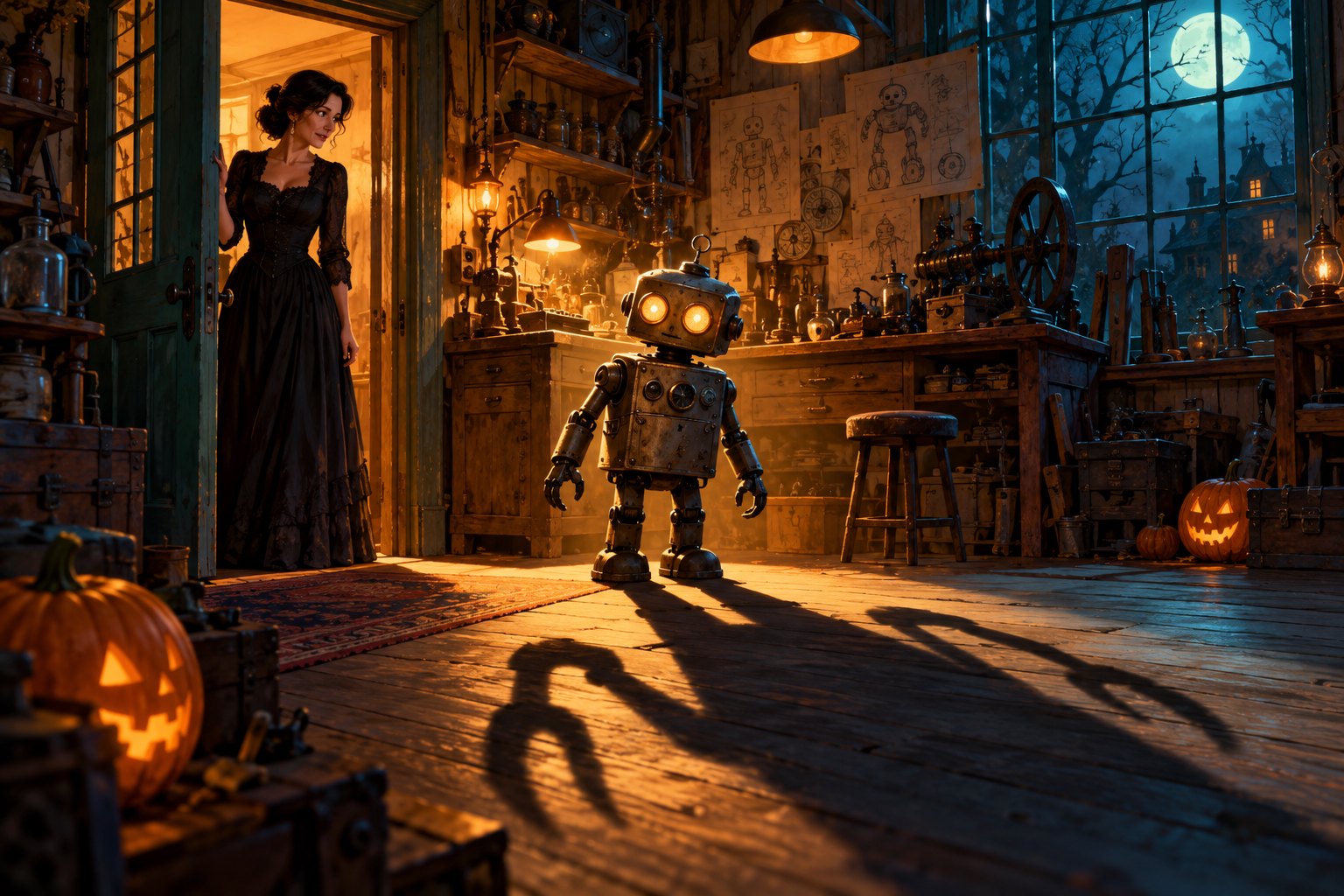
Inde Navarrette’s Halloween Saturday Night Live sketch, The Inventor’s Wife, has an attention-grabbing hook: a seemingly charming robot with a penis-destroying purpose. But the more interesting subject is the woman who receives it. Beneath the outrageous bodily violence sits a compact, ugly joke about emotional neglect—and the lengths someone might go to reinterpret that neglect as love.
The short’s premise invites a laugh at mechanical overkill. Its character logic invites a more uncomfortable response. What happens when proof that a partner wanted to possess you feels better than the suspicion that he barely cared? That question makes the wife more than a witness to a special-effects gag. She gives the absurdity its emotional stakes.
Spoiler warning: This commentary discusses the short’s central reveal and ending. It also addresses sexualized violence. The accompanying images are conceptual illustrations, not frames from the broadcast.
A marriage defined by the difference between love and liking
The story begins with Navarrette’s character mourning her inventor husband. Her assessment of their marriage contains its own quiet wound: “My husband loved his inventions and he… liked his wife.” The distinction establishes an emotional imbalance before the robot enters the story.
That sentence matters because it gives her grief an unresolved question. Losing a spouse is one experience; losing the possibility of ever finding out how much you mattered to that spouse is another. From her perspective, the inventions are evidence of the attention he could give when something interested him. She appears to have occupied a less certain place in his priorities.
My reading is that the short’s strongest structural choice is to begin with this dissatisfaction. Without it, a violent robot would be an isolated surprise. With it, the machine becomes a possible answer to the wife’s doubts. The audience has a reason to care about what the inventor left behind beyond curiosity about a gadget.
The title reinforces that arrangement. The Inventor’s Wife defines its central woman through her relationship to the man whose work overshadowed her. Even after his death, his identity supplies the terms through which we meet her. That does not establish a deliberate statement by the filmmakers, but it gives the eventual reversal an especially bitter resonance.
The robot offers companionship before it reveals control
After the funeral, the widow discovers a small robot her husband has left for her. Called PD-44, it becomes a companion even though its underlying purpose remains unclear. The story eventually advances six years, reaching the point when she is ready to date again.
Those developments create two different ways to understand the gift. To the widow, companionship can look like care arriving late: perhaps her husband understood her loneliness better than she realized. To a viewer waiting for the Halloween turn, the unknown purpose creates suspicion. A machine can be comforting in everyday use while still serving an intention its recipient never agreed to.
The distinction is essential to the joke. Affection for the companion does not tell her what it was built to do. Nor does the inventor’s technical ingenuity establish that his intentions were generous. A gift can be elaborate, costly in effort, and deeply selfish.
That tension also helps explain why the robot premise suits a short film. The object carries a question that does not require extensive explanation: what is this thing for? Meanwhile, the wife carries a different question: did my husband love me? The payoff arrives when those questions collide.
The grotesque reveal changes the meaning of the gift
When the widow brings a new romantic prospect home, the robot’s hidden function becomes brutally clear. Its attack turns the apparently affectionate inheritance into an instrument of sexual possessiveness. The machine has not simply failed to behave. Its purpose makes the inventor’s priorities newly legible.
Viewed through the husband’s implied perspective, the invention offers a monstrous substitute for accepting his wife’s independence. He can no longer participate in her life, but he has arranged to interfere with it. The engineering extends his influence beyond his own absence.
Viewed through hers, the same revelation supplies something she has been missing: evidence that she mattered intensely to him. Her response—“My husband loved me after all!”—is the more consequential punchline. The attack provides the spectacle; her interpretation makes the story disturbing.
We do not have to accept her conclusion to understand its appeal to her. If she has understood the marriage as a competition she lost to his inventions, discovering that an invention was specifically concerned with her may feel like a victory. The horror lies in how little room that victory leaves for her freedom.
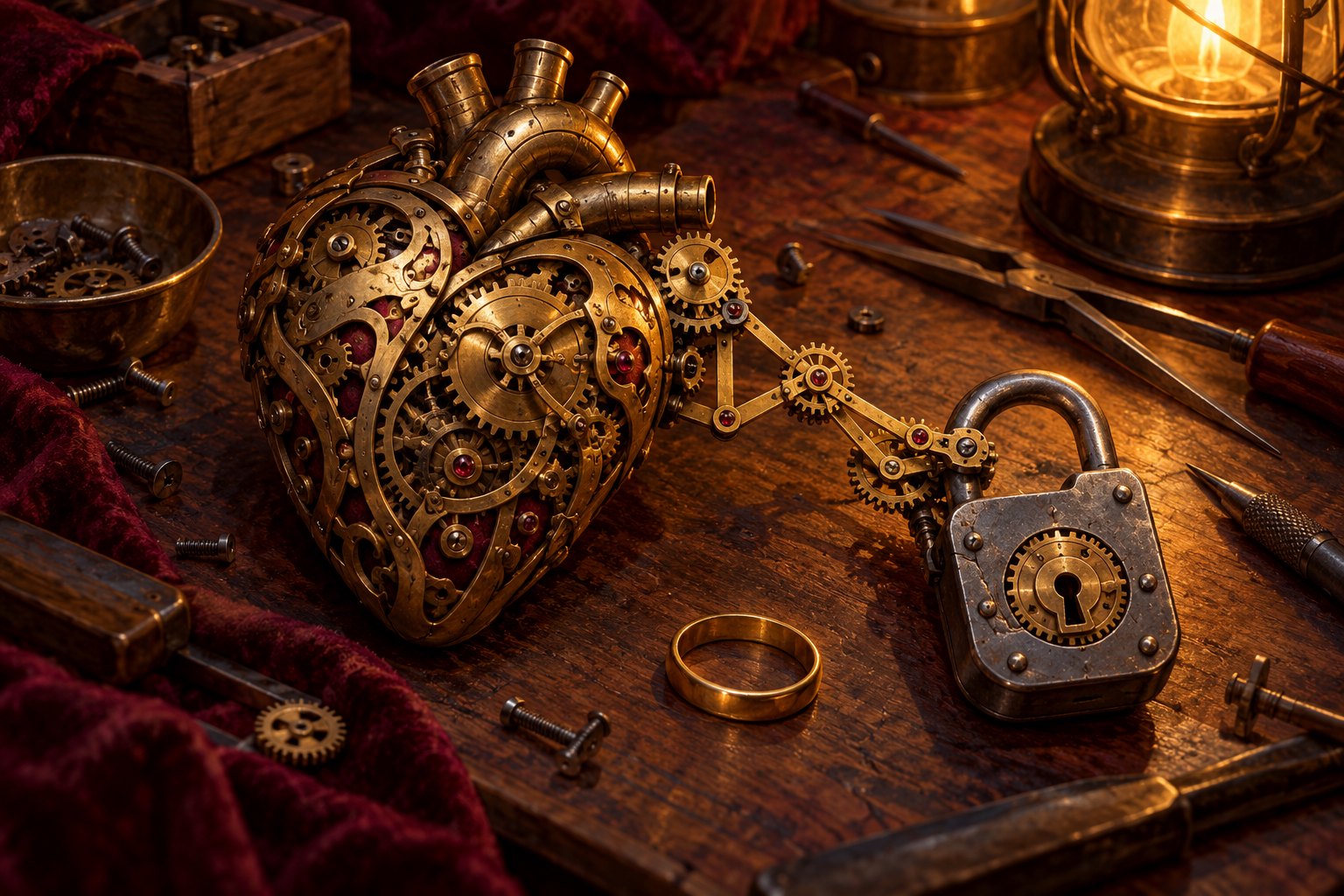
Why the wife’s reaction matters more than the machinery
Navarrette’s role occupies the junction between the short’s emotional premise and its grotesque conclusion. The character must make the desire for reassurance understandable, even when the reassurance itself becomes indefensible. Reading the wife only as foolish would flatten that contradiction.
Instead, her reaction can be understood as an extreme version of a familiar interpretive habit: treating intensity as evidence of affection. Jealousy, effort, and love become interchangeable in her assessment. The audience can see the disastrous difference even as she experiences emotional closure.
That is also where viewers may divide. Some will find the gruesome escalation sufficient as a Halloween joke. Others may find the closing response too broad to support much psychological weight. My judgment is that the emotional reversal supplies the more durable idea. The robot’s destructive capacity is exaggerated; the desire to discover that an unfulfilling relationship secretly meant more is recognizable.
For a related discussion of how horror can emerge from emotional bonds, our analysis of Pokémon’s potential as a horror movie considers why frightening imagery needs a relationship worth caring about. Here, too, the disturbing image gains meaning from the attachment around it.
A Halloween transformation with an emotional aftertaste
Halloween offers an obvious setting for a harmless-looking companion to reveal something monstrous. But the more effective transformation is conceptual: a keepsake becomes a restriction, and restriction becomes, in the widow’s eyes, a declaration of love.
That movement goes beyond the pleasures of costume and recognition discussed in our look at celebrity Halloween costumes and the art of playing famous. This short depends on changing what an apparently familiar thing means. The comforting invention and the threatening invention are the same object.
The deeper interpretation is therefore less about technology than about the widow’s standard for affection. She finally receives an answer to whether her husband cared, but the answer exposes a worse question: what kind of caring leaves no space for her to choose a future?
The Inventor’s Wife gets its loudest hook from an outrageous robot. Its sharpest idea belongs to the woman who welcomes what that robot reveals. In my reading, the ending is funny because her emotional problem appears solved—and unsettling because the solution requires her to mistake possession for love.
Original content by this site's editorial team. Published: November 1, 2026 at 09:12:17 PST (Los Angeles time)