
Hollywood’s enthusiasm for the prospect of federal funding puts a practical question behind the celebration: what would that support make possible? For moviegoers, the answer matters well beyond a studio’s balance sheet. The conditions under which films get made can shape which stories reach the screen, how much time performers have to develop them, and whether experienced crews can keep doing the work.
The New York Times describes a weary Hollywood welcoming the possibility of federal support. That establishes the subject of the discussion, but anticipation alone cannot establish its outcome. A funding prospect is not evidence of money reaching a production, a crew returning to work, or a film securing release. This commentary considers what would make that prospect worth celebrating from the perspective of cinema and its audience.
What Hollywood’s relief does—and does not—tell us
The appeal of possible support is understandable. Making a film requires people to commit money, labor, equipment, and time before anyone knows how audiences will respond. A measure that makes those commitments easier could matter to the people assembling a production. Yet enthusiasm from potential beneficiaries cannot, by itself, demonstrate that a policy would be effective.
Several questions therefore remain essential: Who would qualify? When would assistance become available? What obligations would recipients accept? How would the public know what its contribution achieved? Without established answers, specific promises about jobs, budgets, or new releases would outrun the evidence.
My view is that the strongest case for support begins with additional opportunity: work and creative possibilities that would otherwise be difficult to sustain. Assistance becomes harder to defend when its principal accomplishment is improving the finances of an activity that would have proceeded on the same terms anyway. Distinguishing those outcomes requires scrutiny after the announcement, when the celebratory language has faded.
Look past the studio name to the people making the scene
Hollywood is a convenient shorthand, but an incomplete description of who makes movies. Consider a hypothetical scene in which two estranged siblings sit at a kitchen table. Its emotional force might appear to belong entirely to the actors. In practice, the audience’s ability to inhabit that moment also depends on sound, lighting, production design, costume, camera placement, and editing.
A room can suggest a character’s history before a line is spoken. A microphone can preserve a hesitant breath. A lighting adjustment can keep a face readable without making the setting feel artificial. These are creative decisions made through skilled work, and they are part of what an argument for sustaining production should recognize.
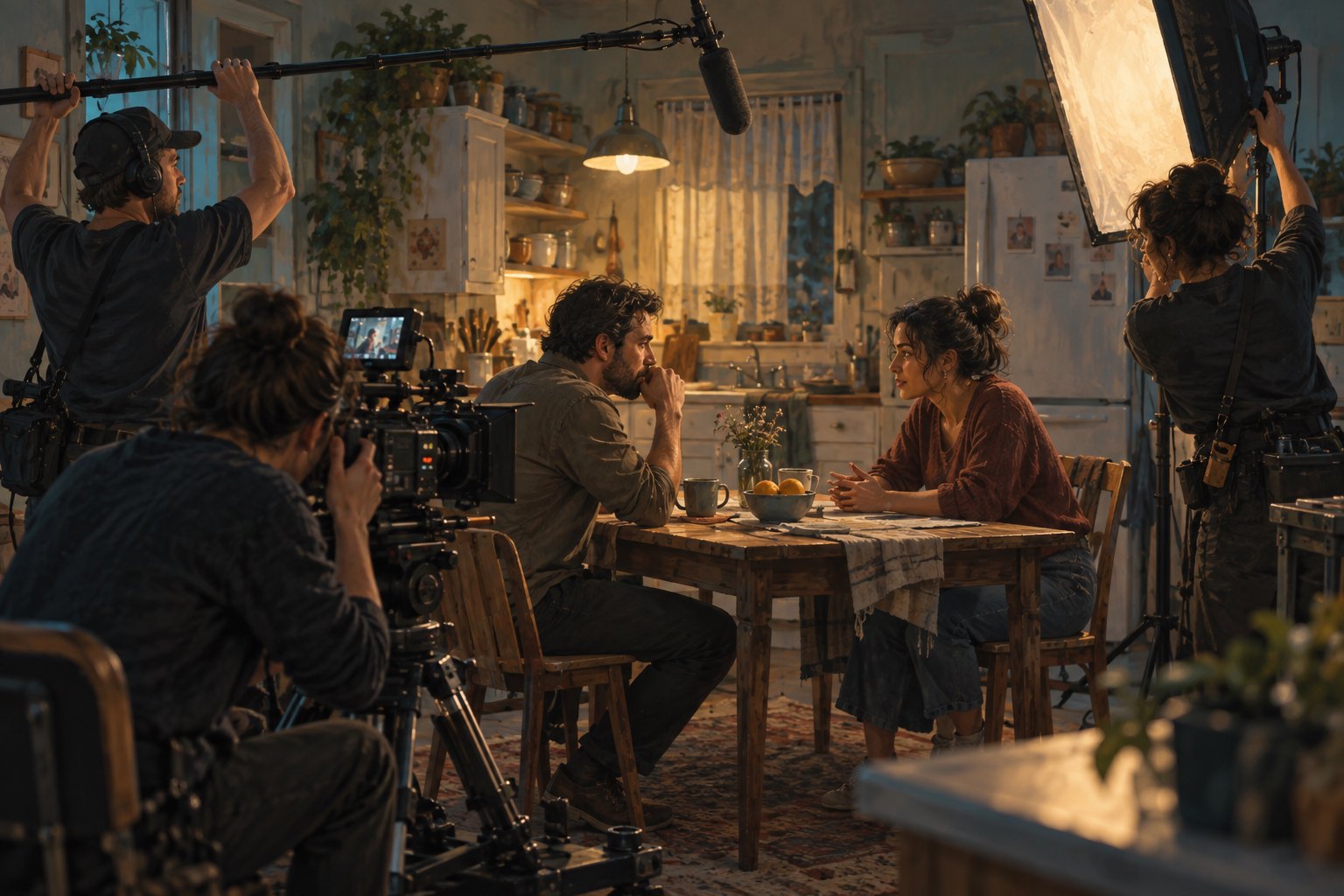
That does not mean any particular funding arrangement would protect those jobs or improve those working conditions. It means those outcomes deserve to be examined directly. A production announcement offers one kind of evidence; sustained paid work offers another. The quality of the opportunity matters alongside its existence.
Our discussion of how dance can reveal character in an Astaire biopic approaches a related creative problem: performance needs filmmaking choices that let viewers understand it. The connection here is a critical principle, not a claim that the project would receive assistance. Supporting production should mean taking the craft behind the image seriously.
More production and a wider range of movies are separate goals
A policy could help increase filming without broadening the kinds of stories audiences encounter. Those goals can overlap, but neither guarantees the other. More activity might involve familiar properties, smaller original dramas, television, or some combination. Until eligibility and results are clear, it would be premature to attach a particular creative future to the prospect of funding.
For film lovers, access is a useful point of inquiry. Could a smaller producer realistically navigate the requirements? Would the timing of assistance help a project get started, or would it primarily benefit companies already able to finance production? These are questions about how a possible program would function, rather than assumptions about its design.
The distinction matters because an opportunity available on paper may still be difficult to use. If a hypothetical arrangement required substantial spending before support arrived, the ability to raise that initial money would remain decisive. A reader should therefore look beyond an announced benefit to the sequence of commitments needed to obtain it.
Creative variety should also be judged with care. An original screenplay is not automatically adventurous, and an adaptation is not automatically timid. As our analysis of why successful video game adaptations begin with character argues, familiar material can still demand thoughtful dramatic choices. A meaningful cultural outcome would leave room for different approaches, scales, and sensibilities.
Public accountability should leave room for difficult art
Federal support introduces a legitimate question about public benefit. People should be able to understand what assistance costs, how recipients are selected, and whether stated obligations are fulfilled. Enthusiasm for movies does not eliminate that responsibility.
At the same time, financial accountability and artistic approval are different tasks. My editorial position is that a defensible system should be able to examine spending and compliance without requiring films to flatter public officials or present an agreeable picture of national life. This is a principle for evaluating support, not an allegation about conditions attached to any current proposal.
Cinema needs space for unreliable narrators, uncomfortable conflicts, unresolved endings, and characters whose behavior resists easy endorsement. A public contribution should not make a protagonist’s moral acceptability a substitute for a project’s eligibility. The freedom to portray failure, cruelty, or institutional weakness is part of the medium’s value.
What readers should watch for next
The useful next development would be clarity about how the prospect translates into action. Readers evaluating subsequent coverage can keep four distinct questions in view:
- Status: What has actually been proposed, authorized, or put into operation?
- Access: Which productions could use the support, and what practical barriers would remain?
- Results: What evidence connects the assistance to additional work or other stated public benefits?
- Creative independence: Are artistic decisions protected while financial obligations remain accountable?
These questions are more revealing than treating every encouraging announcement as a finished success. They also leave room for mixed results. A measure could be useful to workers yet limited in reach, or accessible to many producers without producing the expected additional activity.
The real stakes are visible on screen
Federal funding cannot guarantee a convincing character, an elegant cut, or an ending that earns its emotion. Resources create possibilities; filmmakers still have to turn those possibilities into cinema. A well-supported production can disappoint, while an inventive team can make something remarkable under severe constraints.
Nevertheless, constraints should not become a romantic excuse for making creative work harder to sustain. The worthwhile hope behind Hollywood’s welcome is that more people might have a viable chance to practice their craft. Whether that hope becomes a defensible public achievement will depend on the details and the results. For audiences, the eventual evidence will include the work itself: the performances, images, and stories that the opportunity helped bring into being.
Original content by this site's editorial team. Published: September 26, 2026 at 02:47:45 PDT (Los Angeles time)