
Heidi Klum dressed as a severed human hand for her annual Halloween party, according to Variety. It is a costume idea with an immediate horror-comedy hook: take something utterly familiar, separate it from its ordinary context, and make it the center of attention. A hand usually helps a person perform. Here, the hand becomes the role.
My reading is that the concept’s appeal lies in that reversal. You do not need a complicated explanation to understand its unsettling premise, yet the image opens several interpretive doors. It can suggest bodily vulnerability, absurd independence, or the pleasure of watching a performer disappear inside an unexpected shape. Those possibilities make this a useful subject for film commentary, even though a party appearance is not a movie.
What Klum’s Halloween reveal establishes
The central reported fact is straightforward: Klum chose a severed-human-hand costume for her annual celebration. Coverage from The New York Times describes the transformation more specifically as her left hand. That gives the idea an additional twist: the subject is a part of the wearer’s own body, elevated into an entire identity.
Neither description alone establishes a particular film reference, a fictional character, or an intended symbolic message. A resemblance to something a viewer remembers from horror entertainment would be an association, not proof of inspiration. The distinction matters because a costume can draw on a broad visual vocabulary without recreating a specific screen appearance.
This assessment concerns the idea rather than unverified construction details. The materials, preparation time, operating mechanisms, and precise range of movement would require their own reporting. Likewise, the conceptual illustrations accompanying this article explore the theme; they do not document the outfit or the party.
Why an ordinary hand becomes an extraordinary subject
A hand is familiar in unusually intimate ways. We recognize the differences between a relaxed palm, a clenched fist, and fingers reaching toward something. We also understand hands as instruments of intention: they make, hold, protect, signal, and refuse. Removing the rest of the body leaves that expressive equipment intact while taking away its usual explanation.
That absence creates the unsettling part. An isolated hand raises questions before any story begins. Where is the person? Does the hand have a will of its own? Is it helpless, dangerous, or simply out of place? The costume’s premise allows those questions to coexist without having to answer them.
Comedy enters through a different kind of recognition. A person has chosen to represent one small component of a person. There is a pleasing disproportion between the ordinary subject and the commitment implied by turning it into a full costume. In my view, that conceptual mismatch is stronger than a joke that depends entirely on topical knowledge. The audience already knows what a hand is; the surprise comes from what it has become.
The balance between eerie and playful is also why Halloween viewing preferences vary so widely. Our guide to choosing a Halloween movie by mood considers that difference in audience appetite. Klum’s reported choice sits at an interesting intersection: its subject suggests horror, while the act of wearing it has an inherently absurd dimension.
Character without a face
For a film critic, the most productive question is how a hand might register as a character. Faces supply a convenient emotional guide, but gesture can communicate before dialogue explains anything. An open palm can invite contact. A pointed finger can accuse. A hesitant reach can imply desire complicated by fear. Context determines the meaning, but the vocabulary is already available.
Imagine the same hand approaching a closed door in three different ways. A quick, impatient tap suggests entitlement. A tentative touch suggests uncertainty. Fingers held motionless just short of the surface suggest apprehension. These are hypothetical examples of performance, not descriptions of Klum’s movements at the party. They illustrate why the subject offers more dramatic possibility than its apparent simplicity suggests.
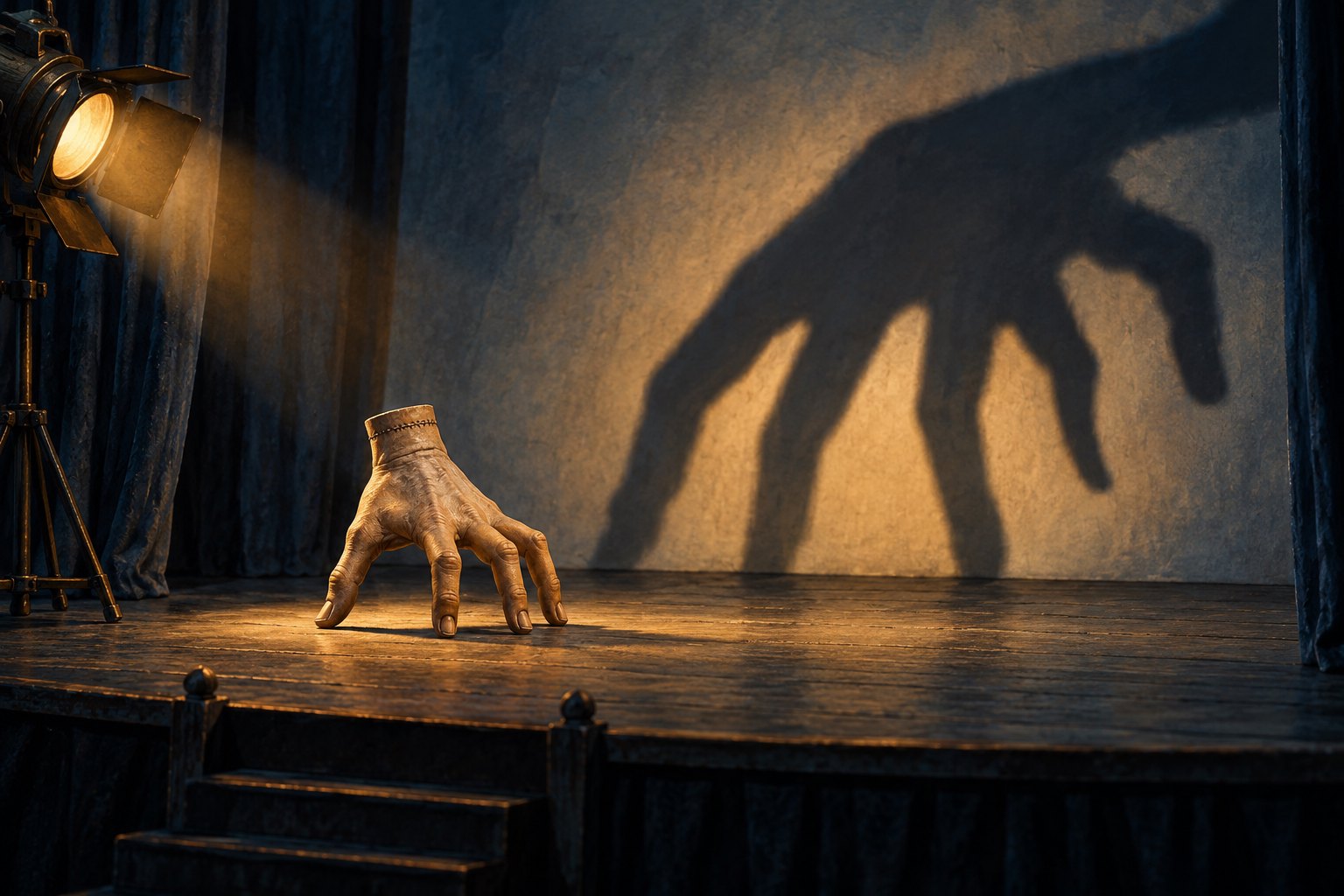
There is a useful lesson here for character analysis: emotion does not always arrive as a speech or a revealing close-up. Sometimes it appears in the delay before an action, or in an action that stops halfway. A costume organized around a hand directs attention toward that physical language.
It would nevertheless be premature to praise a specific performance without observing it closely. A strong premise and expressive execution are separate achievements. The reported concept gives us reason to discuss the possibilities; it does not by itself demonstrate how fully those possibilities were realized.
The difference between a striking reveal and a lasting character
A Halloween entrance and a movie face different demands. A costume can succeed through immediate recognition and surprise. A film character must usually sustain attention through changing circumstances. The opening image establishes a possibility; subsequent choices give it meaning.
That distinction helps explain both the strength and the limit of Klum’s idea. A severed hand is an economical visual premise. It presents an impossible situation in a form that is easy to understand. But any fictional story built around that premise would still need relationships, obstacles, and consequences. Unusual anatomy cannot supply those on its own.
Consider the questions a storyteller would have to answer. What does this character want? How does it communicate a misunderstanding? What can it accomplish, and where does it need help? These questions turn a design into a point of view. They also keep criticism from treating technical complexity as a substitute for emotional interest.
Our discussion of character and ambition in The Nightmare Before Christmas approaches a related issue: how seasonal spectacle gains weight through the desires of the people inhabiting it. Klum’s appearance does not need to carry a feature-length narrative, but it invites appreciation of the same relationship between an arresting exterior and imagined interior life.
A celebrity transformation that changes the terms of recognition
There is another compelling tension in the choice. Celebrity appearances encourage viewers to recognize a person. Transformative costumes encourage viewers to recognize something else. The pleasure comes from holding both identities in mind: we know who is appearing, while the disguise asks us to accept a radically different subject.
Choosing a hand makes that tension especially neat. The costume does not merely propose another human identity. It reorganizes what counts as the whole figure. A body part normally relegated to supporting gestures becomes the principal attraction. I read that as a playful displacement of the face’s usual authority, rather than evidence of a deliberate statement by Klum.
That is the deeper appeal of the reported reveal. The familiar becomes strange without becoming incomprehensible. A fragment invites us to imagine an entire personality, and a potentially grisly premise leaves room for humor. For me, Klum’s severed-hand concept works best as a compact exercise in visual storytelling: it gives the audience something recognizable, removes its expected context, and lets curiosity do the next part.
Original content by this site's editorial team. Published: October 31, 2026 at 23:39:35 PDT (Los Angeles time)