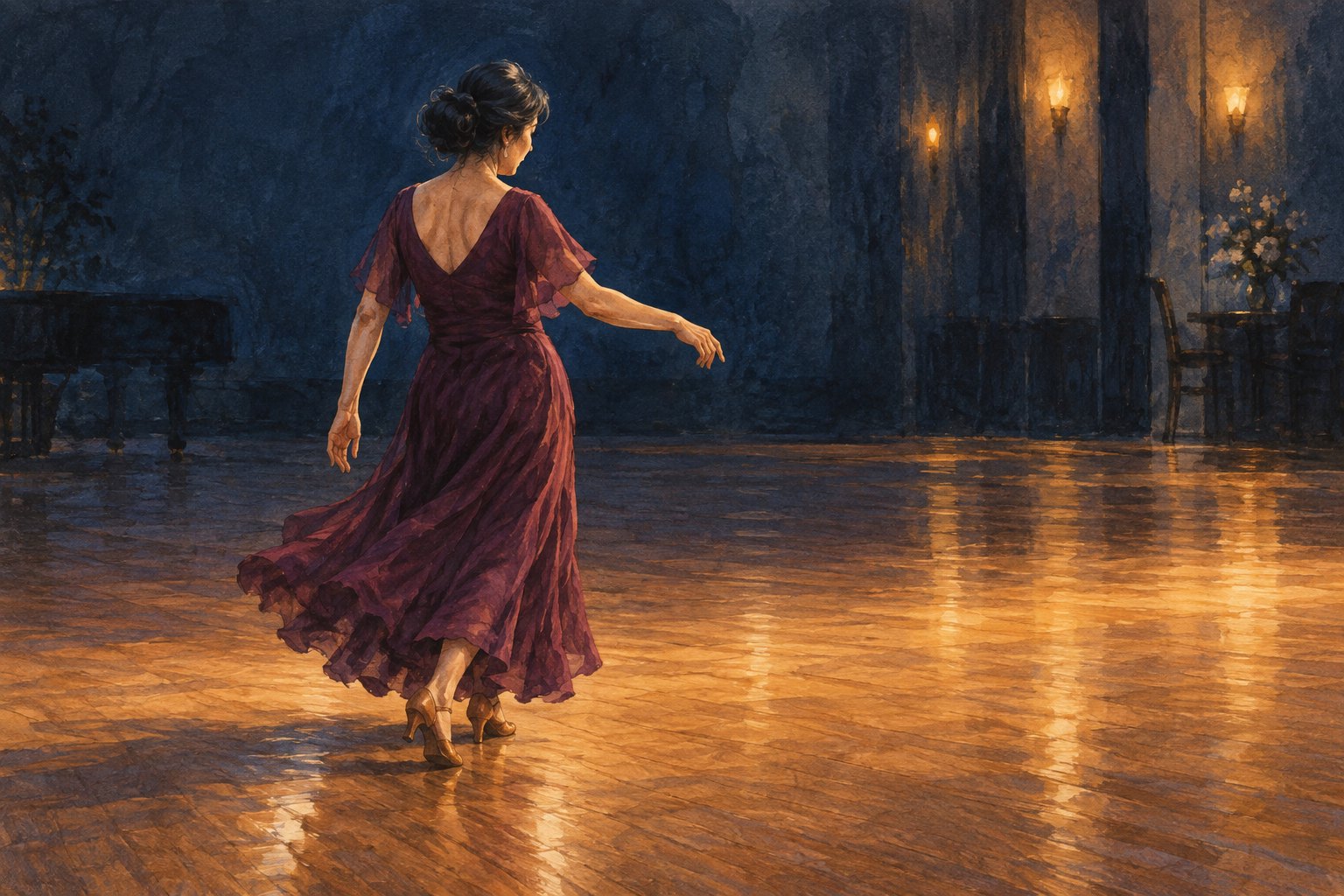
Josef Kubota Wladyka’s Ha-Chan, Shake Your Booty! centers on an emotionally difficult return: a woman goes back to an activity that once belonged to her marriage. Haru, played by Rinko Kikuchi, has lost her husband and dance partner, Luis. When she returns to the studio and becomes attracted to another man, the question is bigger than whether she can fall in love again. Can she reclaim a source of pleasure without feeling that she is abandoning the person who shared it?
Wladyka’s discussion of his new film with NPR brings attention to a story whose exuberant title conceals complicated emotional territory. The following is a critical reading of its confirmed narrative and the filmmaker’s public explanations, rather than a screening-based assessment of every performance or scene.
Spoiler note: This article discusses the central bereavement, Haru’s romantic situation, and a recurring fantasy image. It does not reveal the ending.
Haru loses a partner and a shared way of living
Written by Nicholas Huynh and Wladyka, the film introduces Haru and Luis as participants in Tokyo’s competitive ballroom scene. Tragedy sends Haru into isolation; encouragement from people close to her eventually brings her back to dancing. Those are the foundations established by the [official film synopsis](https://www.sonyclassics.com/film/hachanshakeyourbooty/).
The choice of ballroom dancing gives that loss a particularly concrete shape. Partnership involves learned distances, familiar timing, and the expectation that another body will respond. From Haru’s perspective, returning to dance means entering a practice organized around an absence. A familiar movement can become an encounter with everything that has changed.
That makes her withdrawal understandable without making it the whole of her identity. She had interests, skills, and appetites before bereavement. Reading her only as a grieving widow would flatten the character in precisely the way that returning to an old passion can resist. The studio offers access to a part of herself that survived the marriage, even if she cannot initially imagine using it alone.
This is also why the distinction between resuming an activity and recovering emotionally matters. Showing up does not establish that someone is ready. It establishes that, for the duration of a class, they have chosen to participate.
Fedir makes desire complicated again
Alberto Guerra plays Fedir, the instructor who attracts Haru when she returns. The romantic situation has a consequential complication: he is in an open marriage. Reporting on the story also describes Haru concealing her widowhood and claiming that she, too, has an arrangement with her husband. These details establish a mismatch between what she wants and the situation she agrees to enter. [Deadline’s plot discussion](https://malaysia.news.yahoo.com/chan-shake-booty-review-japanese-044348159.html) documents that development.
My reading is that Haru’s deception creates two overlapping problems. She misrepresents herself to Fedir, and she temporarily avoids acknowledging the conditions of her own life. Calling Luis alive allows an old identity to accompany her into a new encounter. The emotional logic is legible; the dishonesty still has consequences.
It would be too easy to treat attraction as evidence that she has healed. Wanting someone can expose vulnerability as readily as it restores confidence. Haru’s interest in Fedir gives her something immediate to pursue, but pursuit alone cannot resolve the difference between an available relationship and an imagined one.
That tension makes her more interesting than an inspirational example. Sympathy does not require believing that every choice she makes is wise. Indeed, a character recovering the freedom to make mistakes may be more convincing than one who emerges from grief with perfect judgment.
The people who bring her back matter
Haru’s return begins through encouragement from others, before the new instructor becomes her focus. That order deserves attention. A romance can dominate the discussion of a movie while the less glamorous work of companionship makes the romance possible.
From the perspective of those around Haru, inviting her back to the studio offers a practical form of care: a destination, an activity, and company. It asks less than an explanation of how she feels. There is value in that modest scale. People cannot schedule another person’s recovery, but they can make participation easier.
Our discussion of how friendship shapes romantic choices in The Love Hypothesis considers a related question: what becomes visible when we look beyond the central couple? Here, that perspective keeps Haru’s social world in view. Desire matters, but it develops within a network of existing attachments.
Wladyka’s black bird gives grief a physical presence
One of the film’s unusual images is a large black bird appearing in Haru’s home. At Sundance, Wladyka explained that its conception combined associations of crows and ravens with death and the approachable qualities of Japanese mascot culture. He wanted the presence to be both unsettling and comforting. His explanation is recorded in [Sundance’s premiere coverage](https://fest26-wp.festival.sundance.org/blogs/ha-chan-shake-your-booty-encourages-us-to-keep-dancing/).
That combination suggests a useful interpretation: grief can hurt partly because the attachment it preserves remains precious. Haru’s home contains something she cannot comfortably live with and may not want to lose. Making that contradiction visible gives the fantasy a character-based purpose.
The bird is therefore better approached as an expression of emotional experience than as a puzzle with a single hidden solution. Whether viewers find the device moving or overly emphatic will depend on their tolerance for literalized symbolism. Its conceptual strength lies in allowing affection and distress to occupy the same figure.
Why the dance has to carry emotional weight
Wladyka has described his mother’s enduring commitment to ballroom dancing as an inspiration for the film. In the Sundance conversation, he said, “The music is really a character.” Those are the director’s words about the filmmaking, rather than dialogue spoken by Haru.
The distinction helps clarify what to watch for. A dance sequence earns its place when it changes our understanding of a relationship: who approaches, who hesitates, who assumes cooperation, and who wants something the other person cannot provide. Beautiful movement can attract attention; emotional information gives that movement lasting meaning.
That is the same critical distinction explored in what makes a film’s emotional impact last. For Haru, the meaningful measure is not simply whether she dances again. It is what dancing permits her to acknowledge about herself.
A life can expand around an enduring loss
The most productive reading of Ha-Chan, Shake Your Booty! allows Haru’s attachments to remain unresolved for a while. Her love for Luis, attraction to Fedir, dependence on others, and capacity for self-deception need not arrange themselves into orderly stages.
What gives this premise depth is the possibility that renewed pleasure does not settle the past. Haru can want to move and still feel the absence of her partner. She can experience desire without yet understanding what kind of intimacy she needs. Seen through that perspective, returning to the dance floor becomes an act of uncertainty: she is making room for a life whose shape she cannot yet know.
Original content by this site's editorial team. Published: September 26, 2026 at 08:55:58 PDT (Los Angeles time)