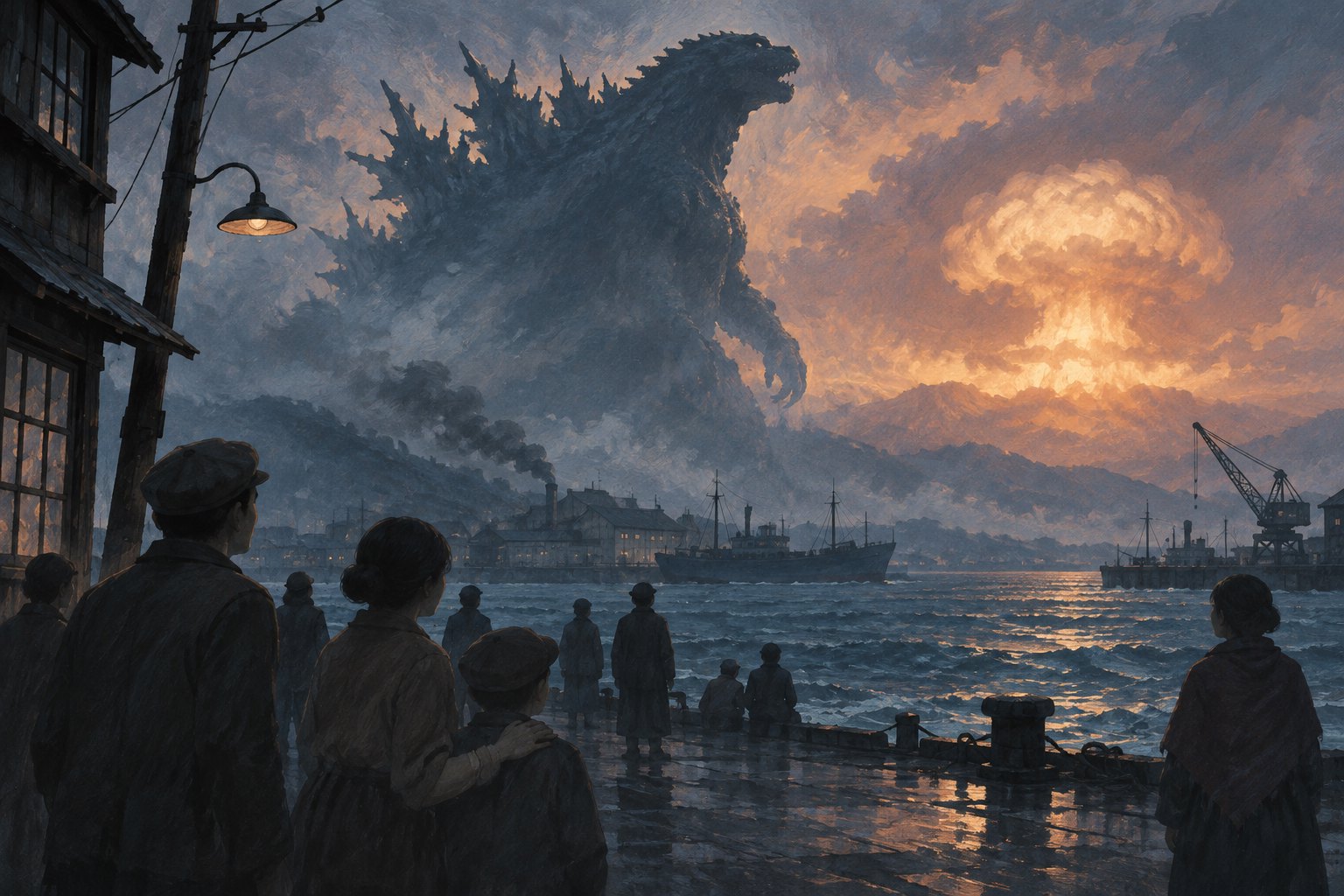
Godzilla Minus Zero was made as a response to Oppenheimer, according to TIME’s reporting. That is a compelling way to frame Takashi Yamazaki’s film because it raises a question larger than which director stages the more impressive catastrophe: whose experience should organize a story about nuclear destruction?
A response can change the position from which an audience watches. Christopher Nolan’s film approaches the atomic bomb through the scientist whose achievement becomes a source of moral dread. Yamazaki’s Godzilla Minus One offers a useful foundation for considering a different perspective: people struggling to build lives while overwhelming violence keeps threatening to erase them.
This is analysis of the reported creative connection, rather than a firsthand review of Godzilla Minus Zero. Major spoilers follow for Oppenheimer and Godzilla Minus One. Specific scenes, dialogue, and outcomes from the new film are not assumed here.
What it means to answer Oppenheimer
The word “response” should not automatically suggest a feud or a declaration that Nolan’s film failed. Films can answer one another by shifting emphasis. A story about developing a weapon and a story about enduring destruction may share an ethical concern while giving their characters profoundly different relationships to power.
In Oppenheimer, responsibility is inseparable from participation. Its central character helps make something possible, then confronts consequences that exceed his ability to control them. His intelligence does not provide a clean escape from the machinery of government or from his own decisions.
A civilian perspective begins with a different imbalance. People facing destruction may have had no meaningful influence over the choices that endangered them. Their dramatic problem concerns what they can protect, whom they can help, and whether they can imagine a future. That difference makes Yamazaki’s reported ambition worth taking seriously before making any judgment about how successfully the new film fulfills it.
Shikishima makes survival an ethical problem
Godzilla Minus One establishes an especially strong basis for this conversation through Koichi Shikishima. He survives the war and an encounter with Godzilla, but survival brings guilt rather than relief. His relationship with Noriko and the orphaned Akiko creates the possibility of a family while his past continues to govern his understanding of himself.
My reading is that the film’s most effective conflict lies in the distance between being alive and accepting permission to live. Shikishima has a possible future in front of him, yet he keeps measuring his worth against an obligation to die. Godzilla gives that internal struggle an external form: the threat returns, and with it comes another opportunity to mistake self-destruction for moral repair.
That distinction matters to the Oppenheimer comparison. The scientist’s guilt grows from what he helped accomplish. Shikishima’s guilt attaches itself to his continued existence. Treating those emotions as interchangeable would flatten both characters. One confronts responsibility for an achievement; the other must escape a destructive definition of duty.
The ending of Minus One makes its position concrete. Shikishima survives his attack on Godzilla by ejecting from his aircraft. The action matters because the film allows courage and survival to coexist. His usefulness to others does not require his disappearance.
Noriko and Akiko give the argument something to protect
Noriko and Akiko make the stakes more specific than an abstract obligation to save humanity. A household needs continuity: people returning, children receiving care, adults doing the ordinary work that catastrophe interrupts. Through that lens, rebuilding becomes a sustained commitment rather than a single triumphant image.
There is also a critical limitation worth examining. When a woman’s apparent loss drives a male protagonist toward another dangerous mission, her experience can become subordinate to his transformation. Minus One invites us to care about Noriko, but a character-focused reading should still ask how much room she receives beyond what she means to Shikishima.
That is a useful standard for considering any continuation. A larger canvas becomes emotionally richer when it expands the characters’ choices and relationships. Simply increasing the number of people in danger does not accomplish the same thing. Our discussion of what a returning franchise character needs from a new story applies here: recognition supplies an entrance, while meaningful decisions sustain a film.

Oppenheimer’s final words leave space for an answer
Near the end of Nolan’s film, Oppenheimer returns to the fear that the scientists’ work could initiate a world-destroying chain reaction. Einstein asks, “What of it?” Oppenheimer replies, “I believe we did.” The exchange turns a technical anxiety into a judgment about what their work has set in motion.
Those final words are devastating because they deny the comfort of a finished event. The immediate experiment has ended, but the consequences remain active. My interpretation is that the scene makes Oppenheimer’s imagination a kind of prison: he can envision the catastrophe without possessing the authority to prevent it.
A Godzilla film can approach that continuing consequence through bodies, buildings, movement, and interrupted daily life. The potential connection is therefore more substantial than matching an explosion to a monster attack. Cinema can move between the person who fears what his work means and the person who must find shelter from its consequences.
Neither viewpoint automatically supplies the complete moral picture. A tightly focused portrait can illuminate one consciousness while leaving others outside its frame. Recognizing that boundary allows another film to widen the conversation without reducing the first to a mistake.
The spectacle has to preserve the people inside it
For me, the strongest test of the reported Minus Zero ambition is whether spectacle keeps human experience legible. Scale can produce awe, but awe alone does not explain what has been lost. A convincing response to nuclear cinema needs more than solemn dialogue surrounding impressive destruction.
Three questions help distinguish an ethical perspective from a thematic label. Whose experience governs the sequence? Does the film give endangered people choices and relationships? What remains emotionally unresolved after the immediate threat passes? These questions concern the organization of the drama, not the number of effects shots.
They also connect to the problem explored in our analysis of who controls the telling of violence. Making suffering visible is only one decision. Giving the people who endure it meaningful presence is another.
The deeper connection: what responsibility asks of the living
The most productive way to understand Yamazaki’s reported response is as an opportunity to connect responsibility with care. Oppenheimer leaves its protagonist contemplating a terrifying legacy. Godzilla Minus One gives Shikishima a route toward continuing his life with others. Their endings produce different emotional pressures, and that difference is precisely what makes the comparison worthwhile.
Guilt can direct attention toward harm, but it can also trap a character inside his own suffering. The harder dramatic question is what follows recognition. Can the person act differently? Can he accept obligations that require patience, dependence, and continued existence?
For Godzilla Minus Zero, the promise of answering Oppenheimer lies in that human territory. The monster may provide the scale. The people must provide the meaning: what they remember, what they owe one another, and what kind of life remains worth rebuilding.
Original content by this site's editorial team. Published: November 3, 2026 at 06:49:32 PST (Los Angeles time)