
Arjun Fischer, a William & Mary film studies alumnus, has won a Student Academy Award for Artificial Love, a short documentary exploring relationships between humans and AI. According to W&M News, the film received the bronze award in the documentary category. Its central participant is Patrick, a middle-aged man who has developed a relationship with a female chatbot.
That premise raises a question more interesting than whether a machine can imitate affection: how should a filmmaker portray someone whose emotional life an audience may find difficult to understand? Fischer’s recognition brings attention to a subject that demands curiosity, skepticism, and care in equal measure.
Coverage note: This is spoiler-free commentary on the reported premise and filmmaking approach, not a review based on a screening. No ending, unverified dialogue, or scene-by-scene interpretation is presented.
What Fischer’s award brings into focus
W&M News identifies Fischer as a 2020 graduate who subsequently studied film at the University of Southern California. The university’s account describes extensive research before he settled on Patrick as his documentary’s main participant. It also reports that the film struggled to secure festival attention before its awards breakthrough.
For viewers, the useful consequence of this recognition is an invitation to notice a film that might otherwise escape their attention. An award can start that encounter. It cannot determine the response that follows. Whether Artificial Love is perceptive, emotionally persuasive, or formally inventive remains a question for the film itself.
There is also a distinction between winning a Student Academy Award and receiving an Oscar nomination. The former should be celebrated on its own terms, without allowing the familiar Academy name to turn one achievement into another. The accomplishment here is specific: recognition for Fischer’s student documentary.
Patrick deserves to be understood before he becomes an argument
The reported premise places Patrick at the center of an unusually charged subject. An audience may arrive with a verdict already prepared: this relationship must be sad, absurd, comforting, dangerous, or some combination of those things. Each assumption risks making the person disappear behind the issue.
A useful character-focused reading would begin with what Patrick says he experiences. What does he value about the interaction? What does he believe the chatbot understands? How does he describe the relationship in his own terms? These are questions to bring to a screening, not answers that can be inferred from his age or his choice of companion.
It would be equally careless to assume that an attachment to a chatbot proves isolation. The premise alone tells us nothing definite about Patrick’s friendships, family relationships, or wider social life. Treating him as a recognizable stereotype would make the story easier to summarize while making the person harder to see.
My critical preference is for documentary work that lets a participant remain complicated. Someone can be reflective in one moment and evasive in another. A relationship can provide comfort while raising unresolved questions. A film need not flatten those contradictions into either a warning or an endorsement.
The difference between feeling affection and receiving it
The title Artificial Love invites an interpretive distinction: the technology may be artificial, but the human feeling directed toward it need not be insincere. That observation does not establish that the relationship is reciprocal. It identifies two different questions that deserve separate consideration.
One question concerns experience: does the person feel heard, reassured, or emotionally engaged? Another concerns the partner: what kind of understanding, intention, or commitment exists on the other side? Evidence of the first cannot automatically settle the second.
For a documentary, the challenge is to make that distinction legible without lecturing its participant. Simply showing that someone feels strongly would not resolve the larger questions. Conversely, explaining how a system operates would not erase what a person feels while using it.
Our commentary on the human questions behind Andrew Garfield’s Artificial considers technology through the people involved in creating it. Fischer’s reported subject suggests a different point of entry: the person living with its emotional consequences. Keeping those perspectives distinct helps prevent every AI story from becoming the same broad argument.
Documentary intimacy depends on trust
Fischer’s reported research process matters because access to someone’s private life is not the same thing as understanding it. An interview can supply information; sustained attention can reveal how a participant qualifies, revises, or struggles to explain that information.
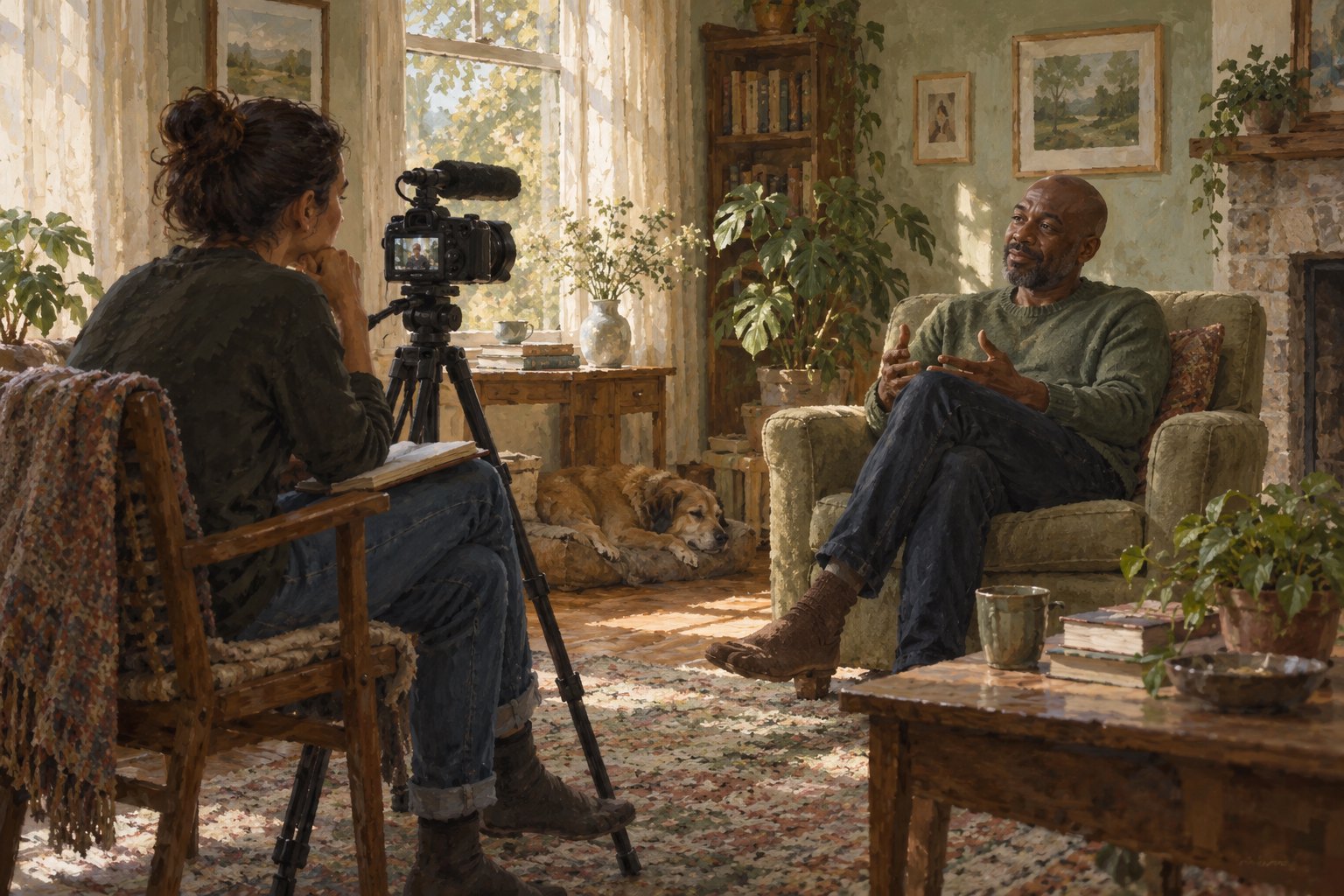
The ethical questions become especially sharp when a subject is easy to ridicule. Music can make an ordinary pause seem ominous. A reaction shot can invite laughter. An edit can remove the qualification that made a statement reasonable. These are general possibilities of documentary form, not claims about techniques used in Artificial Love.
When watching, pay attention to where the film places your sympathy and how it gets you there. Are you learning something from the participant, or being encouraged to feel superior to him? Does the film give you enough context to disagree thoughtfully? Does uncertainty remain available, or does every moment push toward a predetermined conclusion?
There is a related concern in our character analysis of intimacy and public access in Notting Hill: being allowed to observe someone does not mean knowing everything about them. Documentary audiences need that distinction as much as fictional characters do.
What to look for beyond the award
A screening of Artificial Love would offer the chance to evaluate three things that its premise cannot establish. First is specificity: whether Patrick emerges as an individual rather than an illustration of a trend. Second is perspective: whether the filmmaking clarifies whose understanding shapes each moment. Third is complexity: whether the film can acknowledge emotional benefit and unanswered questions without forcing them into a simple balance sheet.
Those standards are more useful than asking whether the documentary is broadly for or against AI companionship. A film can be valuable because it changes the precision of the question, even when it does not supply a final answer.
The deeper question behind Artificial Love
The most compelling interpretation suggested by the premise concerns recognition. What makes a person feel that another presence has noticed them? Is it a response, a memory, an expression of concern, or the knowledge that someone has chosen to stay? These experiences may resemble one another while carrying different meanings.
Fischer’s award gives that inquiry a larger audience. The opportunity now is to encounter Patrick without making him stand for everyone who forms an attachment to technology. A person’s emotional life is worth examining at its own scale. That is the promise of Artificial Love that deserves attention beyond the accolade.
Original content by this site's editorial team. Published: October 16, 2026 at 08:07:19 PDT (Los Angeles time)