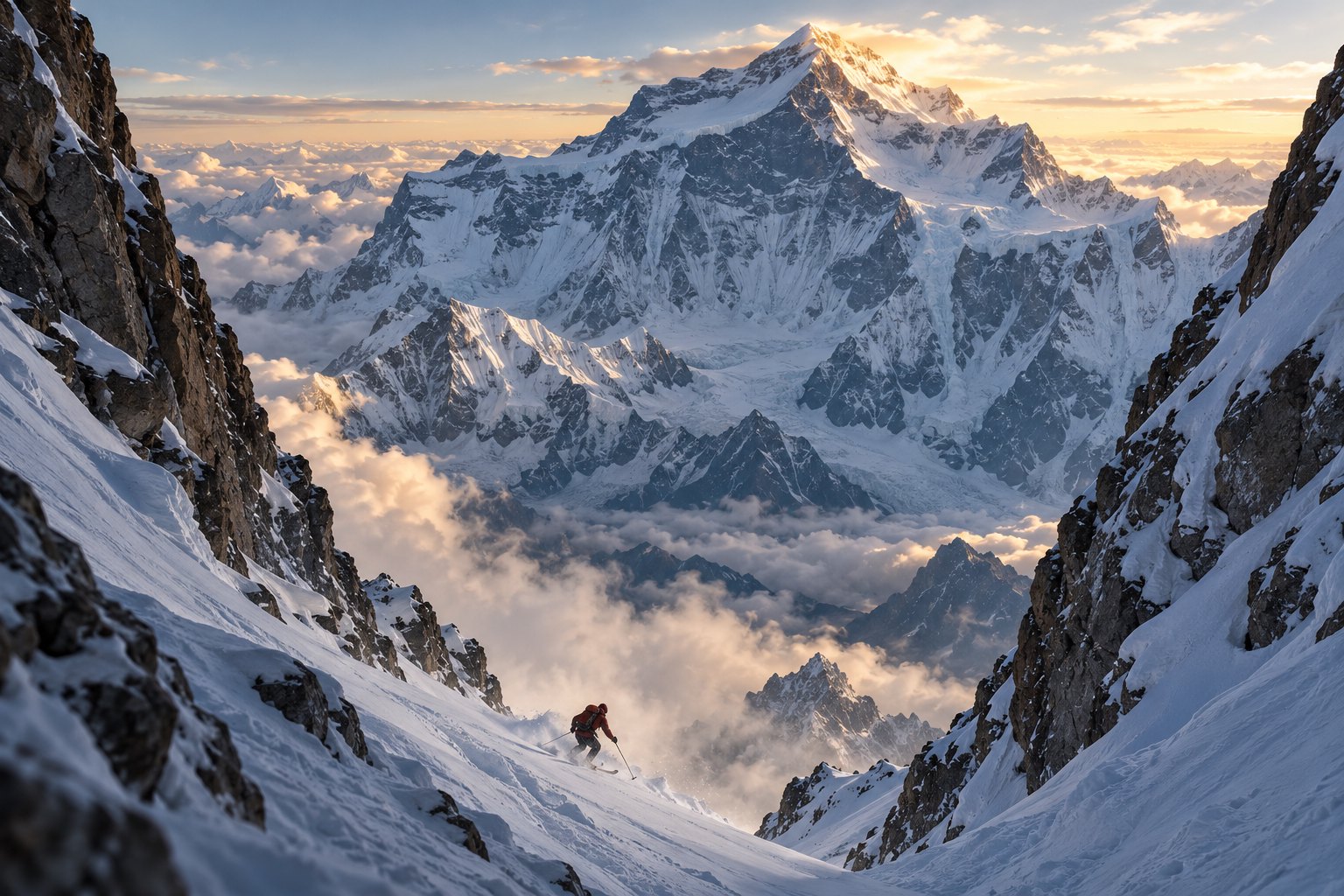
Everest: The Other Side connects a historic ski descent with a much harder journey to measure: continuing to live after devastating loss. Directed by Elizabeth Chai Vasarhelyi and Jimmy Chin, the documentary follows ski mountaineers Jim Morrison and Hilaree Nelson and their shared ambition to climb and ski Everest’s direct North Face. Its essential tension lies in the relationship between that concrete objective and the emotional meaning it acquires.
The film opened in limited theatrical release on October 30, 2026. For readers drawn by the Everest achievement, the important distinction is that this story concerns a particular route, rather than the first skiing anywhere on the mountain. For viewers interested in the people, its larger question is whether completing a shared dream can become an act of remembrance without being mistaken for recovery.
Spoiler notice: The discussion below addresses bereavement and the expedition’s outcome. This is a critical reading of the documentary’s publicly confirmed story and reported dialogue, rather than a firsthand assessment of its complete editing, sound, or cinematography.
A shared dream changes meaning
The official film description establishes Morrison and Nelson as accomplished athletes whose romantic relationship develops alongside their mountaineering ambitions. That starting point matters. Their Everest project belongs to a partnership: two people recognizing a desire in each other that most outsiders would find difficult to understand.
From their perspective, a mountain is more than an obstacle. Planning a route, assessing conditions, and committing to an expedition can be ways of building a life together. The emotional significance of their goal therefore precedes any record. It carries the intimacy of knowing what another person wants and wanting to pursue it alongside them.
That is the most useful way into this story for viewers with little interest in skiing. You do not need to share the ambition to recognize the relationship beneath it. Couples organize their lives around projects, places, and imagined futures. Here, the scale is extraordinary, but the underlying act of imagining a future together is familiar.
Hilaree Nelson deserves to remain a person, not a symbol
Nelson died in an avalanche in 2022. Her death changes the meaning of the Everest project and creates a fundamental challenge for anyone interpreting the film: how to discuss Morrison’s grief without reducing Nelson to its cause.
The distinction begins with agency. Nelson helped originate the ambition. She was an athlete pursuing a demanding objective, not simply a loved one accompanying somebody else’s quest. Remembering that makes the later expedition more emotionally complicated. Morrison is carrying forward something they wanted together, but he must now decide what continuing means without her.
My reading is that the story becomes richer when Nelson’s ambition and Morrison’s mourning remain distinct. Her life does not become fully explainable through his loss. Nor can his eventual achievement stand in for everything she might have done. A memorial can honor a person while acknowledging how much it cannot contain.
This concern also shapes our discussion of remembering Anthony Bourdain through a collaborator’s perspective: the person telling the story offers essential intimacy, but that perspective remains one part of a larger life.

Jim Morrison’s goal is clear; its emotional meaning is not
In dialogue reported by the Associated Press, Morrison describes the objective as “the raddest ski line in the world.” The phrase preserves something important: the appeal of skiing itself. Reading every decision exclusively through grief would flatten the athletic desire that existed before the loss.
That distinction keeps the analysis from becoming an armchair diagnosis. An observer cannot determine that an expedition represents healing, avoidance, devotion, or compulsion merely because its participant has suffered. Several motives may coexist, and the person making the journey may not be able to separate them neatly.
What the story does allow is a distinction between an achievable task and an unfinishable emotional process. A route has a beginning and an end. Mourning does not follow that geography. Reaching a destination can give someone a meaningful experience without settling the questions that sent them there.
For me, this is the documentary’s most compelling interpretive possibility: Morrison’s persistence can be moving without becoming a prescription. Viewers do not have to believe that extraordinary danger is necessary for a meaningful life in order to understand why this particular undertaking matters to him.
The filmmakers are part of the moral equation
Vasarhelyi’s reported onscreen statement, “This movie, the worst happened,” gives the story a blunt center. It also shifts attention toward the people behind the camera. Recording an expedition involves relationships and responsibilities that continue when the footage stops.
In an interview with NOLS, Chin explained that the production placed friendship and support first, mountaineering second, and filmmaking third. He also said that filming needs could not take precedence over the people or the climb. That is a stated working principle, rather than proof of how every individual decision unfolded, but it provides a useful framework for considering the project.
It encourages viewers to think beyond the apparent solitude of a skier on a huge slope. Such an image can suggest radical independence while depending on collective preparation, judgment, and labor. The camera’s presence is itself evidence that the undertaking has a social dimension.
Our character-focused discussion of The Mosquito Bowl raises a related storytelling issue: individual courage becomes more meaningful when the people sharing its consequences remain visible.
What the historic descent can—and cannot—resolve
Cascadia Daily News reports that Morrison completed the objective on his third attempt in October 2025, while Chin chose not to ski down. Those two decisions deserve to be considered together. One person’s commitment does not require everyone nearby to make the same choice.
The distinction also complicates a familiar adventure-story assumption: that continuing always demonstrates courage and declining always signals failure. Different roles, abilities, and judgments can produce different responsible decisions. A successful outcome does not make every alternative decision wrong.
The descent supplies a natural narrative endpoint, but its emotional implications remain open. My interpretation is that achievement here can function as a tribute, a continuation of a relationship’s influence, and an assertion of personal agency. None of those meanings requires calling grief conquered.
What to know before watching
The British Board of Film Classification records a running time of approximately 115 minutes and describes upsetting bereavement material, avalanche danger, and occasional strong language. Its content advice includes the discovery of a dead partner, presented without detailed imagery. Viewers seeking uncomplicated mountain escapism should understand that loss is central to the experience.
The deeper value of Everest: The Other Side lies in holding accomplishment and absence in the same frame. The mountain offers a route that can be completed; love leaves an influence that continues. Reading the film through that difference allows the historic descent to remain astonishing while giving the people involved something more generous than a victory narrative: room for achievement, grief, and unfinished life to coexist.
Original content by this site's editorial team. Published: November 1, 2026 at 10:56:20 PST (Los Angeles time)