Spoilers ahead for the crossword’s central reveal and the ending of Halloween.
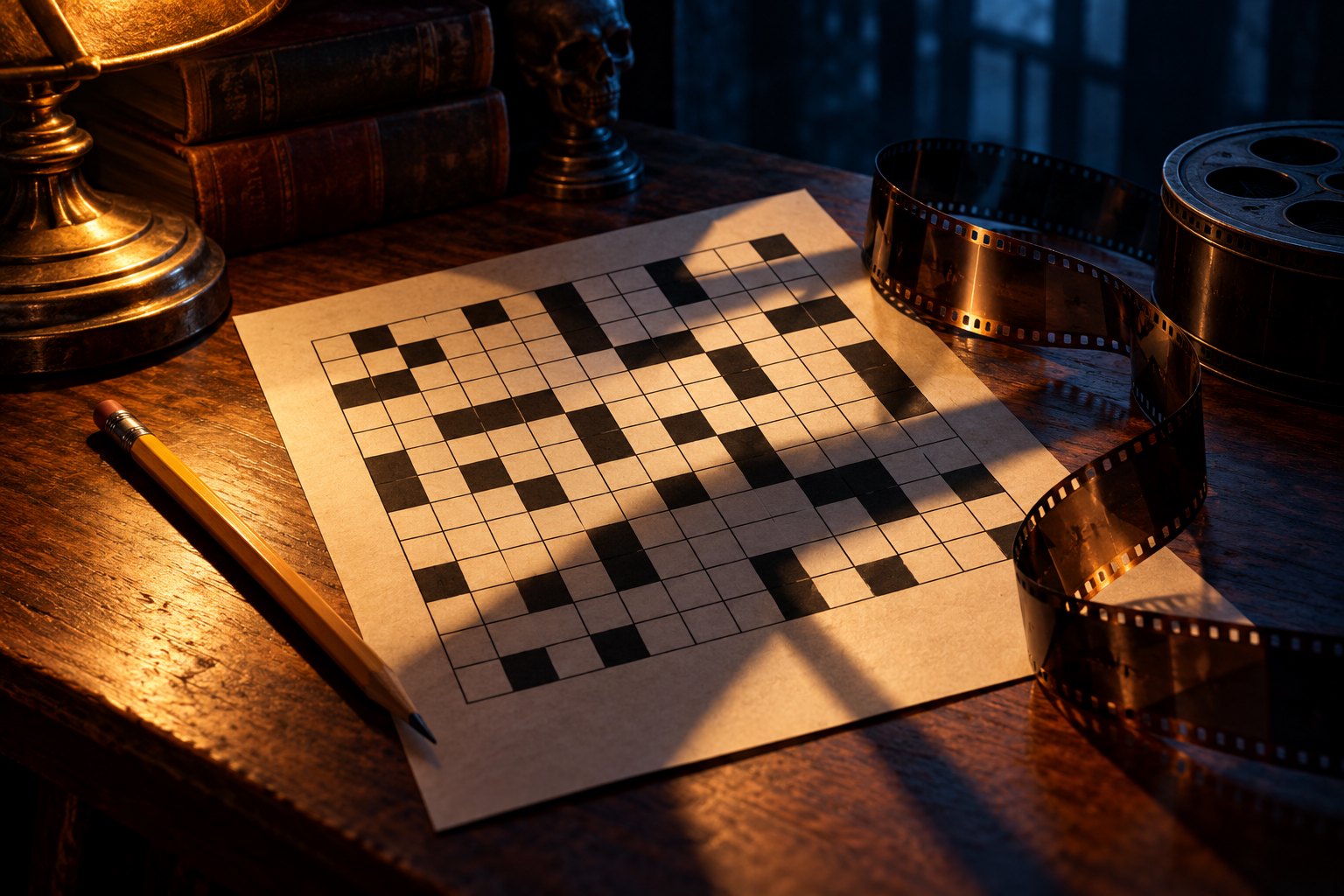
Birnholz’s October 25 “Slasher Film” crossword hides HALLOWEEN in black squares; its director answer is JOHN CARPENTER. The Washington Post’s solution identifies that connection.
For movie lovers, the revealing detail is the hiding place. Darkness contains information. Something that initially appears to separate meaningful pieces becomes meaningful itself. That is an inviting way to revisit Halloween (1978), a film that repeatedly asks us to examine the parts of an image we might otherwise disregard.
The comparison has a limit, and that limit makes it interesting. A crossword rewards attention with resolution. Carpenter rewards attention with the growing suspicion that resolution may be impossible. You can identify the threatening figure, track his movements, and recognize the danger without understanding what animates him.
Laurie Strode: noticing is the beginning of fear
Jamie Lee Curtis’s Laurie Strode gives the film its emotional center. Michael Myers returns to Haddonfield after escaping confinement, and Laurie begins noticing him during an otherwise ordinary day. She later babysits Tommy Doyle as the threat closes in. Those events establish a straightforward suspense story; Curtis makes the experience of living through it more complicated.
Laurie’s watchfulness is compelling because it does not immediately produce confidence. Seeing something strange and knowing what to do about it are different abilities. Her uncertainty feels recognizable: an unfamiliar person, an uncomfortable glance, a detail that disappears before anyone else can confirm it.
From her perspective, the day is not announcing itself as a horror movie. It still contains school, friends, obligations, and the expectation that ordinary explanations will hold. Curtis preserves that everyday scale. Her performance lets apprehension accumulate without making Laurie seem mysteriously aware of the screenplay.
That distinction matters to the crossword comparison. A solver knows a construction contains an intended pattern. Laurie has no such assurance. She must decide whether the pattern exists at all. Watching her, we occupy the uncomfortable space between having more information than she does and being just as unable to explain it.
Loomis has an answer, but not an explanation
Donald Pleasence’s Dr. Loomis approaches Michael from the opposite direction. Laurie struggles toward certainty; Loomis arrives carrying it. His description of Michael as “purely and simply evil” closes off the possibility of ordinary negotiation. He believes the danger is absolute.
As drama, that conviction is effective. Pleasence makes Loomis sound like someone whose warning has become exhausting to repeat. His urgency gives the film a second rhythm: while everyday life continues around Laurie, another character is already treating the situation as a catastrophe.
Yet certainty is not the same as understanding. Calling something evil tells us how Loomis judges it. It does not tell us why Michael chooses a particular movement, victim, or moment. The description supplies a moral category while leaving the mechanism inaccessible.
My reading is that this gap keeps Loomis interesting. He is indispensable as a warning voice, but his knowledge cannot restore order on demand. Recognizing danger is valuable; the film refuses to make recognition magically sufficient.
Michael Myers makes empty space feel occupied
Michael’s mask offers almost nothing to interpret. An expressive villain can reveal pleasure, anger, hesitation, or disappointment. Michael withholds those signals. His stillness makes viewers search elsewhere for meaning: distance, posture, timing, and the relationship between his body and the surrounding space.
Carpenter’s compositions encourage that search. A doorway becomes a possible entrance. The dark area behind a character becomes an unresolved question. The viewer’s attention starts moving independently of the conversation in the foreground.
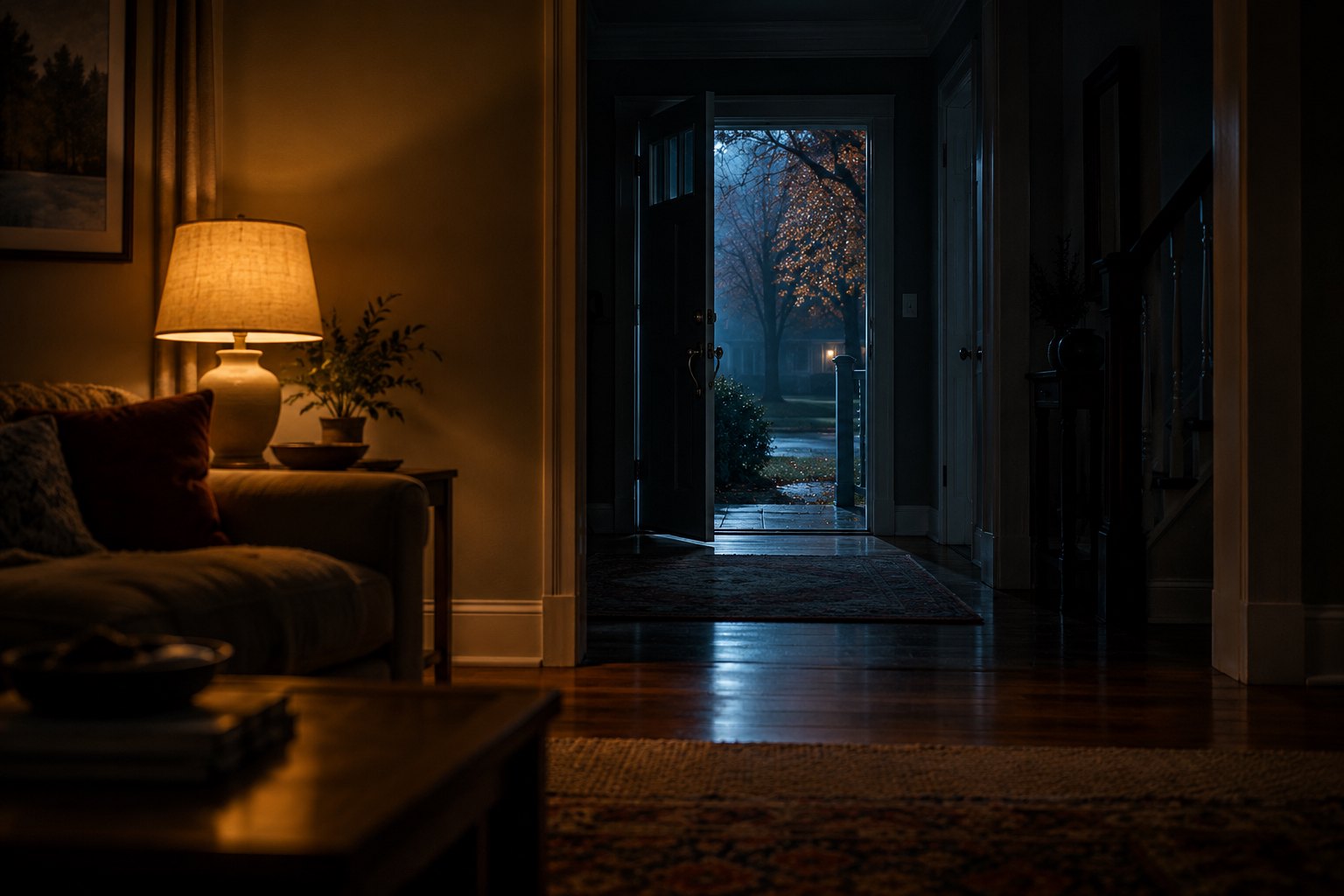
For me, this is the film’s strongest achievement. It changes the work of watching. Instead of passively receiving action, we inspect the frame for evidence. Even an unoccupied patch of darkness can demand attention because an earlier image has taught us what might appear there.
The crossword offers a useful prompt for that kind of viewing without becoming a blueprint for the movie. In both experiences, looking again can revise an initial impression. In the film, however, the revision does not necessarily make the world easier to read. It can make every apparently harmless space newly suspect.
The music gives uncertainty a pulse
Carpenter’s score intensifies this habit of anticipation. Its repeating figures create the feeling of something continuing beyond the boundaries of the current shot. A character may pause or a location may change, but the listener remains caught in a pattern.
The effect is especially persuasive when considered from Laurie’s perspective. Ordinary time is elastic: conversations wander, errands interrupt one another, attention drifts. Suspense compresses that freedom. Repetition makes the next moment feel scheduled, even when we do not know what it will contain.
Our discussion of how movie soundtracks reveal character explores music’s ability to make inner experience audible. Here, I hear the score doing something more invasive: imposing a threatening rhythm on a character’s everyday world.
Why the ending refuses to behave like a solution
After Loomis shoots Michael and he falls from the balcony, the place where his body should be is empty. The film’s closing images and breathing refuse the reassurance of a securely contained threat.
Laurie’s question, “Was that the boogeyman?” receives Loomis’s answer: “As a matter of fact, it was.” The exchange names the terror while leaving its boundaries uncertain. A childhood category has become more adequate than an ordinary explanation.
This is where the connection to a solved crossword becomes most revealing. Finding the answer normally changes uncertainty into satisfaction. Halloween lets its characters recognize what they have encountered without granting that satisfaction. The missing body makes absence active again.
That is also why I would resist treating the original film mainly as an introduction to later mythology. Its unanswered questions already perform a dramatic function. As in our consideration of what a familiar film title must deliver beyond recognition, knowing the name is only the beginning. The important experience is what the filmmaking makes that name mean.
A television detail worth catching
One concrete film reference rewards a closer look: Tommy watches The Thing from Another World (1951). Carpenter subsequently directed The Thing (1982). The earlier movie’s appearance is an enjoyable connection for a repeat viewing, although calling it a prediction would overstate what the detail establishes.
It also creates a suggestive contrast within Halloween: frightening entertainment plays inside a home while danger approaches outside it. The screen offers a frame around fear. The surrounding house offers no equally reliable boundary.
Birnholz’s title makes a fitting invitation to return to this movie with more attentive eyes. My verdict on Halloween is that its enduring power lies in turning perception into a source of vulnerability. Laurie survives by responding to what she sees, yet seeing never makes everything understandable. The deepest horror is that careful attention can reveal a threat without revealing its limits.
Original content by this site's editorial team. Published: October 25, 2026 at 09:38:30 PDT (Los Angeles time)