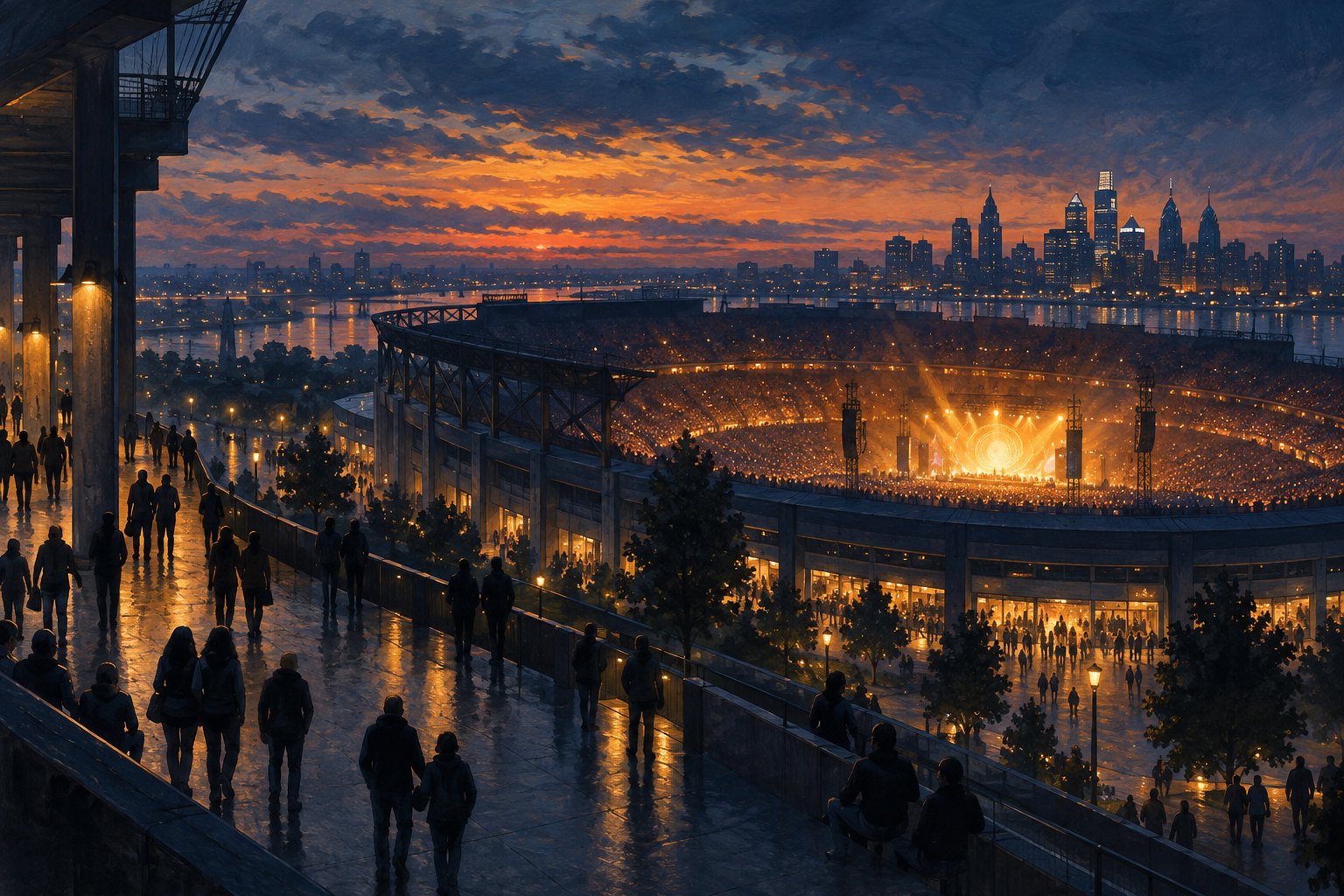
Ed Sheeran’s Philadelphia concert brought several stories into the same setting: a performer addressing his audience, a statement about Gaza, a show proceeding without opening acts, and pro-Palestinian protests outside Lincoln Financial Field. The challenge in understanding the evening is deciding how those stories fit together without allowing the most emotionally compelling one to swallow the rest.
The Wall Street Journal described a tearful apology as the tour resumed without openers. NPR reported that Sheeran called the situation in Gaza “catastrophic and unjustifiable.” Local broadcaster 6abc covered protests outside the venue, while The Philadelphia Inquirer reported his assessment of the concert as the best show he had experienced. These accounts establish different dimensions of the event. They do not, individually or together, establish that its underlying tensions were resolved.
For readers interested in film and visual storytelling, this is a useful occasion to consider how public events acquire the shape of a movie. A distressed central figure, a difficult appearance, and an uplifting conclusion can form a persuasive narrative. My view is that Philadelphia deserves a wider frame: one that recognizes the concert’s emotional significance while resisting an ending that belongs only to its headliner.
How the performer becomes the main character
A concert naturally directs attention toward the person onstage. The performer has the microphone, the lighting, and the audience’s immediate attention. When that performer becomes emotional, the event gains an intimate center. Viewers can observe an expression or hear a wavering voice much more easily than they can understand an institutional dispute or a distant humanitarian crisis.
That imbalance is a feature of spectacle, not proof of anyone’s intention to manipulate it. Sheeran’s reported tears may matter deeply to people who care about him. A responsible interpretation can acknowledge that emotional moment without treating it as a complete explanation of everything surrounding the show.
Character-focused film criticism asks what a protagonist knows, wants, fears, and can control. Applied cautiously to a real public appearance, the same questions can clarify the limits of our knowledge. We can examine a reported statement. We cannot read private motives from a facial expression or assume that visible distress answers questions about decisions made elsewhere.
Our earlier discussion of the emotional response to Sheeran’s Philadelphia appearance considers the bond between performer and listeners. The distinct issue here is editorial perspective: what disappears when that bond becomes the organizing principle for the entire story?
The stadium gates should not define the story’s boundaries
The reported protests outside Lincoln Financial Field matter because they place another public response alongside the performance. Their presence means the concert cannot be understood solely through what happened within the venue. Yet acknowledging a protest is only the beginning of representing it fairly.
A report can mention demonstrators while still reducing them to atmosphere: tension outside, relief inside. That structure quietly assigns them a dramatic function in someone else’s experience. Their role becomes making the star’s eventual appearance feel more difficult, rather than expressing a position that deserves to be understood on its own terms.
The available reporting outlined here does not establish every protester’s demand, personal experience, or reaction to Sheeran’s remarks. Those gaps should remain gaps. It would be equally careless to invent a unified protest agenda or to characterize demonstrators as a threat simply because the evening carried an atmosphere of apprehension.
Likewise, attending a concert does not establish a ticket holder’s complete political outlook. People can care about Palestinian suffering and value an artist’s music. Others may find attending incompatible with their convictions. Coverage becomes more useful when it leaves room for that variety rather than casting everyone as either loyal supporters or hostile opponents.
What a close-up leaves outside the frame
In a film, a close-up tells us where to look. Editing tells us which response belongs to which action. Music can tell us whether a moment should feel threatening, sorrowful, or redemptive. These techniques are not inherently dishonest, but they make meaning through selection.
The same principle helps explain why a short concert clip can be emotionally persuasive and informationally incomplete. A camera aimed at the stage records one portion of an event. Its narrowness becomes a problem when viewers are encouraged to mistake that portion for the whole.
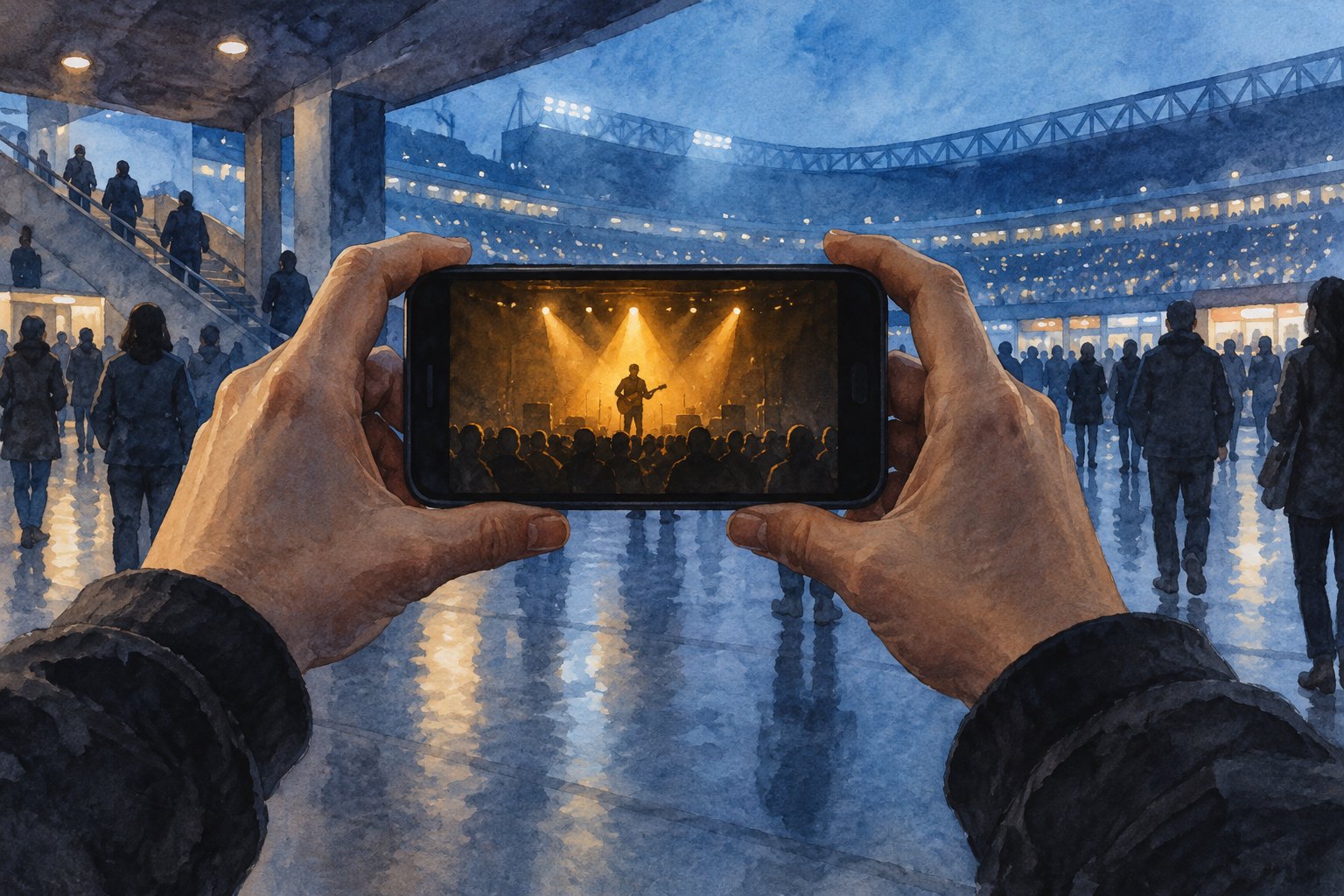
This is a viewing framework, not a claim that any particular Philadelphia video was deceptively edited. The practical question is what a piece of coverage enables us to know. Does it preserve the context of a statement? Does it distinguish the performer’s experience from the experiences of people outside? Does its conclusion follow from its evidence?
Consider the reported description of the concert as Sheeran’s best show. That is meaningful as his evaluation of a performance. Turning it into a declaration that the controversy ended would change the claim. A personal judgment about a concert cannot establish a collective resolution among people with different concerns.
An apology, a political statement, and an explanation do different work
The Philadelphia coverage includes both an apology and a statement about Gaza. These should be read with attention to their distinct purposes. An apology addresses an audience or an injury; a political statement expresses a position. Neither automatically provides an account of how a disputed decision was made.
The wording reported by NPR communicates Sheeran’s stated condemnation of the situation in Gaza. It should be considered on those terms. Expanding that phrase into an unreported commitment, policy position, or promise would go beyond what the words establish.
Similarly, the report of a tearful apology does not justify inventing its full scope. Readers need the actual language and context before deciding precisely what was acknowledged. Emotion can reinforce speech, but it cannot supply missing particulars.
For the separate issue of responsibility surrounding the tour, our commentary on Sheeran’s Gaza statement and the unresolved Macklemore tour question examines why a statement of belief and an explanation of a decision require different evidence.
Hope does not have to function as an ending
The most tempting version of the Philadelphia story is also the neatest: anxiety gives way to connection, and connection becomes resolution. That structure is satisfying because it resembles the final movement of a crowd-pleasing film. The protagonist gets through the ordeal, and the audience receives emotional release.
Real events rarely distribute resolution so evenly. A performer can experience relief while a protester’s objection remains. A listener can find comfort in a song while recognizing that the suffering invoked in a speech continues beyond the stadium. These experiences can coexist without cancelling one another.
My reading is that hope becomes more credible when coverage gives it a limited, human scale. A meaningful evening can offer connection. It need not be made to prove that disagreement has vanished or that the person under the spotlight has answered every relevant question.
The deeper significance of Sheeran’s Philadelphia concert lies in who gets to determine when its story is over. The performance has an ending; the issues surrounding it may not. Keeping those timelines separate allows the music to matter while preserving space for the people and concerns that remain outside its final frame.
Original content by this site's editorial team. Published: September 20, 2026 at 16:24:19 PDT (Los Angeles time)